Introduction: A Kelly Cut Unlike Any Other #
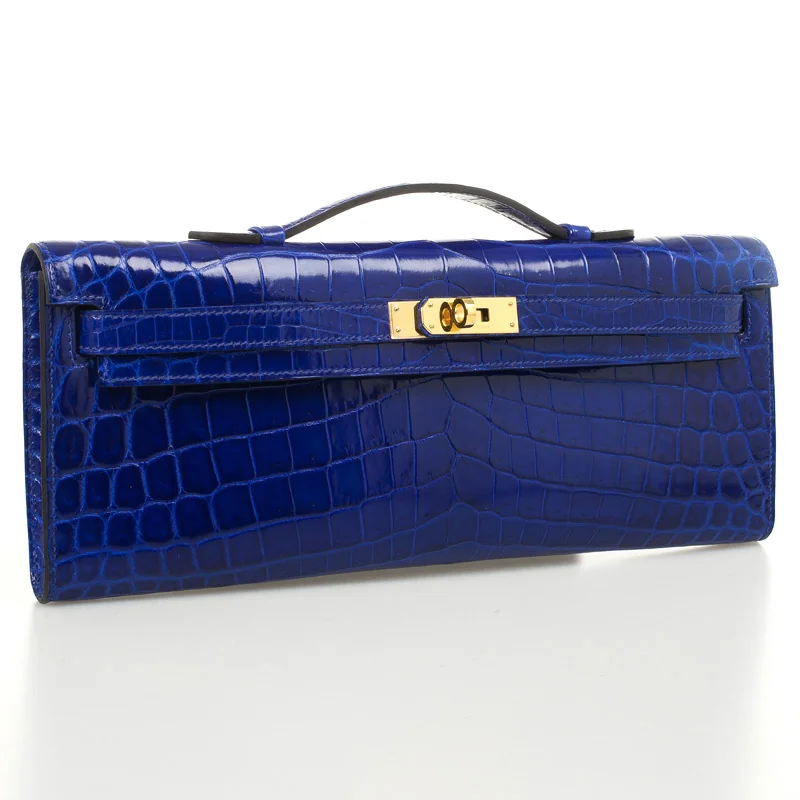
The orange box is never boring, but some deliveries hit differently. When our team unwrapped a Hermès Kelly Cut clutch in Bleu Electrique Niloticus crocodile, the reaction in the room was immediate: a sharp intake of breath, then everyone reaching to touch it at once. That’s the effect this piece has. Under office lighting, the glazed crocodile scales caught the light like wet glass, and the color read almost neon against the neutral leather goods usually lined up on the shelf.
This is the piece we’re using to unpack a color and a leather that generate constant questions from buyers: Hermès Bleu Electrique. What is it, why does it command such a premium on exotic skins, and how do you tell a genuine crocodile Kelly Cut from the increasingly convincing fakes circulating on the resale market? We’ll go through the color’s history, the sourcing story behind Niloticus crocodile, the construction details that separate real from replica, and what this all means for price and long-term value.
What Is Hermès Bleu Electrique? #
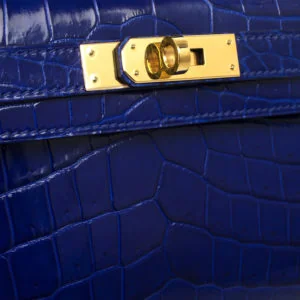
Bleu Electrique is exactly what the name promises: a saturated, high-voltage blue with almost no gray or green undertone pulling it down. Where colors like Bleu Roi lean toward a classic navy-adjacent royal blue and Bleu Zanzibar sits closer to a deep, muted denim, Bleu Electrique is unapologetically bright. It’s a color designed to be seen, not blended in.
Hermès has never marketed colors with the seasonal fanfare of a fashion house drop, but Bleu Electrique built its reputation the way most cult Hermès colors do: through word of mouth among collectors and its consistent appearance on exotic skins, where the glazing finish amplifies saturation in a way that calf leathers like Togo or Epsom simply can’t replicate. On matte leathers it’s striking. On glossy crocodile or lizard, it borders on luminous.
Under Different Light: How Bleu Electrique Shifts #
One thing buyers underestimate when shopping online is how dramatically this color shifts depending on the light source. This matters more for Bleu Electrique than for most Hermès colors because the exotic glazing acts almost like a lens.
| Lighting Condition | How Bleu Electrique Reads | Buying Implication |
|---|---|---|
| Direct sunlight | Vivid, almost fluorescent blue with strong highlight flare across scale ridges | Best condition to judge true saturation; ask sellers for outdoor photos |
| Overcast daylight | Cooler, slightly deeper blue, less flare, truer to in-hand color | Good baseline for accurate color matching against accessories |
| Warm indoor/incandescent | Blue shifts slightly toward teal-green at the edges | Can make the bag look darker or duller than it is; don’t judge color from this alone |
| Cool LED/showroom lighting | Closest to sunlight rendering, high contrast on glaze | Common in resale studio photos; still verify with a daylight shot if possible |
| Flash photography | Overexposes the glaze, washing out scale texture and sometimes blowing out the blue entirely | Treat flash-only listing photos with caution |
If you’re buying long distance or online, request at least one photo in indirect daylight and one in shade. A seller unwilling to provide varied lighting shots on a piece this valuable is a minor red flag on its own.
Bleu Electrique vs Other Hermès Blues #
| Color | Undertone | Typical Finish Seen On | Relative Rarity | Best Comparison Use |
|---|---|---|---|---|
| Bleu Electrique | True blue, minimal gray | Crocodile, lizard, occasional calf | High on exotics | Statement piece, standalone color |
| Bleu Roi | Blue with slight purple depth | Togo, Epsom, calf | Moderate | Everyday classic blue |
| Bleu Zanzibar | Muted, denim-like | Togo, Clemence | Moderate | Understated, office-friendly |
| Bleu Saphir | Deep jewel blue, slightly darker than Electrique | Epsom, Swift | Moderate to high | Richer, low-glare alternative |
| Blue Izmir | Bright but softer than Electrique, more turquoise lean | Chevre, Swift | Seasonal, lower availability | Warmer-weather styling |
Inside Niloticus Crocodile: Sourcing and Craftsmanship #
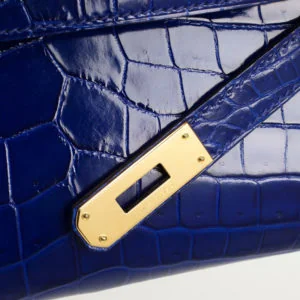
Hermès sources Niloticus crocodile from farms it operates directly along the Nile river in Africa, a vertical integration that’s unusual in luxury leather goods and part of why the house can guarantee traceability and consistent skin quality. Niloticus crocodiles can grow past 15 feet, but the leather used for handbags comes almost exclusively from the belly. The belly scales are smaller, flatter, and more uniform than the ridged, irregular scales along the back and flanks, which is why belly-cut crocodile is prized for its clean, symmetrical scale pattern and smoother glazed finish.
Because only the belly panel is usable, it takes roughly three to four crocodiles to yield enough matched, flawless skin for a single bag. That ratio alone explains a significant chunk of the price tag before you even factor in labor. Each skin is graded for scale symmetry, size consistency, and absence of scarring or growth marks, and Hermès rejects skins that don’t meet its internal standard, which further tightens supply of usable material.
It’s worth distinguishing Niloticus from Porosus crocodile, the other exotic Hermès uses. Porosus, generally sourced from Australia and Southeast Asia, tends to have smaller, denser scales and is often considered the more prestigious of the two, commanding a further premium. Niloticus sits just below it but is still firmly in the top tier of exotic materials, and on a color like Bleu Electrique, the slightly larger scale pattern actually shows off the color’s saturation more generously than Porosus’s tighter grain.
The Kelly Cut Clutch: Design Details Worth Knowing #
The Kelly Cut is a flattened, clutch-format interpretation of the Kelly bag’s silhouette, stripped of the handle and structured base to become an evening piece. On an authentic exotic Kelly Cut, a few details should be non-negotiable:
- Turn-lock hardware: The signature Kelly lock and strap closure should sit flush, with a clean, deep engraving on the lock face and no visible mold seams or pitting on the metal. Genuine hardware has real heft; it doesn’t feel like stamped sheet metal.
- Scale alignment across the seam: On a well-cut exotic piece, the scale pattern should flow logically across the front flap and body, not look randomly pieced together. Hermès leatherworkers select and match panels from the same skin for this exact reason.
- Saddle stitching: Hand stitching should be even, slightly angled, and recessed just beneath the surface, not sitting flat on top like a machine zigzag.
- Interior stamps: A blind stamp (craftsman’s mark) and the leather’s own CITES tag for exotic skins should be present, along with the date stamp indicating production year.
- Glazing consistency: The glossy topcoat on Niloticus should be even across every scale, without cloudy patches, cracking, or a plasticky sheen that suggests a printed or embossed imitation leather rather than genuine crocodile.
How to Authenticate a Hermès Crocodile Piece #
Counterfeiters have gotten considerably better at faking exotic Hermès leather goods, and crocodile pieces are a frequent target precisely because the price premium makes forgery profitable. A few practical checks:
Scales. Genuine crocodile scales are irregular in fine detail even when symmetrical in overall layout; no two are perfectly identical. Printed or embossed fakes (often calf or cowhide with a crocodile pattern stamped in) show suspiciously repetitive, mechanically perfect scale shapes.
Weight and hand-feel. Real crocodile leather has a distinct rigidity and slight coolness to the touch, with scales that have a faint natural ridge you can feel with a fingernail. Faux exotic leather tends to feel uniformly flexible, almost rubbery.
Stamps. Every genuine Hermès exotic piece carries a blind stamp with a craftsman’s letter/number code and a date stamp (a letter inside a shape indicating production year). Blurry, off-center, or incorrectly formatted stamps are a strong red flag. Cross-reference the stamp era against the bag’s claimed style if something feels inconsistent.
Hardware. Genuine palladium or gold-plated hardware is noticeably heavy and cold, with crisp, deep engraving on the Hermès name and lock. Light, hollow-feeling hardware with shallow or fuzzy engraving is one of the most common tells on fakes.
CITES documentation. Legitimate exotic skin pieces should be accompanied by, or at minimum traceable to, CITES paperwork given the protected-species trade regulations around crocodile. A seller who can’t speak to this at all, especially on a high-value piece, warrants extra caution.
Price as a signal. If a Bleu Electrique Niloticus Kelly Cut is priced dramatically below comparable recent sales, treat that gap as information, not a bargain. Authentic exotic Hermès rarely trades at a steep discount to market.
When in doubt, use a professional authentication service or a reputable pre-owned platform with in-house verification before paying. This matters more on exotics than on standard leathers because the financial stakes and the sophistication of fakes are both higher.
Price and Value: Why Exotic Bleu Electrique Pieces Command a Premium #
Several factors compound to push exotic Bleu Electrique pieces toward the top of the Hermès resale hierarchy: the skin (Niloticus crocodile is already a premium material before color enters the equation), the color’s rarity and desirability, and the bag style itself. A Kelly Cut in crocodile sits in a different bracket than the same style in Togo calfskin, and Bleu Electrique specifically tends to trade at a premium over more common exotic colors like black or natural tones, simply because collectors actively seek it out for its color impact.
Retail pricing on new exotic Hermès pieces has climbed steadily over the past decade, broadly tracking the house’s general price increases (which have run several percentage points per year across categories) plus an additional scarcity premium on exotics specific to each release. On the resale market, exotic skins in strong, sought-after colors have historically held value better than seasonal calfskin colors, and in some cases appreciated over the original retail price, particularly for iconic silhouettes like the Birkin and Kelly family.
That said, treat any specific number you see quoted online with skepticism unless it’s tied to a documented, comparable sale (same style, same skin, same condition, same hardware). Condition has an outsized effect on exotic leather specifically, since scale damage, glaze cracking, or fading is far more visible and value-impacting than a scuff on smooth calfskin. A well-kept crocodile piece retains substantially more of its value than one with visible wear.
A general framework for evaluating an asking price:
- Compare against recent completed sales (not active listings, which often reflect aspirational pricing) for the same skin, color, and hardware combination.
- Weight condition heavily: glaze integrity and scale condition matter more on crocodile than stitching wear.
- Factor in hardware finish, since gold and palladium hardware pricing can diverge on the same bag depending on demand at time of sale.
- Recognize that clutches and smaller exotic pieces like the Kelly Cut can sometimes command a higher per-square-inch premium than larger bags, since the exotic skin cost is fixed regardless of bag size.
On production status: Hermès does not publish official lists of discontinued colors, and colors are rotated in and out of the palette across seasons rather than formally retired with an announcement. Bleu Electrique has appeared across multiple past seasons on exotic and select leather pieces, but it is not part of the brand’s permanent, always-available color lineup. If you see it in current boutique offerings, that reflects a specific season’s allocation rather than an ongoing standard color. The practical takeaway for buyers: treat any Bleu Electrique piece, new or resale, as a limited-window opportunity rather than something you can special-order on demand, and confirm current availability directly with an Hermès boutique or a trusted reseller rather than assuming based on older reference material.
Which Leathers and Bags Come in Bleu Electrique #
Bleu Electrique isn’t exclusive to crocodile, though that’s where it makes the strongest impression. Historically, the color has appeared across:
- Exotic skins: Niloticus and Porosus crocodile, and occasionally lizard, typically on Kelly, Kelly Cut, Birkin, and small leather goods like card holders and clutches.
- Structured calfskins: Epsom and Togo, on bags such as the Birkin, Kelly, and Constance, where the color reads slightly less saturated than on glazed exotics but still stands out.
- Softer leathers: Chevre and Swift have carried the color in select seasons, mostly on smaller accessories and select bag styles.
Coordinating accessories are worth planning for if you’re building a look around the piece rather than treating it as a standalone statement:
- Twillies and scarves: Silk twillies and carrés in blue-and-white or blue-and-orange combinations pair naturally, either matching the exact tone or intentionally contrasting with orange, white, or gold accents that echo the brand’s own palette.
- Shoes: Hermès has released sandals and pumps in coordinating blue tones in past seasons; alternatively, neutral gold, tan, or black leather footwear lets the bag stay the focal point.
- Small leather goods: A wallet or card holder in a complementary neutral (black, gold, etoupe) keeps the outfit from feeling overly matched, while a second piece in the same Bleu Electrique family creates a deliberate, high-impact set for those building a themed collection.
If your goal is investment-grade cohesion rather than a single hero piece, prioritize neutral accessories that won’t date, and save exact color-matching for scarves and twillies, which are lower-cost ways to echo the tone without needing a second high-value bag.
FAQ #
Is Hermès Bleu Electrique still in production? Not as a standing, always-available color. Hermès rotates colors seasonally rather than maintaining a fixed permanent palette, and Bleu Electrique has appeared on select leathers and exotic skins in past seasons rather than continuously. Confirm current-season availability directly with a boutique or a specialized reseller before assuming you can order it new.
Why is Niloticus crocodile only made from the belly? The belly scales are smaller, flatter, and more evenly patterned than the back and flank skin, which produces the clean, symmetrical look Hermès requires for its leather goods. Back skin has thicker, irregular ridged scales that aren’t used for fine leather goods construction, which is why it takes several crocodiles to source enough matched belly panels for one bag.
How can I tell if a crocodile Hermès bag is real? Check for irregular, naturally varied scale detail (fakes often look too mechanically uniform), correctly formatted blind and date stamps, heavy well-engraved hardware, and even, crack-free glazing. When the value is significant, use a professional authentication service rather than relying on photos alone.
Is Bleu Electrique the same as Blue Hydra or Bleu Zanzibar? No. Each is a distinct Hermès color. Bleu Electrique is brighter and more saturated with almost no gray undertone, Bleu Zanzibar is a muted, denim-leaning blue, and Blue Hydra sits in yet another family with its own depth and undertone. They’re not interchangeable when color-matching accessories.
Does color affect resale value on exotic Hermès pieces? Yes, meaningfully. Sought-after colors like Bleu Electrique typically command a premium over more common neutral exotic colors, though condition, hardware, and skin type still drive the largest share of value. A well-kept, desirable color in a popular style like the Kelly Cut generally outperforms a common color in the same skin and condition.
Is Niloticus crocodile better or worse than Porosus? Neither is strictly “better,” but Porosus generally carries a higher prestige tier and price point due to its tighter, smaller scale pattern, while Niloticus offers a slightly larger scale that some collectors actually prefer for showing off bold colors like Bleu Electrique more dramatically.
Related Articles #
- Hermès Birkin 30 Bleu Saint Clemence: Bag of the Week
- Hermès Leathers Guide: Togo, Epsom, Exotic Skins Explained
- Hermès Replica vs Pre-Owned: Which Is Worth It?
- Hermès Leathers Guide: Togo, Epsom, Exotic Skins Explained
- Hermès In and Out Birkin: Inside the Limited Edition
Related guides
- Online Bag Authentication: What Photos Can and Cannot Prove
- Blue Crocodile Lady Dior Tote: Buying Guide
- Chanel Vintage Flap Bag Buying Guide: Navy Lambskin
- Louis Vuitton Palm Spring Backpack: Complete Buyer's Guide
- How to Buy an Authentic Luxury Bag from China Safely
- New vs Pre-Owned Luxury Bags: Which Route Is Right for You?
- Chanel Bag Guide: What to Know Before You Buy
- Luxury Bag Houses


Keyword index