Introduction #
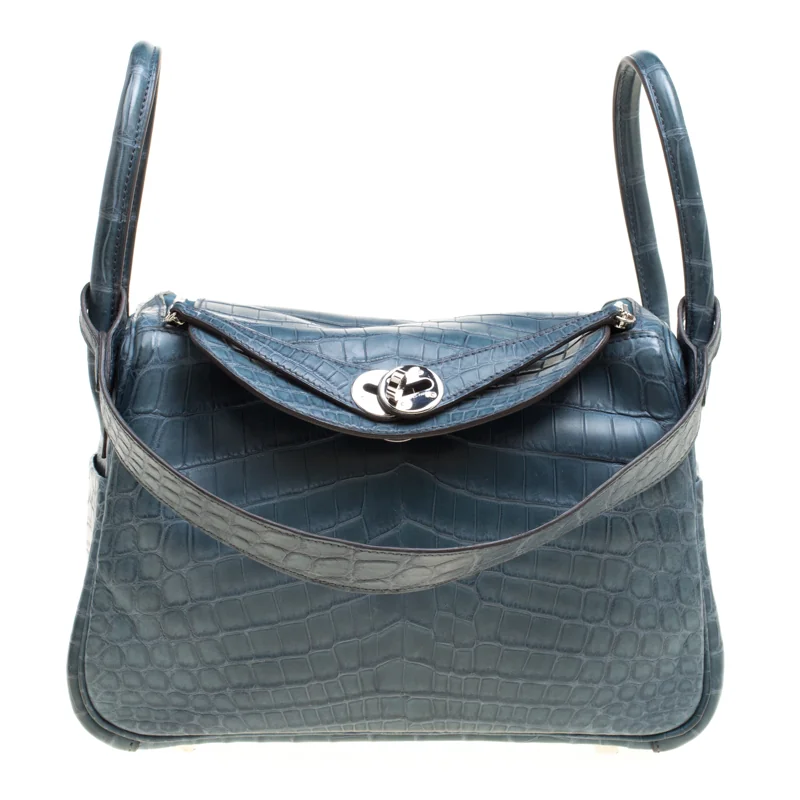
Every week, we pull one bag out of the vault for a closer look, something that deserves more than a passing glance in a listing photo. This week’s pick is the [[Hermès](/buying-guides/best-it-bags-to-buy/)](/brands/kelly-vs-birkin-hermes-bags-compared/) Niloticus Crocodile Lindy 26 in Blue Orage, a piece that quietly does everything right: rare skin, a genuinely useful shape, and a size that’s become the most sought-after in the line.
The Lindy doesn’t get the same headline treatment as the Birkin or Kelly, and that’s part of its appeal. It’s the Hermès bag people buy for themselves once they’ve stopped trying to impress anyone else. This one, in exotic leather, sits at an interesting intersection: casual bag, serious material. We’ll walk through what makes it tick, how to size it up against its siblings, what to check before you buy one secondhand, and where it lands on the value spectrum next to Hermès’ bigger names.
The Hermès Lindy: Origins and Design Philosophy #
Hermès introduced the Lindy in its Spring/Summer 2007 ready-to-wear collection, a relatively recent addition compared to the Kelly (1930s) or even the Birkin (1984). It arrived with a different job to do. Where the Kelly is structured and the Birkin is architectural, the Lindy was built to slouch. It has soft sides, a relaxed silhouette, and none of the rigid corners that define most of the house’s iconic shapes.
That looseness is the point. The Lindy converts between a top-handle tote and a shoulder bag via a single strap threaded through both tubular handles, which makes it one of the more genuinely functional bags Hermès produces. You can sling it over a shoulder for a school run or carry it by hand for something dressier, and the bag doesn’t fight you either way.
It comes in four sizes: 26cm, 30cm, 34cm, and the rarely seen 45cm. The 26 and 30 are the ones you’ll actually see in daily rotation; the 34 leans more into weekend or travel territory, and the 45 is closer to a soft-sided overnight bag than a handbag. In leather (calf, Clemence, Togo), the Lindy has always been considered accessible by Hermès standards. In exotic skins, it moves into an entirely different bracket.
Spotlight: This Blue Orage Niloticus Crocodile Piece #
This particular Lindy 26 is built from Niloticus crocodile, dyed in Blue Orage, a deep, slightly muted blue that reads almost storm-grey in low light and shifts noticeably brighter in direct sun. Niloticus (Nile crocodile) is the more common of Hermès’ two crocodile options, the other being Porosus (saltwater), and it’s generally identified by a finer, more uniform scale pattern with smaller, more evenly distributed tiles across the belly panel, which is the cut used for bags like this.
The construction follows the Lindy’s signature silhouette: soft, slightly slouched sides rather than a boxy structure, even in a material that’s typically associated with stiffer, more formal pieces. That’s actually one of the more interesting things about exotic Lindys. Crocodile in a structured Kelly or Birkin reads formal. Crocodile in a Lindy reads almost contradictory, luxurious material draped over a casual shape, and that tension is a big part of why collectors chase these.
Two tubular handles are fitted at the top, joined by a single shoulder strap, and the leather interior includes two slip pockets plus generous overall room. It’s a genuinely practical everyday bag that happens to be made from one of the most labor-intensive materials Hermès works with.
Hardware and Craftsmanship Details #
The bag closes via a palladium twist lock, a hardware choice worth noting because it changes both the look and the maintenance profile. Palladium won’t tarnish gold in exotic skins the way it sometimes does against warmer leather tones, and it resists tarnishing better than plated gold over time, which matters on a bag you’re planning to keep for years.
Securing the Lindy isn’t as simple as it looks. Two separate zippers run along the top opening, and each one has a pull tab that has to be looped through the twist lock before the lock can close properly. It’s a small design detail, but it’s also one of the first things an experienced eye checks, because the tension and fit of that lock against the leather is hard to fake convincingly on a counterfeit.
Two exterior pockets are built into the front panel, useful for a phone or transit card you want without digging through the main compartment. On the base, five protective studs lift the bag off the ground, standard across most Hermès styles but especially important here, since scuffing crocodile scale on pavement is not a repair you want to be paying for.
Craftsmanship-wise, this is still a single-artisan build, the way all Hermès bags are made, with one leatherworker responsible for a given piece from cut to finished stitch. On exotic skins, that also means matching scale symmetry across panels by hand, which is part of why lead times and prices both climb for crocodile versions.
Authenticating an Exotic Hermès Lindy #
Exotic Hermès pieces are heavily counterfeited because the margins justify it, so authentication matters more here than on a canvas or standard leather bag. A few things worth checking before you commit to a purchase, especially buying pre-owned:
- Scale pattern and texture. Genuine Niloticus has a fine, glossy, fairly uniform scale grid on the belly cut, with natural minor irregularities. Faux or lower-grade crocodile-embossed leather tends to look too repetitive, almost stamped, because it literally is.
- Blind stamp and date stamp. Every Hermès bag carries a blind stamp indicating the year and craftsman, along with “Hermès Paris Made in France.” On exotic skins, check that the stamp sits cleanly within a single, unbroken scale rather than awkwardly straddling a seam, which is a common tell on fakes.
- Stitching. Hermès uses a single continuous thread with saddle stitching, evenly spaced and tight. Uneven stitch length or visible backstitching is a red flag.
- Hardware weight and finish. Palladium hardware should feel substantial, not light or plasticky, and the twist lock mechanism should turn with resistance and a clean action, not loosely.
- CITES documentation. Because Niloticus crocodile is a regulated species, legitimate Hermès exotic bags are sold with, or at minimum are traceable to, CITES paperwork. A reputable pre-owned platform will either provide this or clearly state its authentication process.
If you’re buying online, work with a platform that has in-house authentication specialists rather than relying on seller photos alone. Scale matching, stamp placement, and hardware finish are genuinely hard to judge from a listing image, and this is a category where a mistake is expensive.
Price and Long-Term Value #
Exotic Lindys sit in a strange middle tier. They’re priced well above leather Lindys but generally below exotic Birkins and Kellys of comparable size, largely because the Lindy doesn’t carry the same waitlist mythology. Retail on a new Niloticus crocodile Lindy 26 typically runs into the low-to-mid five figures, depending on color and hardware, with Porosus crocodile versions priced meaningfully higher than Niloticus.
On the resale market, exotic Lindys tend to hold value better than their leather counterparts but don’t command the aggressive premiums you see on exotic Birkins, where scarcity and demand have pushed some pieces to sell above original retail. A Niloticus Lindy 26 in excellent condition typically resells at 60-80% of current retail, which is respectable for a non-quota bag but still trails the Birkin and Kelly, where well-kept exotics in desirable colors can approach or exceed retail.
The honest read: if you’re buying primarily as an investment vehicle, an exotic Birkin or Kelly will outperform an exotic Lindy over time. If you’re buying because you want a genuinely wearable exotic bag at a lower cost of entry than a crocodile Birkin, without the waitlist games, the Lindy is arguably the smarter buy. Blue Orage specifically has held interest well among collectors because it’s a versatile, less saturated colorway compared to black or the more common browns.
Is the Niloticus Lindy 26 a Quota Bag? #
This comes up constantly, and the answer is no. Quota bags, the Birkin and Kelly in exotic skins, are subject to Hermès’ allocation system, where clients typically need purchase history and a relationship with a specific boutique before being offered one. The Lindy has never been part of that system, regardless of material.
That means an exotic Lindy is generally purchasable off the shelf or through special order without the same gatekeeping, which is exactly why it’s become a popular entry point for buyers who want real crocodile without navigating the Birkin waitlist. Availability still isn’t guaranteed, boutiques don’t stock unlimited exotic inventory, and demand for skins like Niloticus in flattering colors like Blue Orage can outpace supply. But there’s no client history requirement standing between you and the bag.
FAQ #
Is the Lindy considered an “entry-level” Hermès bag? In leather, somewhat, it’s often cheaper than a Birkin or Kelly. In exotic skins, that framing breaks down. A crocodile Lindy is a serious purchase in its own right, just priced below crocodile Birkins and Kellys.
How does the Lindy 26 compare to the 30 and 34? The 26 is the most versatile size, easily worn as a shoulder bag day to day. The 30 offers more interior room without losing much wearability. The 34 is noticeably larger and better suited to travel or work use than everyday carry, and in exotic skins its price premium over the 26 is substantial.
How do I care for Niloticus crocodile leather? Keep it away from prolonged direct sunlight and humidity swings, which can dry or crack the scales over time. Avoid contact with perfume, hand sanitizer, and rough fabrics that can catch on scale edges. Store it in its dust bag with the shape gently supported, and have it professionally conditioned by a specialist familiar with exotic leathers rather than a general leather cleaner.
Does Niloticus crocodile scratch easily? More easily than smooth calfskin in terms of surface scuffing on the scale edges, though the material itself is durable. Light handling marks are normal and part of exotic leather’s character; deep gouges or lifted scales are a repair issue.
Is buying a pre-owned exotic Hermès bag risky? It carries more risk than leather pieces simply because counterfeits are more common and harder to spot untrained. Buying from a platform with dedicated authentication, verified CITES documentation, and clear condition grading (typically ranging from pristine/like-new to good with visible wear) significantly reduces that risk.
If the Lindy has caught your eye this week, it’s worth spending time comparing sizes and skins side by side before deciding, the differences in price and wearability between a 26 and a 34, or between Niloticus and Porosus, are bigger than they first appear.
Related Articles #
- Hermès Leathers Guide: Togo, Epsom, Exotic Skins Explained
- Hermès Leathers Guide: Togo, Epsom, Exotic Skins Explained
- Hermès Retail vs. Resale: Which Should You Choose?
- 5 Iconic Bags Named After Famous Women (Buying Guide)
- How to Spot a Fake Hermès Bag: Authentication Guide
Related guides
- Online Bag Authentication: What Photos Can and Cannot Prove
- Private Bag Edit: Hermès Kelly Authentication Blog
- Hermès Date Codes & Stamps Explained: Full Guide
- Hermès Crocodile vs Alligator Bags: Buyer's Guide
- How to Buy an Authentic Luxury Bag from China Safely
- New vs Pre-Owned Luxury Bags: Which Route Is Right for You?
- Chanel Bag Guide: What to Know Before You Buy
- Luxury Bag Houses

Keyword index