Introduction #
Ask any handbag specialist what separates a merely expensive bag from a genuinely rare one, and the conversation almost always turns to exotic skins. A [[Hermès Birkin](/brands/history-of-hermes-harness-maker-to-icon/)](/brands/kelly-vs-birkin-hermes-bags-buying-guide/) or Kelly in crocodile or alligator sits at the top of that hierarchy — not because of a stamped logo, but because of a hide that took years to grow, a tannery process Hermès controls almost entirely in-house, and a single artisan who cuts, skives, and stitches the piece from start to finish.
The catch is that “crocodile” and “alligator” get used interchangeably by sellers, auction houses, and even some boutique staff, when they are in fact different animals with different scale geometry, different sourcing, and different resale ceilings. If you’re spending five figures (sometimes six) on one of these bags, that distinction isn’t academic. It determines what you’re actually holding, what it should cost, and how to tell a genuine skin from a convincing fake. This guide walks through the biology, the Hermès stamp system, the finish types, and the real secondary-market numbers so you can buy with your eyes open rather than trusting a listing description.
Crocodile vs. Alligator: Understanding the Species Hermès Uses #
Hermès sources exotic skins from three species, and each one shows up differently once it’s cut and polished into a bag panel.
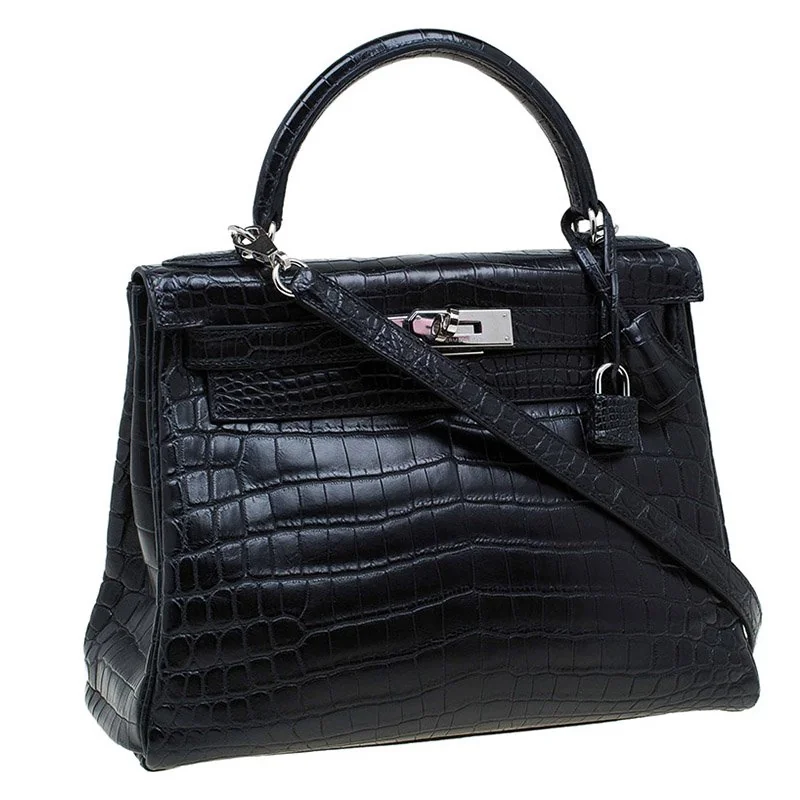
Porosus crocodile (Crocodylus porosus) — the saltwater crocodile — is the benchmark skin for Hermès Birkins and Kellys. It’s farmed primarily in Australia and parts of Southeast Asia under closely audited CITES programs. Porosus hides have small, tightly packed, relatively uniform scales with fine pores, which is why they take a mirror-polish (lissé) finish so well. This is the skin most people picture when they say “croc Birkin,” and it commands the highest average resale premium of the three.
Niloticus crocodile (Crocodylus niloticus) — the Nile crocodile — is farmed in parts of Africa and increasingly in controlled operations elsewhere. Niloticus scales run slightly larger and less regimented than porosus, with a bit more visible texture even after finishing. It’s a genuine step below porosus in market perception, though the gap has narrowed as porosus supply has tightened.
Mississippiensis alligator (Alligator mississippiensis) — the American alligator — is farmed in Louisiana and along the Gulf basin. Alligator hides have a flatter, more rectangular scale pattern with fewer of the small “pebble” scales that fill the gaps between larger scutes on crocodile. Alligator is generally considered slightly more matte-friendly and, per gram, a touch more affordable than porosus crocodile, though top-tier alligator in rare colors can outprice mid-tier crocodile.
Species selection isn’t cosmetic. It affects how the tannery can finish the skin, how the panels are cut around natural markings, how much waste comes off each hide, and ultimately what a workshop can charge. A porosus Birkin 25 in a rare color and an alligator Kelly 28 in the same color can be tens of thousands of dollars apart at resale, purely on species and size.
Key Differences at a Glance: Scale Patterns, Texture, and Feel #
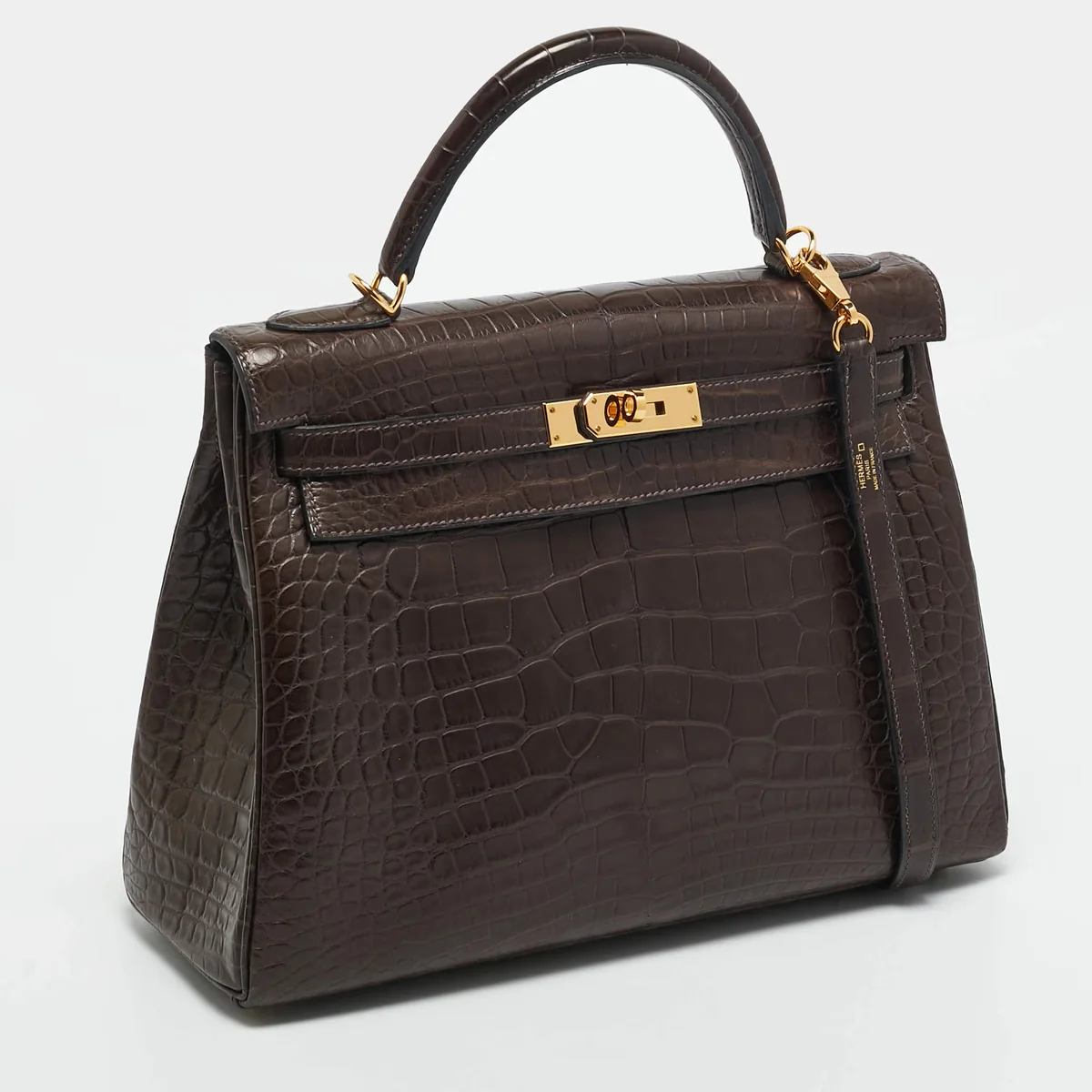
This is the comparison most buyers actually need before they hand over a deposit. Handle enough bags in person and the differences become intuitive, but here’s the breakdown specialists use when they can’t rely on a stamp alone.
| Feature | Porosus Crocodile | Niloticus Crocodile | Mississippiensis Alligator |
|---|---|---|---|
| Scale shape | Small, squarish, tightly packed | Slightly larger, less uniform | Broader, more rectangular |
| Pattern symmetry | Very regular, few gaps | Moderate regularity | High regularity but flatter grid |
| Umbilical scar | Present, off-center, subtle | Present, slightly more prominent | Present, often more elongated |
| Pore visibility | Fine, barely visible under lissé | Slightly more visible | Minimal, smooth surface |
| Hand-feel | Cool, dense, minimal give | Slightly softer, more pliable | Supple, softer flex overall |
| Typical hardness | Firm structure, holds shape well | Firm but slightly less rigid | Softest of the three; more drape |
| Best-suited finish | Lissé (shiny) | Both, leans matte | Both, leans matte |
A few things worth knowing that don’t fit neatly into a chart: crocodile skins generally have a visible line of smaller “transition” scales running down the flanks, where alligator’s scale rows shift more abruptly. Crocodile also tends to show slightly raised, more defined scale edges you can feel with a fingertip even on a lissé finish, while alligator feels closer to flush with the surrounding leather. If you run a thumb across a genuine crocodile panel diagonally against the grain, you’ll feel a faint ridge at each scale boundary; alligator feels comparatively smooth in the same test.
One caution from experience handling both: color and dye job can disguise a lot. A deeply pigmented, heavily lacquered bag can make niloticus look like porosus to an untrained eye. Scale geometry, not color, is the reliable tell.
Authenticating Your Bag: The Hermès Stamp System and Skin Codes #
Every genuine Hermès exotic bag carries an internal identification system, and this is where most convincing fakes fall apart under scrutiny.
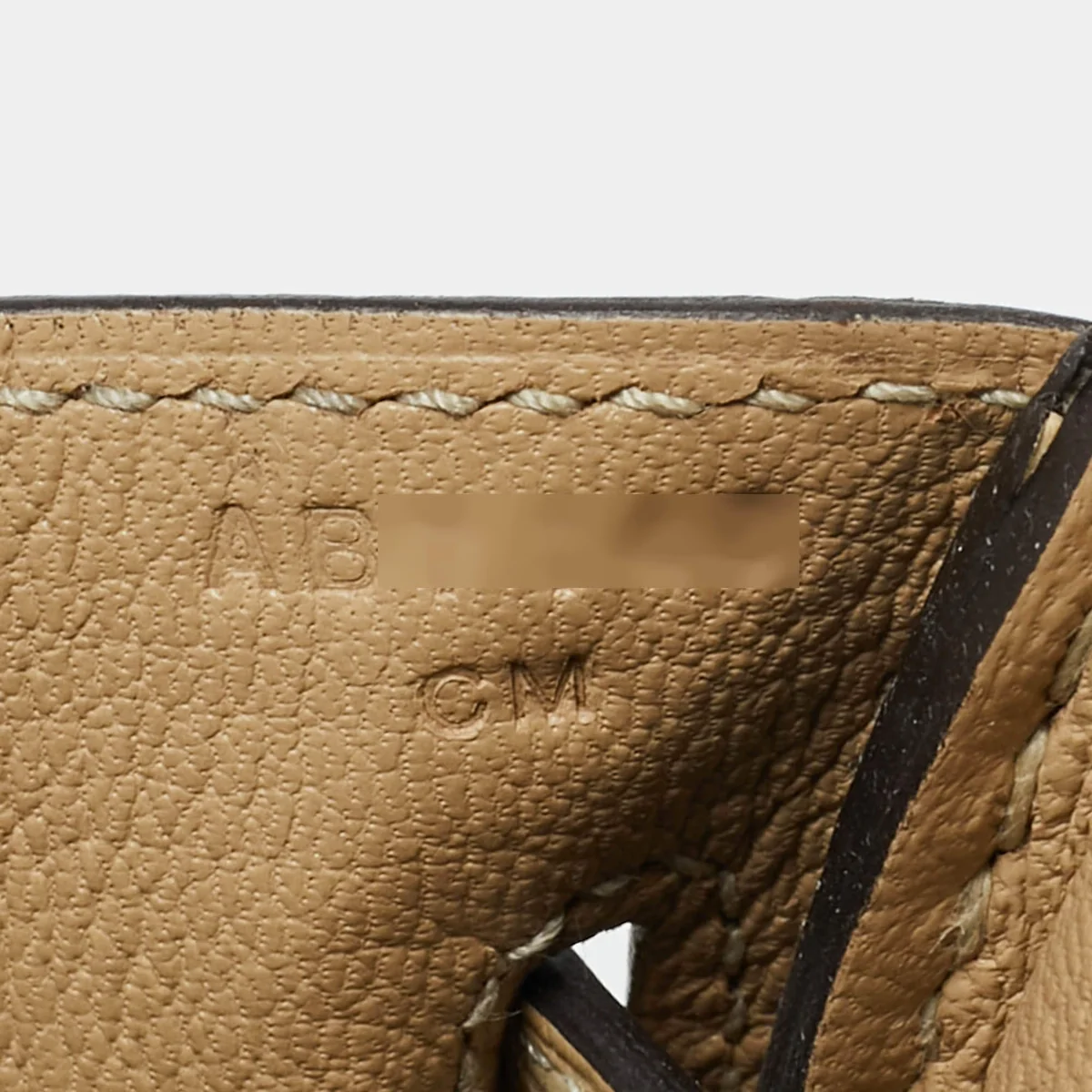
The blind stamp is stamped inside the bag, usually near the top of one side seam, and combines two elements: a craftsman/workshop code (a letter or symbol identifying the artisan or atelier) and a date stamp, typically a letter inside a shape (square, circle, or similar) that Hermès has assigned to specific production years. Since 1997, Hermès has used a rotating single-letter-per-year system; a specialist or authentication service can cross-reference the letter against published Hermès date stamp charts to confirm the bag’s production year lines up with its claimed condition and other details.
The CITES tag is a small paper or plastic hangtag attached to exotic-skin bags, required because crocodile and alligator are regulated under the Convention on International Trade in Endangered Species. A genuine bag purchased new should have had this tag; resale listings that show a bag “with original CITES tag” are signaling extra documentation, though the tag’s absence on an older bag isn’t automatically a red flag since many owners discard it.
Skin type is not printed on a universal label the way you might expect. It’s typically identifiable by the workshop and inferred from scale pattern, sometimes noted in the item’s original receipt or by boutique staff, which is precisely why so much authentication rests on visual scale identification rather than a stamped skin code.
What to actually check when authenticating:
- Blind stamp location and clarity — genuine stamps are crisp and evenly pressed; blurry or off-center stamps are a warning sign.
- Date stamp consistency — does the claimed production year match the hardware style and stitching details typical of that era?
- Stitching — Hermès uses a saddle-stitch by hand with consistent, slightly angled stitch holes; machine-perfect, dead-straight stitching is a common tell on fakes.
- Hardware weight and engraving — genuine palladium or gold-plated hardware has heft and crisp, evenly spaced engraving on turn-locks and clochettes.
- Scale symmetry across panels — counterfeiters frequently use printed or embossed calf leather that fakes the scale pattern but repeats identically across the bag, which real skin never does.
As one long-time exotic-skin authenticator put it to me during a bag inspection: “Fakers can copy a stamp font. They can’t copy a hide that grew on an actual animal — the irregularity is the proof.” That irregularity, more than any single stamp, is what separates real crocodile and alligator from an expensive imitation.
Finishes and Craftsmanship: Matte vs. Shiny (Lissé) #
Hermès exotic skins come in two primary finishes, and the difference is achieved through the tanning and polishing process rather than a different type of leather.
Lissé (shiny) is the glossy, mirror-like finish most associated with crocodile Birkins in editorial photos. It’s achieved through repeated buffing and polishing during tanning, which flattens and smooths the scale surface while preserving its geometric pattern underneath. Lissé shows every scale edge crisply and photographs beautifully, but it also shows scuffs, water spotting, and fingernail marks more readily than matte. It’s more commonly seen on porosus crocodile because the tight, fine scale structure takes a polish more evenly.
Matte finish skips the high-gloss buffing stage, leaving a softer, more natural-looking surface. Matte is more forgiving day to day — it hides light surface marks better and tends to develop patina more gracefully — but it’s also historically been priced slightly lower than lissé for equivalent skin and size, partly because lissé is seen as more labor-intensive and partly because it’s the more recognizable “collector” finish.
In terms of value, lissé crocodile in porosus generally sits at the top of the pricing hierarchy, with matte crocodile and both matte/lissé alligator following behind, though rare colors can override finish when it comes to final resale price. Care requirements differ too: lissé needs more careful handling to avoid scratches and should be kept out of direct sun to prevent finish dulling, while matte is more tolerant of daily use but still requires专业 conditioning to prevent the scales from drying and lifting at the edges.
Popular Models, Rare Colors, and Secondary Market Pricing #
The Birkin 25 and 30, and the Kelly 25 and 28, are the most sought-after formats in exotic skins, largely because smaller sizes use less hide, sell faster, and appeal to a broader buyer pool than the 35 or 40. Sellier-style Kellys (structured, rigid construction) in crocodile are particularly prized among collectors because the stiffer shape shows off scale symmetry more dramatically than the softer Retourne construction.
On color, a handful of shades consistently outperform the rest of the market:
- Himalaya (a graduated grey-to-white niloticus crocodile finish) remains the single most valuable colorway Hermès produces, regularly reaching six figures at auction for Birkins in good condition.
- Rouge H, Bordeaux, and Vert Emeraude crocodile pieces hold strong secondary demand due to rich saturation on lissé finishes.
- Matte alligator in Gris Elephant or Etain has a smaller but loyal following among buyers who want the exotic texture without high-shine maintenance.
On pricing, based on recent resale and auction activity across major platforms and houses:
| Skin & Finish | Typical Size | Approx. Resale Range (USD) |
|---|---|---|
| Porosus crocodile, lissé, palladium hardware | Birkin 25 | $45,000 – $70,000 |
| Porosus crocodile, matte, gold hardware | Kelly 28 | $40,000 – $60,000 |
| Niloticus crocodile, lissé | Birkin 30 | $35,000 – $55,000 |
| Alligator, matte, palladium hardware | Kelly 25 | $30,000 – $48,000 |
| Alligator, lissé, rare color | Birkin 25 | $38,000 – $58,000 |
| Himalaya niloticus crocodile | Birkin 30 | $90,000 – $150,000+ |
These ranges shift with hardware finish (gold-plated hardware typically adds a modest premium over palladium in current demand cycles, though this has flipped periodically over the past decade), condition, and whether the bag has full original packaging and CITES documentation. Auction houses like Christie’s and Sotheby’s have both logged Himalaya Birkins clearing six figures in the past several seasons, and porosus crocodile Birkins in classic colors have shown steadier appreciation than most alligator pieces over the last ten years, according to resale data tracked by major consignment platforms.
Hermès Skin Types Explained: Porosus, Niloticus, and Mississippiensis #
It’s worth separating these three by name because “crocodile” as a catch-all term hides meaningful sourcing and pricing differences that matter at the point of purchase.
Porosus is farmed mainly in Australia and parts of Southeast Asia, under some of the most tightly audited CITES-compliant programs in the exotic leather trade. It’s the smallest-scaled and most uniform of the three, which is why it’s the default skin for lissé finishes and commands the top of the pricing bracket.
Niloticus comes from farmed Nile crocodile populations, with larger, slightly less regular scales than porosus. It’s a legitimate, CITES-regulated skin, but sits a tier below porosus in collector hierarchy — with the notable exception of Himalaya, where the niloticus base skin is transformed by a labor-intensive graduated dye process into the most valuable colorway Hermès makes.
Mississippiensis alligator comes from Louisiana and Gulf-region farms, is broader-scaled and softer-handling than either crocodile species, and generally prices below porosus crocodile at equivalent size and color, though this gap narrows considerably for rare alligator colorways.
Knowing which species you’re looking at — rather than accepting a blanket “crocodile” or “alligator” label from a seller — is the single most useful piece of vocabulary for negotiating price or spotting a mislabeled skin. Sellers occasionally mislabel niloticus as the pricier porosus, intentionally or not; scale size and regularity are the fastest way to check the claim yourself.
Price Comparison: Crocodile vs Alligator Hermès Bags #
Buyers consistently ask a version of the same question: is crocodile always more expensive than alligator? Not always, but usually, and the reasons are structural rather than arbitrary.
Porosus crocodile sits at the top of the market because of its fine, uniform scale structure, its suitability for the coveted lissé finish, and tighter farmed supply relative to demand. Niloticus crocodile trades below porosus but above most alligator, with Himalaya as the major exception that outprices everything else in the category. Alligator, while still a genuine luxury exotic and often the softer, more comfortable bag to actually carry day to day, tends to land at the more accessible end of the exotic-skin spectrum — accessible being relative, since even entry-tier alligator Birkins routinely start in the low $30,000s on the resale market.
A rough rule that holds up across most listings and auction results: for the same size, hardware, and condition, expect porosus crocodile to run roughly 15–30% above equivalent alligator, with niloticus crocodile sitting somewhere in between, except where a rare color or finish (Himalaya being the clearest case) overturns the hierarchy entirely. Hardware finish adds a smaller variable on top — gold-plated hardware has traded at a slight premium over palladium in recent years, though buyers should treat that as a soft trend rather than a fixed rule, since demand for each finish moves in cycles.
For a buyer trying to decide between the two skins purely as an investment, the honest answer is that porosus crocodile in a classic color has shown the most consistent appreciation historically, while alligator and niloticus crocodile carry more upside if you’re buying rare colors ahead of a trend, but with somewhat less price stability if that trend doesn’t materialize.
Frequently Asked Questions #
Is alligator or crocodile more valuable on a Hermès bag? Generally, porosus crocodile with a lissé finish sits at the top of the resale hierarchy, followed by niloticus crocodile, then alligator, though rare colorways like Himalaya (niloticus) can outprice everything else in the category regardless of species.
How can I tell if my Hermès bag is real crocodile and not embossed leather? Check for scale irregularity across the panel, a visible umbilical scar, a slight ridge at scale edges when you run a finger diagonally across the surface, and a genuine, evenly pressed blind stamp inside the bag. Printed or embossed fakes repeat the same pattern across panels, which real skin never does.
Does the CITES tag matter if I’m buying secondhand? It adds documentation value and buyer confidence, but its absence on an older bag isn’t automatically disqualifying — many original owners discarded the tag years ago. Focus more on the blind stamp, stitching quality, and hardware.
Is matte or shiny (lissé) finish worth more? Lissé crocodile, particularly in porosus, has traditionally commanded a premium over matte due to the labor involved and stronger collector recognition, but matte is more forgiving to maintain day to day and holds up better against everyday scuffing.
Should I buy crocodile or alligator if I plan to carry the bag regularly? Alligator’s softer hand-feel and slightly more forgiving matte finishes tend to suit daily use better. Crocodile, especially lissé, rewards careful handling and is better suited to occasional wear or investment holding.
Related Articles #
- Hermès Color Guide: Codes, Shades & Resale Value
- Hermès Date Codes & Stamps Explained: Full Guide
- Hermès Leathers Guide: Togo, Epsom, Exotic Skins Explained
- Hermès Niloticus Crocodile Lindy 26: Bag of the Week
- How to Spot a Fake Hermès Bag: Authentication Guide
Related guides
- Online Bag Authentication: What Photos Can and Cannot Prove
- Private Bag Edit: Hermès Kelly Authentication Blog
- Hermès Date Codes & Stamps Explained: Full Guide
- Hermes Oran Sandals Guide: History, Sizing & Authenticity
- How to Buy an Authentic Luxury Bag from China Safely
- New vs Pre-Owned Luxury Bags: Which Route Is Right for You?
- Chanel Bag Guide: What to Know Before You Buy
- Luxury Bag Houses


Keyword index