Introduction: The Birkin Legacy and a New Limited Edition #
Every Birkin conversation starts the same way: waitlists, relationships with boutique staff, years of patience, and still no guarantee. That scarcity isn’t marketing spin — Hermès genuinely produces the bag in small batches, and every example is built start to finish by one artisan who may spend upward of 18-24 hours on a single piece. Add rare skins, unusual leather treatments, or one-off design concepts, and you get the sub-category collectors chase hardest: special edition Birkins. The Himalayan, the Tressage, the Shadow — each pushed the silhouette somewhere new.
The Hermès In and Out Birkin, unveiled to the trade at the close of 2021, belongs firmly in that lineage but takes a different creative route. Instead of an exotic skin or a technical leatherworking flex, it plays with an idea: what if the bag showed you, right there on the front panel, what’s usually hidden inside? That premise alone has made it one of the more talked-about limited releases in recent Birkin history, and it’s a piece worth understanding in detail before you go looking for one.
A Closer Look at the Design and Craftsmanship #
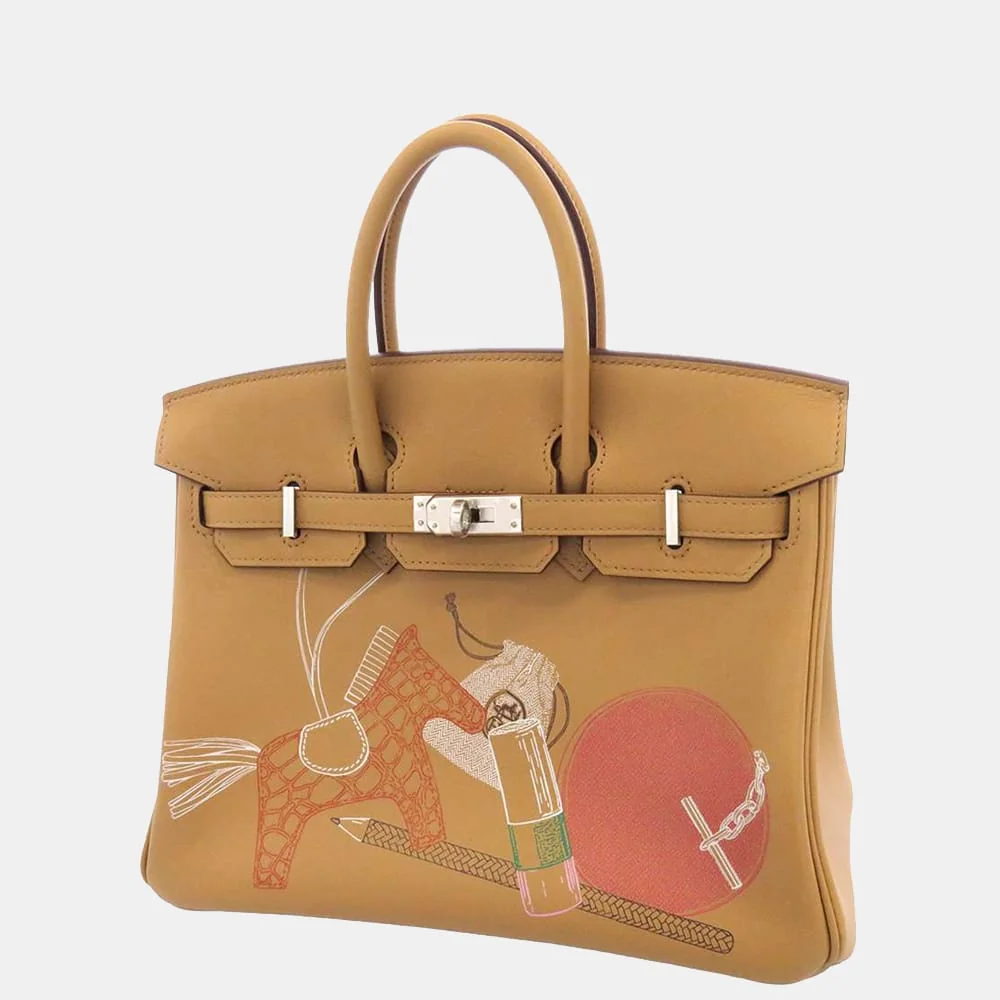
Strip away the novelty print and this is a Birkin 25 through and through — the rectangular holdall shape Jean-Louis Dumas designed in 1984, twin rolled handles, protective clou feet, a front flap, and the signature turn-lock closure. Nothing about the construction has been altered to accommodate the concept, which is part of what makes it work: it reads as a Birkin first, a conversation piece second.
The example most widely seen on the market is done in Biscuit, a warm, neutral tan, rendered in Swift leather — a smooth, fine-grain calfskin Hermès favors for its lightness and the crispness it gives to printed or embossed detail. Palladium-plated hardware sits on top, a cooler, silvery finish that Hermès uses specifically because it doesn’t compete visually with a busy front panel.
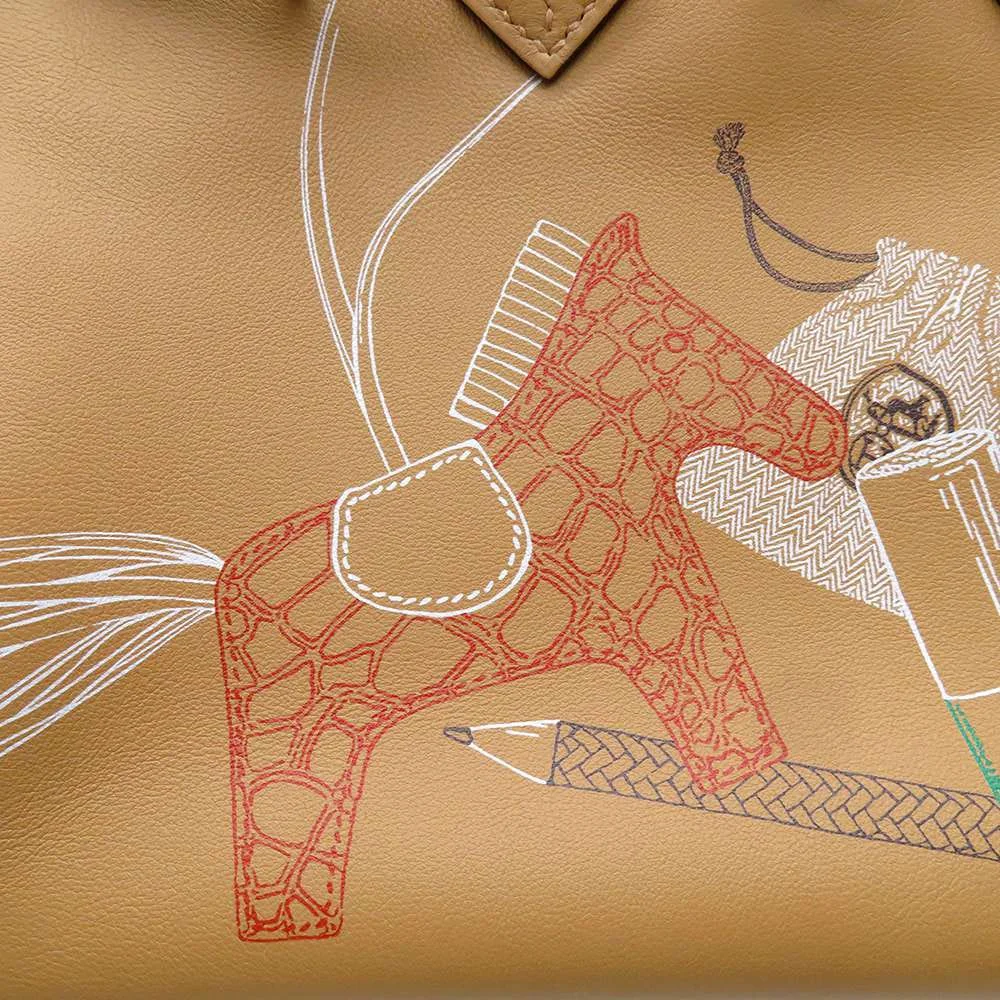
And busy it is. The exterior is printed in a trompe l’oeil style meant to mimic an x-ray scan of the bag’s interior, rendered almost like a line illustration you’d see framed in an Hermès window display. Within that “scan,” you can make out a Rodeo charm design, a braided leather pencil, a small dust pouch, an Hermès-branded lipstick case, and a coin purse strung on a Chaîne d’Ancre lanyard — a lineup that nods to the house’s equestrian roots and, not coincidentally, to several actual Hermès accessories sold separately. Inside, the bag is functional rather than gimmicky: a proper zip pocket and slip pocket, the same organization you’d expect on a standard Birkin 25.
The Story Behind the Trompe l’oeil Concept #
The question the design is built around — what do women actually carry in their bags? — has been asked about the Birkin specifically for decades, mostly because the bag has such a mythologized, guarded interior. Hermès’ answer here is almost cheeky: rather than answer it, they illustrate it, turning the inside out and putting it on display as art.
That’s the trick worth understanding, because it changes how you should evaluate the bag. This isn’t a technical showcase like the Himalayan’s dégradé dyeing or the Tressage’s woven paneling. It’s closer to a design statement, more akin to Hermès’ occasional forays into whimsical prints on scarves or silk. The “insides on the outside” concept works because it’s specific to the Birkin’s cultural weight — a bag so scrutinized and speculated about that literally drawing its contents on the front becomes its own kind of commentary. If you’re buying it expecting exotic-skin-level technical rarity, recalibrate; you’re buying a design idea executed on a Birkin, and that’s a different kind of desirability.
Rarity, Production, and Availability #
Hermès has never published exact production numbers for the In and Out Birkin, and that’s typical of how the house handles nearly all special editions — scarcity is implied through allocation, not announced through figures. What’s known is that it followed the same artisan-built process every Birkin does: one leatherworker, one bag, hand-set hardware and saddle-stitching throughout. The printed panel adds an extra production step, since the trompe l’oeil has to be applied and finished without disrupting the leather’s surface or the bag’s structure, which likely limits how many can be produced in a given run even before you factor in Hermès’ usual allocation constraints.
In practice, this means the bag was never sold as an open SKU you could walk in and request. It moved through the same relationship-based allocation Hermès uses for its most sought-after pieces, offered to established clients rather than listed for general purchase. That’s the honest reason most interested buyers today are looking at the pre-owned market rather than a boutique: the initial release window has passed, and Hermès is not restocking a discontinued limited edition.
Price and [[[[Resale Value](/brands/celine-luggage-tote-guide-sizes-history-resale-value-1/)](/brands/celine-luggage-tote-guide-sizes-history-resale-value/)](/prices-and-value/luxury-price-hikes-2026-resale-impact/)](/buying-guides/best-time-to-buy-a-luxury-handbag-1/) #
Hermès doesn’t publish retail pricing for special editions like this one, and original invoices vary depending on region and year, so treat any number you see as an estimate rather than an official figure. On the resale market, Swift leather Birkin 25s in a special-edition print like this one tend to trade at a premium over a comparable standard Birkin 25 in plain leather, driven less by the leather itself (Swift is not an exotic skin, so it doesn’t carry crocodile- or lizard-level pricing) and more by the limited print run and the fact that it’s discontinued.
Here’s how it stacks up against other well-known special editions, based on typical resale listings and auction results rather than any official Hermès price sheet:
| Special Edition | Material | Key Feature | Relative Rarity | Typical Resale Positioning |
|---|---|---|---|---|
| Himalayan Birkin | Niloticus crocodile | Hand-dyed grey-to-white ombré | Extremely rare, exotic skin | Highest — often six figures |
| Tressage Birkin | Woven leather/exotic panels | Multi-material braided construction | Rare, limited runs | High — well above standard exotic Birkins |
| Shadow Birkin | Embossed calfskin | Digital camo-style embossed pattern | Limited seasonal release | Moderate premium over standard leather Birkin |
| In and Out Birkin | Swift leather | Trompe l’oeil x-ray print | Limited, discontinued print | Moderate premium, driven by design rarity, not skin value |
The takeaway: the In and Out won’t command Himalayan money, and it shouldn’t — it’s a leather bag, not an exotic. Its value proposition is closer to the Shadow’s: a standard-material Birkin made desirable by a discontinued, distinctive design. As an investment, it’s better viewed as a collector’s piece for people who specifically want the concept, rather than a guaranteed appreciating asset. Condition, completeness of the printed accessories set, and box/dust bag presence all move the price meaningfully.
How to Spot an Authentic Hermès In and Out Birkin #
This bag actually gives counterfeiters a harder problem than a plain leather Birkin, which cuts both ways — the print is distinctive enough to be hard to fake convincingly, but that same complexity means a poor reproduction is often easier to catch if you know what to check.
Start with the print itself. On an authentic piece, the trompe l’oeil lines are crisp, evenly saturated, and follow the leather’s natural grain without cracking or sitting on top like a sticker. Cheap reproductions tend to show pixelation under close inspection, uneven ink density, or a print that looks glued rather than integrated into the leather’s finish.
Then work through the standard Birkin checks, because they still apply:
- Blind stamp: Every Birkin has a stamp inside indicating the artisan and the production year (a letter code). Check that the letter is consistent with the bag’s known release window — a stamp that doesn’t line up with late 2021 onward is a red flag on this particular bag.
- Stitching: Hermès uses saddle stitching with waxed linen thread — stitches should be even, diagonal, and tight, never machine-uniform in a way that looks too perfect or glued down.
- Hardware: Palladium-plated pieces should feel cool and substantial, with clean, deep engraving on the turn-lock and no plating that flakes or looks painted on.
- Accessories: The Rodeo charm, coin purse, and dust pouch that echo the print should match Hermès’ actual hardware finish and stitching quality — not generic charms bundled in to look complete.
- Chaîne d’Ancre strap: Links should be soldered and even in weight, not lightweight jump rings.
- Paperwork: Ask for the original receipt or an Hermès extrait, and don’t be talked out of a third-party authentication check (a service like Entrupy or a specialist authenticator) before you commit, especially on a private sale.
If a seller resists photos of the interior stamp, the underside of the hardware, or close-ups of the print’s edges near the seams, walk away. These are the areas counterfeiters cut corners on most.
The Reversible Design Explained #
Worth clearing up directly: despite what the name suggests, the In and Out Birkin is not a flip or reversible bag in the literal sense — there’s no mechanism that lets you turn the exterior inside out or swap panels. The flap opens and closes with the same turn-lock every Birkin uses, and the bag functions structurally like a standard Birkin 25.
The “in and out” naming refers to the concept, not a physical feature — the idea of taking what’s normally kept “in” the bag and displaying it “out” on the exterior through the print. If you’re shopping for this bag because you read about a reversible mechanism, you’re likely thinking of a different Hermès release (the house has done genuinely reversible styles elsewhere in its lineup). This one’s innovation is purely visual and conceptual, not mechanical, and it’s a useful distinction to have straight before you’re evaluating a listing or negotiating a price based on a feature the bag doesn’t actually have.
Color and Leather Combinations #
The combination most consistently documented and available through specialist resellers is Biscuit Swift leather with palladium hardware — a deliberately neutral base that lets the printed detail read clearly rather than fighting a bold color underneath. That pairing isn’t incidental: a busier colorway would muddy the trompe l’oeil, so the tonal restraint is part of the design logic, not a limitation Hermès settled for.
Special editions built around a specific visual concept like this one are typically released in a very narrow color range, sometimes just one, precisely because the design is the point rather than the color story. If you come across a listing claiming a materially different leather color or hardware finish for this exact print, treat it with more scrutiny rather than less — it’s the kind of detail that’s easy to misrepresent on a resale listing, and it’s worth cross-checking against verified sale photos before assuming it’s a genuine variant.
Caring for the Swift leather #
Swift is prized for being soft and lightweight, but that same softness makes it more prone to surface scratching and color transfer than a structured leather like Togo or Epsom. A few practical points specific to this bag:
- Keep it away from dark denim and unfinished leather — Biscuit is light enough that transfer marks show quickly.
- Avoid overstuffing. Swift has less structural rigidity, so an overloaded bag will stretch the flap and strain the handles over time.
- Store in the dust bag, away from direct light, when not in use — prolonged UV exposure will dull both the leather tone and the print’s contrast.
- Be more protective of the front panel specifically. The printed surface is a finish applied to the leather, and repeated friction (rubbing against zippers, rough surfaces, or careless handling) can wear it faster than it would wear plain-dyed leather. This is a genuine downside of the design worth knowing before you buy: the feature that makes the bag special is also its most delicate point.
- Have it professionally cleaned and conditioned by a leather specialist familiar with Hermès pieces — generic leather conditioners can alter how the print sits on the surface.
A step-by-step guide to buying this bag pre-owned #
- Source from a reputable pre-owned specialist, not an unverified private listing, especially for a limited edition where fakes are more profitable to produce.
- Request full documentation — original receipt, box, dust bags, and any accompanying accessories that came with the print concept.
- Ask for high-resolution photos of the blind stamp, hardware engraving, interior stitching, and the print’s edges near the seams before paying anything.
- Get independent authentication if the platform doesn’t already provide in-house verification — worth the fee on a bag in this price bracket.
- Check the return policy in writing before purchase; reputable resellers offer authentication guarantees.
- Compare the asking price against recent comparable sales rather than listed “retail equivalent” pricing, which is often inflated.
- Confirm payment protection — use a platform or payment method with buyer protection rather than a direct bank transfer to a private seller.
A few quick questions, answered #
Is the In and Out Birkin still available new from Hermès? No — it was released as a limited allocation in 2021 and has not been reissued. Pre-owned specialists are the realistic route now.
Does the print wear off with normal use? It shouldn’t under normal handling, but it’s a leather finish, not dye penetration, so it’s more vulnerable to abrasion than the surrounding leather. Careful use and storage matter more with this bag than with a plain-leather Birkin.
Is it a better investment than a standard Birkin 25? Not necessarily. It’s more of a design collector’s piece. A plain Togo or Epsom Birkin 25 in a popular color often holds value more predictably because demand isn’t tied to appreciating a specific print concept.
If you’re set on adding one to your collection, The Luxury Closet carries authenticated pre-owned Birkins, including special editions like this one, alongside other Hermès mainstays — Constance, Picotin, Evelyne, and Kelly — worth comparing before you settle on which piece earns the shelf space.
Related Articles #
- Hermès Retail vs. Resale: Which Should You Choose?
- Hermès Leathers Guide: Togo, Epsom, Exotic Skins Explained
- Hermès Leathers Guide: Togo, Epsom, Exotic Skins Explained
- Hermès Scarves Guide: History, Prints & Buying Tips
- Popular Handbag Brands: Which One Is Right for You?
Related guides
- Online Bag Authentication: What Photos Can and Cannot Prove
- Private Bag Edit: Hermès Kelly Authentication Blog
- Hermès Date Codes & Stamps Explained: Full Guide
- Hermès Crocodile vs Alligator Bags: Buyer's Guide
- How to Buy an Authentic Luxury Bag from China Safely
- New vs Pre-Owned Luxury Bags: Which Route Is Right for You?
- Chanel Bag Guide: What to Know Before You Buy
- Luxury Bag Houses


Keyword index