Introduction: Meet the Ralph Lauren Ricky Bag #
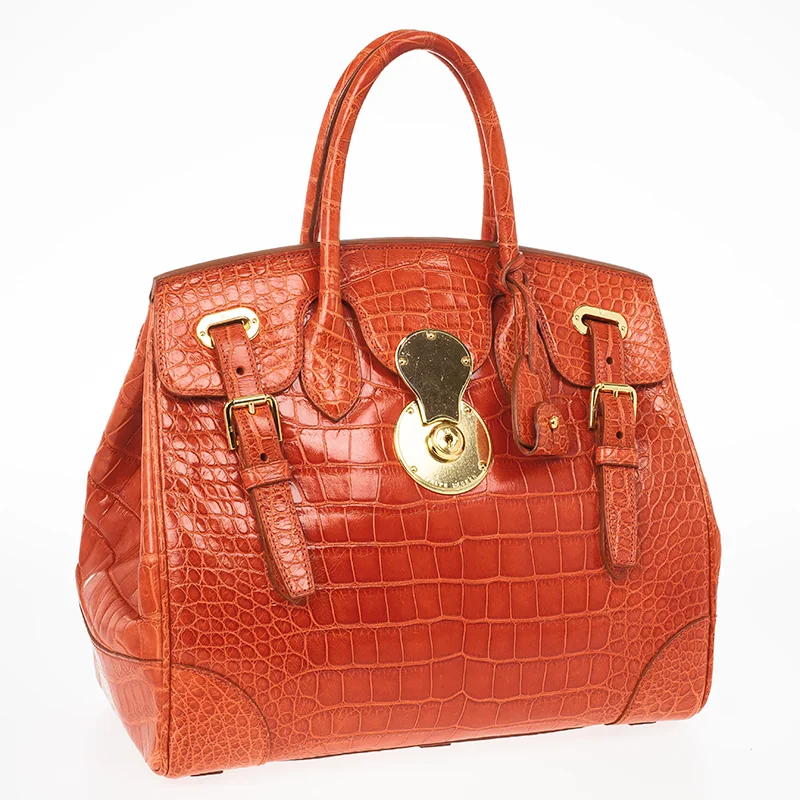
Ask ten handbag collectors to name the most underrated exotic-leather bag on the resale market, and most will reach for a Chanel discontinuation or a vintage Fendi. Almost none will say Ralph Lauren. That’s the quiet irony of the Ricky bag: a structured, hardware-heavy, exotic-skin satchel that has been sitting in plain sight for over a decade, routinely mistaken for “just another American designer bag” by people who haven’t handled one in person.
We have. Two exotic Ricky bags came through our hands recently — genuine alligator, in orange and red — and the build quality forced us to reassess where this bag actually sits in the luxury pecking order. Purse Blog has called it one of the most underrated bags on the market, and after inspecting the leather, the hardware, and the construction firsthand, we’d argue that label undersells it. This is a bag built with the same exotic-skin sourcing and hardware ambition as the pieces it’s constantly, if quietly, compared to: the Hermès Kelly and Birkin.
This isn’t a puff piece. We’ll get into the real downsides — resale liquidity, brand perception, and the lack of a waitlist mystique — right alongside what makes the Ricky worth a serious look for anyone building an exotic-leather collection outside the Hermès ecosystem.
The Story Behind the Name: Ralph Lauren’s Tribute to His Wife #
The Ricky bag is named after Ricky Lauren, Ralph Lauren’s wife of over five decades. It’s a personal tribute in the same tradition as the Kelly (Grace Kelly) and the Birkin (Jane Birkin) — a designer naming a signature piece after a woman he associates with understated elegance rather than a marketing persona.
That parallel is not incidental. Ralph Lauren has never hidden his admiration for the codes of old-world European luxury, and the Ricky reads like a deliberate American answer to the Hermès formal handbag tradition: structured silhouette, top handle, frame closure, exotic-skin options, and a namesake with personal meaning rather than a celebrity endorsement deal behind it.
Where the Ricky diverges from its Hermès inspiration is in tone. It doesn’t carry the decades of royal-and-Hollywood provenance that built the Kelly’s mystique, nor the assembly-line mythology (and infamous waitlist) that turned the Birkin into a cultural punchline about wealth. The Ricky has stayed a designer’s-wife bag rather than becoming a status object — which is exactly why it’s flown under the radar for so long.
Craftsmanship and Design: Alligator Leather Meets Gold-Tone Hardware #
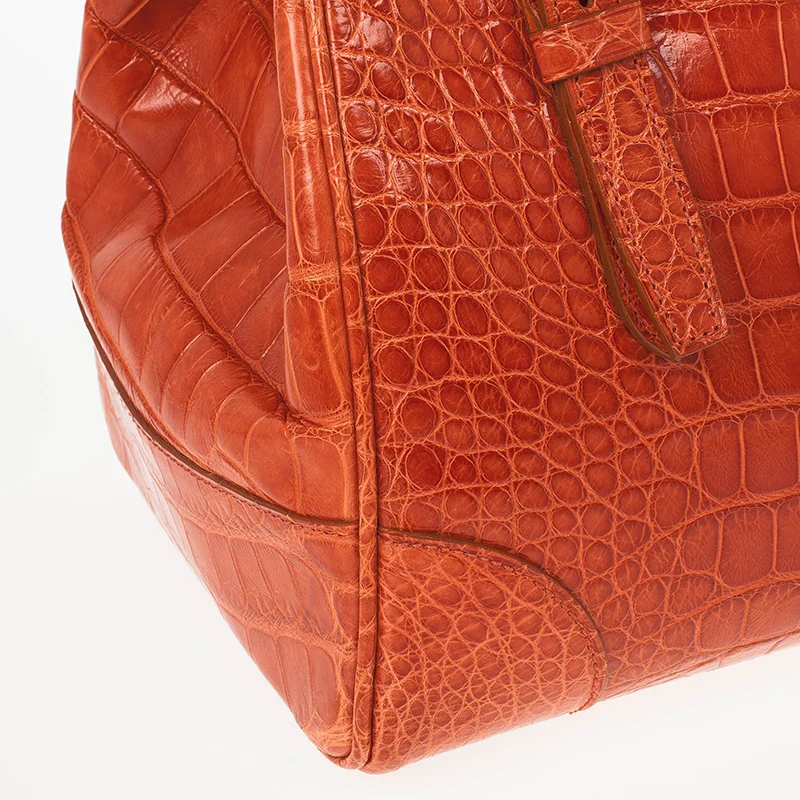
The Ricky’s construction is where it earns the comparison to Hermès leather goods, not just the naming convention.
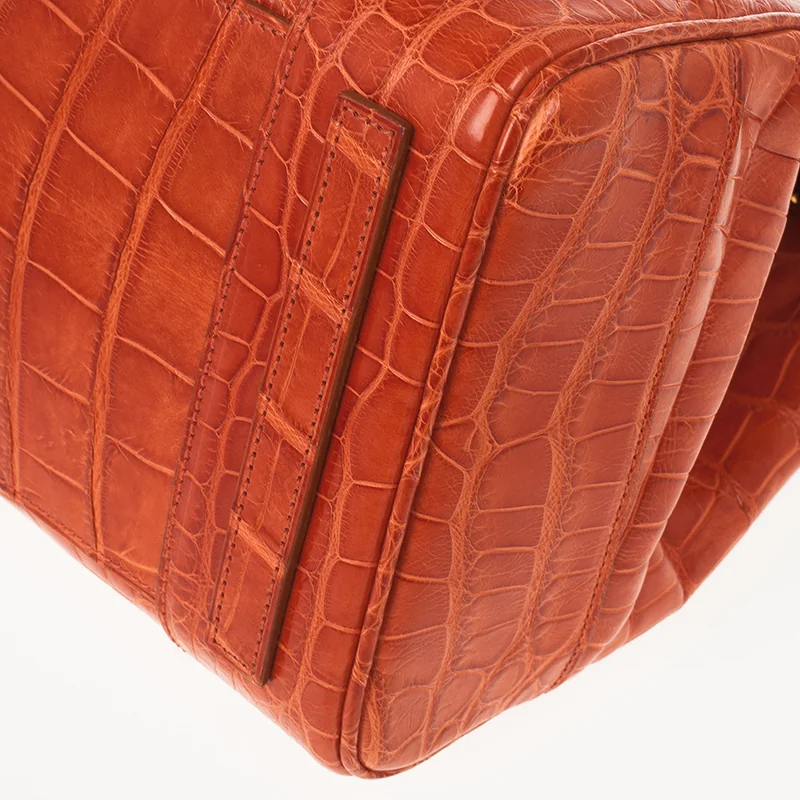
Exterior: The exotic versions are cut from genuine alligator or crocodile skin, with the scale pattern matched across panels — a detail that separates real exotic tanning from embossed calfskin trying to fake the look. The pieces we handled, in orange and red alligator, showed the kind of tight, even scale alignment you’d expect from a house sourcing from established exotic-leather tanneries, not a mass-market supplier.
Hardware: Gold-tone hardware frames the bag, with a turn-lock or snap-flap closure depending on the generation and size, plus a leather clochette that houses the keys — again, a direct structural echo of the Birkin’s clochette-and-lock system. The plating on the hardware we inspected was solid, with no flaking or discoloration despite age, which is one of the more reliable indicators of real investment-grade metal versus a designer bag padded with hardware for visual weight.
Interior: Lined in leather (typically black), the interior layout is genuinely functional rather than decorative: a snap pocket, a zip pocket, and a dedicated phone pocket. That’s a more thought-out interior than either the Birkin or Kelly, which are famously light on interior organization — a small but real practical advantage for anyone who’s used a Kelly as a daily bag and cursed the lack of a zip pocket.
Sizing: Ralph Lauren sold the Ricky in a range of sizes using centimeter-based naming (small, mid, and larger structured sizes, along with a mini), echoing the way Hermès names Birkin sizes by width in centimeters. It’s not a coincidence — it’s a naming convention borrowed wholesale from the house it’s most often compared to, and it makes size-matching against a Birkin or Kelly straightforward once you know the numbers.
Ricky vs. Kelly and Birkin: How It Stacks Up Against Hermès #
Here’s the honest comparison, based on hands-on inspection of exotic-skin Ricky pieces and years of handling Kelly and Birkin bags for authentication purposes.
| Criteria | Ralph Lauren Ricky | Hermès Kelly | [[Hermès Birkin](/buying-guides/hermes-jypsiere-buying-guide/)](/buying-guides/handbags-worth-investing-in/) |
|---|---|---|---|
| Craftsmanship | High — hand-matched exotic skins, solid hardware, functional interior | Exceptional — saddle-stitched, single-artisan construction | Exceptional — saddle-stitched, single-artisan construction |
| Exclusivity | Moderate — limited runs, no formal waitlist | Very high — quota system, waitlist required | Very high — quota system, waitlist required |
| Brand heritage/story | Personal (namesake’s wife), no royal/celebrity mythology | Grace Kelly, decades of red-carpet provenance | Jane Birkin, cultural icon status |
| Resale liquidity | Low to moderate — niche buyer pool | High — active global resale market | Very high — most liquid luxury bag on resale |
| Entry price (exotic) | Roughly $6,000–$18,000+ depending on skin/size, secondary market | $30,000–$100,000+ depending on skin/size | $15,000–$150,000+ depending on skin/size |
| Investment trajectory | Undervalued relative to build quality; appreciation less predictable | Consistently appreciates, especially in exotic skins | Consistently appreciates, benchmark for the category |
| Authentication difficulty | Moderate — fewer counterfeits, but also fewer verification resources | High — sophisticated counterfeit market, but robust verification infrastructure exists | High — same as Kelly |
| Interior functionality | Better — multiple organized pockets | Minimal — single slip pocket | Minimal — single slip pocket |
The takeaway: the Ricky is not competing with Hermès on exclusivity or resale liquidity, and it shouldn’t be marketed that way. Where it competes — and arguably wins — is dollar-for-dollar craftsmanship in exotic skins at a fraction of the entry price. For a buyer priced out of the Hermès quota system but unwilling to compromise on real alligator or crocodile, the Ricky is one of the few honest alternatives on the market.
A Bag Worth Stealing: The 2012 Flagship Store Theft #
In 2012, a brown crocodile Ricky bag was stolen directly off display at Ralph Lauren’s flagship store in New York. It’s a small news item, but it’s a useful data point: nobody steals a bag that doesn’t have real resale value to a thief. Exotic Ricky bags were, even a decade ago, worth enough on the secondary and gray markets to justify the risk.
We’d rather have the provenance paperwork than the anecdote — both of our exotic Rickys were purchased through normal retail channels, not “acquired” via five-finger discount. But the theft is a reminder that this bag’s value has been recognized by more than just collectors and fashion editors for a long time.
Buying Guide: What to Know Before Investing in a Ricky Bag #
Pricing reality. Exotic-skin Ricky bags (alligator, crocodile) typically move on the resale market in the $6,000–$18,000+ range depending on size, skin type, and condition, with rarer colorways and larger sizes commanding more. Calfskin and non-exotic versions sit considerably lower, often in the low-to-mid thousands. These are broad secondary-market ranges — Ralph Lauren has never published official retail pricing tiers the way Hermès does, and pricing history is far less documented, which itself is a risk factor for buyers used to Hermès-level price transparency.
Availability. The Ricky was never sold through a quota or waitlist system. It appeared in limited runs through Ralph Lauren Collection boutiques and select department stores, which means supply was genuinely scarcer in some colors and skins than demand data suggests — not because of artificial scarcity marketing, but because runs were simply small and inconsistent.
Exotic leather considerations. Buying alligator or crocodile means checking CITES documentation where applicable, especially for cross-border resale or shipping. Ask any seller for country-of-origin paperwork on exotic pieces. Condition matters more on exotic skins than on calfskin — dryness, cracking at the fold lines, and hardware corrosion are the three things we check first.
Authentication red flags. This is the area where the Ricky requires more caution than a Birkin or Kelly, precisely because there’s no centralized authentication infrastructure or blind-stamp dating system built around it. What to check:
- Scale pattern on exotic skins should be symmetrical and matched panel-to-panel. Embossed calfskin pretending to be alligator will show repeating, unnaturally uniform patterns.
- Hardware should carry a clean, deep “Ralph Lauren” engraving with no soft or blurry edges, and the gold-tone plating should show no flaking, even on older pieces.
- Interior lining and pocket construction should match the described layout exactly (snap pocket, zip pocket, phone pocket). Missing or mismatched pockets are a common tell on replicas.
- Weight matters. Genuine exotic-skin Ricky bags with full metal hardware have real heft. A suspiciously light bag is a warning sign.
- Buy from sellers who can produce original receipts, dust bags, or boxes, and when in doubt, use a third-party authentication service before paying — the same discipline you’d apply to a Kelly or Birkin purchase.
The honest downside. Resale liquidity is the real risk. If you need to exit quickly, the buyer pool for a Ricky is a fraction of the size of the Birkin or Kelly market. This is a hold-and-enjoy purchase, not a flip.
Ricky Bag vs. Hermès Birkin: Key Differences #
- Closure mechanism: Both use a lock-and-clochette system, but the Birkin’s turn-lock and strap configuration has decades of refinement and a global counterfeit-detection infrastructure built around it. The Ricky’s hardware is well-made but far less studied by authenticators.
- Price-to-craftsmanship ratio: This is the Ricky’s strongest argument. An exotic Ricky can deliver comparable hand-matched skin quality to an entry-level exotic Birkin at roughly a third to half the price.
- Waitlist and access: The Birkin requires a purchase history and relationship with Hermès sales staff to even be offered one. The Ricky has no such gatekeeping — you can generally buy one outright if you find it in stock or on the resale market.
- Resale market depth: The Birkin has an established global resale ecosystem with price indices, auction records, and dedicated authenticators. The Ricky’s resale market is thin and regional by comparison.
- Cultural cachet: The Birkin is instantly recognized; the Ricky is a conversation starter for people who know handbags, and invisible to everyone else. Depending on what you want from a bag, that’s either a downside or the entire appeal.
FAQ: Your Ralph Lauren Ricky Bag Questions Answered #
Is the Ralph Lauren Ricky bag discontinued? The Ricky has had inconsistent availability for years, with limited exotic runs appearing periodically rather than as a permanent core line item. Check current Ralph Lauren Collection offerings for active production status, but expect the exotic versions in particular to be sourced mainly through resale.
What sizes does the Ricky bag come in? Ralph Lauren used centimeter-based naming similar to the Birkin’s sizing convention, with the Ricky offered in a range from a compact mini size up to larger structured totes. Exact size availability has varied by season and skin type.
Is the Ricky bag a good investment? In craftsmanship terms, yes — exotic versions use real alligator and crocodile at prices well below comparable Hermès pieces. As a liquid investment, it’s weaker than a Birkin or Kelly because the resale market is smaller and less standardized. Buy it because you want to wear it, with appreciation as a bonus, not the primary goal.
How can I tell if a Ricky bag is authentic? Check the scale symmetry on exotic skins, the engraving quality on the hardware, the interior pocket configuration (snap, zip, and phone pockets), and overall weight. Because there’s no centralized Ralph Lauren authentication database like Hermès has for blind stamps, provenance documents and third-party authentication matter more here, not less.
Who has been seen carrying the Ricky bag? It’s never had the celebrity-photographer pipeline that the Birkin and Kelly enjoy, and that’s part of its underrated status. It has surfaced occasionally in fashion press coverage of high-profile figures over the years, but it has never become a paparazzi staple — which is exactly why prices have stayed reasonable relative to build quality.
Why is the Ricky compared to the Hermès Birkin? The comparison comes from structural similarities — the frame silhouette, the lock-and-clochette closure, exotic-skin options, and even the centimeter-based sizing — combined with a personal namesake story that mirrors how Hermès named its own icons. It’s a deliberate design lineage, not a coincidence.
Related Articles #
- Ralph Lauren Brand History: The Story Behind the Icon
- Ralph Lauren Ricky Bag: Fashion’s Best-Kept Secret
- Fendi First Bag Guide: History, Design & Resale Value
- Hermès Kelly Clutch: Smartest Entry Into Luxury Bags
- 5 Iconic Bags Named After Famous Women (Buying Guide)
Related guides
- Online Bag Authentication: What Photos Can and Cannot Prove
- Blue Crocodile Lady Dior Tote: Buying Guide
- Chanel Vintage Flap Bag Buying Guide: Navy Lambskin
- Louis Vuitton Palm Spring Backpack: Complete Buyer's Guide
- How to Buy an Authentic Luxury Bag from China Safely
- New vs Pre-Owned Luxury Bags: Which Route Is Right for You?
- Chanel Bag Guide: What to Know Before You Buy
- Luxury Bag Houses


Keyword index