Introduction: The King of Casual Wear #
Ask ten people to name an American fashion brand and at least half will say Ralph Lauren before they say anything else. That’s not an accident of marketing. It’s the result of nearly six decades of one designer building a look so specific — East Coast prep, Western ranch, Savile Row tailoring, all filtered through an American lens — that it became shorthand for a certain kind of effortless polish.
We cover Ralph Lauren on this site for the same reason we cover [[[[Hermès](/buying-guides/best-designer-everyday-bags-to-invest-in-2026/)](/buying-guides/best-it-bags-to-buy/)](/buying-guides/investment-handbags-worth-buying-2026-guide/)](/brands/kelly-vs-birkin-hermes-bags-compared/): both brands reward buyers who understand what they’re looking at. A Kelly bag and a Purple Label sport coat are worlds apart in price and craft tradition, but the resale market for both is crowded with counterfeits and mislabeled pieces, and the difference between a smart purchase and an expensive mistake comes down to knowing the brand’s real history, its actual product structure, and what authentic construction looks like. This piece walks through where Ralph Lauren came from, how the company is organized today, and what to check before you buy pre-owned.
From a Drawer in the Empire State Building to a Necktie Empire #
Ralph Lauren didn’t start as a designer. He started as a Brooks Brothers salesman who noticed something the menswear establishment had missed: American men wanted wider, more expressive neckties than the era’s slim, buttoned-down conservatism allowed. The story usually cited is that he was struck by the way actor Douglas Fairbanks Jr. wore a broad, European-cut tie, and he tried to bring that silhouette to the American market through the company that employed him. They passed. They didn’t see the commercial case for it.
So he left, at 26, and worked out of what’s often described as little more than a drawer of office space in the Empire State Building, cutting ties from remnant fabric. That’s the part of the story worth sitting with if you’re evaluating this as a heritage brand: Ralph Lauren wasn’t backed by old family capital or a fashion house apprenticeship. It was built from a menswear salesman’s instinct and a small loan.
The turning point came when Neiman Marcus placed an order for 1,200 of his neckties — a serious vote of confidence from a department store that didn’t need to take a chance on an unknown. In 1967, Lauren opened his own necktie line under the name “Polo,” and he licensed the name from Brooks Brothers, his former employer, who kept the rights to their own signature button-down collar design. That licensing detail matters historically because it shows how entangled Ralph Lauren’s early identity was with the very establishment brand he’d just left. He wasn’t rejecting American prep. He was expanding it.
Building the Polo Aesthetic: Boutiques and the Purple Label #
Once menswear took hold, Lauren moved fast into full ready-to-wear, then womenswear, then retail. By 2007, the brand had grown to roughly 35 boutiques across the United States, and within that footprint only 23 locations carried Purple Label — the men’s luxury tailoring line built on Italian fabrics and construction closer to bespoke tailoring than to mainstream ready-to-wear.
That exclusivity was deliberate, and it’s the model Ralph Lauren still runs on: a wide, accessible base (Polo, now Polo Ralph Lauren) supporting a narrow, expensive top (Purple Label). It’s the same tiered structure luxury houses use to protect margin and prestige at once — mass distribution funds the brand’s visibility, while a restricted top tier protects its status. If you’re shopping resale today, that tiering is the first thing to understand, because price and craftsmanship vary enormously across lines carrying the same name.
Ralph Lauren’s current portfolio, by line:
- Ralph Lauren Purple Label — men’s luxury tailoring, made largely in Italy, hand-finished details, the closest thing the brand has to haute couture pricing.
- Ralph Lauren Collection — the womenswear equivalent of Purple Label, formal and eveningwear-oriented.
- Polo Ralph Lauren — the core brand most people know: polo shirts, chinos, outerwear, accessible pricing, wide distribution.
- RRL (Double RL) — Lauren’s Americana and vintage-Western line, heavy denim, rugged workwear references, priced above core Polo but below Purple Label.
- Lauren Ralph Lauren — a diffusion womenswear line, department-store distribution, lower price point than Ralph Lauren Collection.
- Polo Ralph Lauren Children’s / Polo Ralph Lauren Denim & Supply — younger, casual, lower-priced offshoots aimed at a younger customer or more relaxed price bracket.
- Ralph Lauren Home — furniture, bedding, china, textiles.
At various points the company has run more than two dozen sub-labels and licensed lines; not all of them survive today, but the tiered logic (luxury tailoring at the top, accessible sportswear in the middle, licensed home goods and diffusion lines beneath) has stayed consistent since the Purple Label era began.
Iconic Designs That Defined an Era #
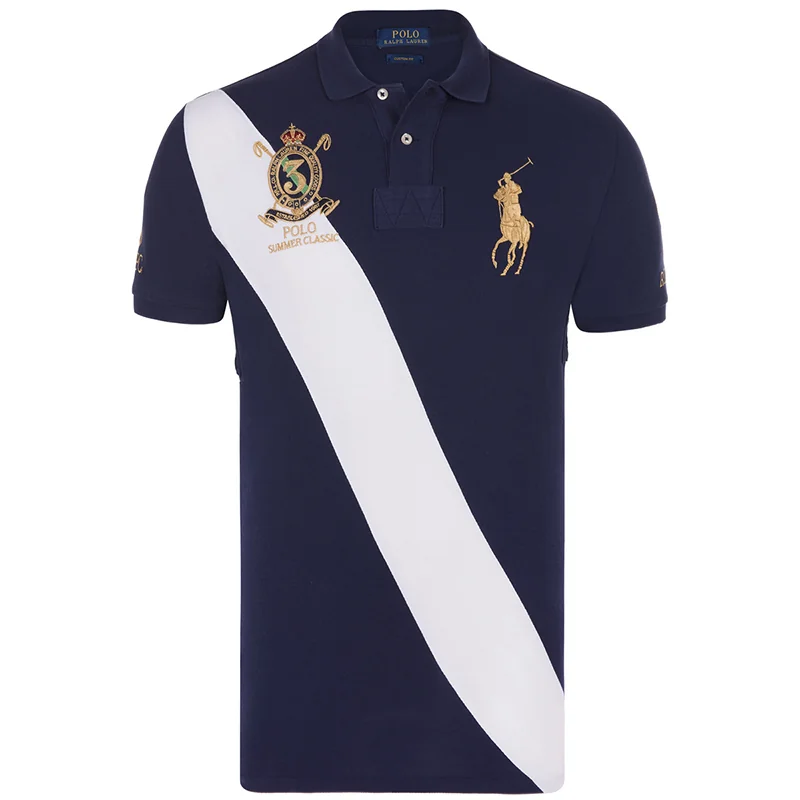
The Polo shirt, introduced in 1972, is the single garment that made Ralph Lauren a household name. It wasn’t a new invention — the tennis shirt existed before Lauren touched it — but he refined the fit, expanded the color range to 24 shades at launch, and put a small embroidered polo player on the chest that turned a plain knit shirt into a status marker. That embroidered logo did something most fashion branding doesn’t: it made the wearer part of the advertising. You didn’t need a bag or a box with a name on it. The shirt did the talking.
It’s worth being honest about why that worked. Ralph Lauren was selling access to an aspirational American identity — East Coast old money, country clubs, boarding schools — to a much broader customer base that had none of that background. The logo let anyone buy into the aesthetic without needing the pedigree. That’s the same commercial insight that runs through his 1983 safari collection (designed by a man who had, at that point, never set foot on the African continent) and his Gatsby-era, Downton Abbey-influenced tailoring: Ralph Lauren doesn’t sell historical accuracy, it sells a curated fantasy of a lifestyle, built with real fabric and real construction quality behind it.
Beyond Clothing: Ralph Lauren’s Lifestyle and Home Collections #
By the late 1970s and through the 1980s, Ralph Lauren stopped being a clothing company and became a lifestyle company — a distinction that matters if you’re trying to understand its business model. Ralph Lauren Home launched furniture, bedding, drapes, towels, rugs, china, and silverware, all carrying the same visual language as the clothing: heraldic crests, tartan, leather, brass hardware, an old-money aesthetic applied to a dinner table instead of a blazer.
This is the same playbook other heritage brands would later copy (Tommy Hilfiger and Calvin Klein both expanded into home and lifestyle categories, though neither built as deep or as consistent a home collection as Ralph Lauren did). The strategic logic: once a customer buys into an aesthetic through clothing, selling them the same aesthetic in their living room extends the brand’s reach without diluting the core fashion line, and it builds a much stickier, higher-margin relationship with the customer than apparel alone.
How to Shop Authentic Pre-Owned Ralph Lauren #
Ralph Lauren is one of the more heavily counterfeited American brands, mostly because the logo is small, simple, and easy to replicate badly. Here’s what to actually check.
Check the embroidery first. Authentic polo player embroidery is dense, clean, and slightly raised, with no visible loose threads on the back of the fabric. Counterfeit embroidery is often flatter, uses a slightly different thread sheen, and the mallet or horse proportions are subtly off — the player’s stick is a common giveaway, either too thick or bent at the wrong angle.
Read the labels, not just the logo. Genuine Ralph Lauren garments carry a woven care label with a specific line designation (Polo Ralph Lauren, RRL, Purple Label, etc.), a country of origin, and a fabric content breakdown that matches the garment’s actual weight and hand-feel. Purple Label pieces should specify Italian manufacture; if a “Purple Label” jacket has a Made in China tag and thin lining, that’s a red flag before you even look at the stitching.
Compare construction to price. A genuine RRL selvedge denim jacket has heavier hardware, chain-stitched hems, and a rougher, more industrial finish than core Polo denim — because it’s priced and built differently. If a listing prices RRL like Polo core, or Purple Label like Lauren diffusion, something is mismatched.
Buy from platforms that authenticate. For pre-owned pieces, resale platforms with in-house authentication teams (The RealReal, Vestiaire Collective, or specialist luxury resellers) reduce risk substantially compared to open marketplaces like eBay or Facebook groups, where sellers may not know what they’re selling, let alone be trying to deceive you. Expect authentication fees to be baked into the price — that’s the cost of certainty, and for anything above a few hundred dollars, it’s worth paying.
Know what you should be paying. New Polo core pieces (shirts, chinos) typically run $70–150. RRL denim and outerwear runs $200–800 new. Purple Label tailoring starts around $1,000 for shirts and climbs well past $3,000–5,000 for suiting and outerwear. Pre-owned, expect 40–70% off retail depending on condition and line, with Purple Label and RRL holding value noticeably better than core Polo, which depreciates fast because supply is so large.
The honest downside of buying pre-owned Ralph Lauren: because the core Polo line was produced in huge volume for decades, most pieces you’ll find secondhand are not rare and won’t appreciate. Buy them because you like the garment and the price is fair, not as an investment. Purple Label and vintage RRL are the exceptions where scarcity and craftsmanship genuinely support long-term value.
The Polo Player Logo: Meaning and Design Origins #
The embroidered polo player logo has appeared on Ralph Lauren apparel since the Polo shirt’s 1972 launch, and it draws directly from the brand name itself: polo, the sport, chosen originally for the necktie line because it evoked exactly the kind of old-money, country-club Americana Lauren was building his aesthetic around. Lauren himself never played competitive polo in any serious sense — the sport was chosen for its image, not his résumé. The logo’s job was never to signal athletic pedigree. It was to signal belonging to a particular social aesthetic, compressed into a mallet-swinging figure small enough to embroider on a chest pocket. That’s also precisely why it’s one of the most copied logos in fashion: it’s simple enough to fake quickly, which is exactly why the embroidery details described above matter so much when authenticating a piece.
FAQs About Ralph Lauren #
Is Ralph Lauren considered a luxury brand? Parts of it are. Purple Label and Ralph Lauren Collection compete at true luxury pricing and craftsmanship. Core Polo Ralph Lauren is better described as premium or aspirational sportswear — well-made, but priced and distributed like a mainstream brand, not a luxury house.
What’s the difference between Polo Ralph Lauren and Ralph Lauren Purple Label? Polo is the accessible core line: cotton knits, chinos, mass distribution, moderate pricing. Purple Label is the top-tier men’s tailoring line, largely Italian-made, with construction and pricing closer to a luxury suiting house.
What does RRL stand for, and why is it priced differently? RRL stands for Double RL, named after Ralph Lauren’s own ranch. It’s the brand’s Americana and vintage-workwear line, built with heavier denim, more labor-intensive finishing (like chain-stitched hems), and vintage-inspired detailing, which puts it above core Polo pricing but below Purple Label.
How can I tell if a Ralph Lauren polo shirt is fake? Check the density and cleanliness of the embroidered polo player, confirm the woven label lists a specific line and country of origin consistent with the garment’s quality, and compare the fabric weight and stitching to genuine reference photos from the same line. If the price is dramatically below market for that specific line, treat it as a warning sign.
Where’s the safest place to buy pre-owned Ralph Lauren? Resale platforms with dedicated authentication teams reduce risk considerably compared to unmoderated marketplaces. For higher-value pieces like Purple Label tailoring or vintage RRL, that authentication fee is worth paying.
How does Ralph Lauren compare to Tommy Hilfiger or Calvin Klein as a heritage brand? All three built American identity into their branding, but differently. Ralph Lauren built a layered, aspirational old-money aesthetic across multiple price tiers, extending into home goods more deeply than either competitor. Tommy Hilfiger leaned into a more casual, flag-and-logo Americana aimed at a younger, more mass-market customer. Calvin Klein built its identity around minimalism and sexuality-driven advertising rather than lifestyle world-building. Of the three, Ralph Lauren has the most extensive luxury tier and the deepest lifestyle-goods expansion.
Related Articles #
- 5 Iconic Bags Named After Famous Women (Buying Guide)
- Trussardi Brand History: Italy’s Underrated Leather House
- 4 Reasons Bally Bags Are Worth Buying: A Buying Guide
- Kelly vs Birkin: Hermès Bags Buying Guide
- TOD’S Brand Guide: Heritage, Gommino Loafers & D-Bag
Related guides
- Online Bag Authentication: What Photos Can and Cannot Prove
- How to Spot a Fake Hermès Birkin: Expert Tips
- How to Authenticate a Chanel Bag: 10 Expert Checks
- Fake Goyard Bag Guide: How to Spot Real vs Fake (2026)
- How to Buy an Authentic Luxury Bag from China Safely
- New vs Pre-Owned Luxury Bags: Which Route Is Right for You?
- Chanel Bag Guide: What to Know Before You Buy
- Luxury Bag Houses

Keyword index