Introduction #
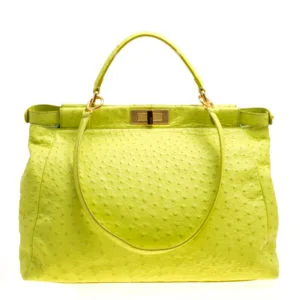
Neon has quietly taken over the accessories conversation this season. It started with sneakers, moved into outerwear, and now it’s landed squarely on handbags — the one category where a loud color choice actually gets remembered. A neon bag isn’t background noise on your arm; it’s the whole outfit’s focal point, which is exactly why we’re spotlighting this Fendi Peekaboo in electric ostrich green as our Bag of the Week.
This isn’t a bag we’re picking for shock value alone. The Peekaboo has spent over a decade earning its place next to the Baguette in Fendi’s design hierarchy, and exotic skins like ostrich push it into rarer territory than the calfskin versions most people encounter. If you’re shopping pre-owned exotics — and most Peekaboos worth buying today are pre-owned — you need to know what you’re paying for, how to spot a fake, and whether a color this bold actually holds value. That’s what we’re unpacking here.
The Peekaboo’s Rise from It-Bag to Fendi Icon #
Silvia Venturini Fendi, the house’s Creative Director of Accessories and Menswear, introduced the Peekaboo in the Spring 2009 collection. The name comes directly from the childhood game she grew up playing, and it’s a literal description of the bag’s function: the framed opening lets you glimpse the interior without fully unzipping or unbuckling anything. That’s a small mechanical idea, but it’s the detail that separates the Peekaboo from every other structured top-handle bag on the market.
By the time the style hit its 10th anniversary, it had already outgrown “it-bag” status. Trend-driven bags tend to have a shelf life of a few seasons before resale prices soften. The Peekaboo didn’t follow that pattern — it kept appearing on Meghan Markle, Angelina Jolie, Amal Clooney, and Rihanna years after its debut, which is usually the clearest signal a design has crossed into archive-classic territory rather than fad territory. Fendi has since expanded the line into multiple sizes and reinterpreted the silhouette (ISeeU, X-Lite) without discontinuing the original, which tells you the house treats it as a permanent pillar alongside the Baguette rather than a seasonal experiment.
Why Ostrich Leather Makes This Piece Rare #
Most Peekaboos you’ll see are calfskin, and calfskin is a perfectly good leather — durable, structured, easy to maintain. Ostrich is a different category entirely. The hide’s defining feature is the quill follicle pattern, the raised pores left where feather quills once grew, arranged across the skin in a way no embossing or printed texture can replicate. That texture is the tell: it’s the first thing an experienced buyer checks, and it’s the hardest thing for a counterfeiter to fake convincingly at scale.
Ostrich skin is genuinely scarcer than calf or even most exotic alternatives like python. Usable ostrich hides are smaller than cattle hides, which means more skins are needed to cut the panels for a single large-size bag, and the crown area with the most pronounced quill pattern is limited on each hide. That scarcity, combined with tanning that’s more labor-intensive than calfskin finishing, is why exotic Peekaboos carry a meaningful premium — often 2 to 3 times the price of the same size in calfskin, depending on colorway and hardware finish.
The honest downside: ostrich is more delicate than people expect. The pored surface can dry out and crack if it’s not conditioned, and it scuffs more visibly than smooth calf. If you’re buying exotic for the flex, know you’re also buying a slightly higher maintenance commitment.
Signature Hardware and Silhouette Details #
The Peekaboo’s hardware isn’t decorative flourish — it’s the mechanism that makes the bag work as designed. Here’s what defines the silhouette:
- Gold-tone turn locks — two locks sit at the top frame, one over each side compartment. Turning them releases the flap so you can “peek” into either side independently, without opening the bag fully.
- Framed top opening — the rigid frame is what gives the bag its structured, boxy stance rather than the slouch you’d get from a soft-sided tote.
- Single top handle — rolled or structured depending on the edition, sized for hand-carry rather than forearm carry.
- Detachable shoulder strap — clips in for hands-free wear and comes off cleanly when you want the bag to sit as a strict top-handle piece. This convertibility is a big part of why the style has stayed relevant across a decade of shifting carry preferences.
- Dual compartment interior — the inside is split into two independent sections divided by a central spine, each accessible through its own turn-lock flap. There’s typically a zippered or slip pocket on one interior wall for keys, cards, or a phone, plus a middle divider pocket depending on the generation.
For everyday use, the two-compartment layout is genuinely practical — you can keep essentials like your phone and cardholder in one side and bulkier items in the other, which cuts down on digging around. It fits a phone, compact wallet, sunglasses case, and a slim pouch comfortably in the regular size; the mini is closer to an evening-bag capacity, and the large gives you room for a light cardigan or a small tech pouch on top of daily basics.
How to Authenticate a Fendi Peekaboo Bag #
Exotic-skin Fendi bags attract counterfeiters precisely because the price gap between real and fake is so large. If you’re buying pre-owned, especially in ostrich, treat authentication as non-negotiable rather than a formality.
Leather grain and quill pattern #
Genuine ostrich quill pores are irregular in size and spacing and sit slightly raised from the surrounding leather. Printed fakes show a pattern that’s too uniform or too flat — run your fingertip across it; you should feel texture, not just see it.
Stitching #
Fendi’s stitching on the Peekaboo is straight, tight, and consistent in length, with no loose threads at stress points like the handle base or turn-lock anchors. Wavering stitch lines or visibly glued edges are a red flag.
Hardware stamping and weight #
Authentic turn locks and the interior FF logo plate should carry crisp, evenly depth-stamped engraving — not shallow or blurry. The hardware should also feel substantial; lightweight, tinny-feeling locks are a common tell on counterfeits.
Lock mechanism function #
This is a detail casual buyers skip. On a genuine bag, the turn locks rotate smoothly and the compartment flap releases with a clean, single motion. Stiff, gritty, or misaligned lock action often means either a fake or a genuine bag with hardware damage — either way, factor it into your offer.
Interior lining and date code #
Check the lining material and stitching quality match what’s expected for the production year, and look for the interior leather stamp with the size and material designation. If a seller can’t produce this or photos of it, treat that as a negotiating point, not a minor omission.
Provenance #
For exotics specifically, buy from resellers who authenticate in-house or through a third party, and ask for the original receipt or box when possible. The resale premium on exotic skins makes them the most heavily counterfeited tier of the entire Peekaboo line.
Price and Investment Value #
Pricing on the Peekaboo splits clearly along two lines: size and material.
By size (calfskin, approximate retail-adjacent range):
- Mini — the smallest, most casual version, generally the entry point into the line
- Regular/Medium — the size most people mean when they say “Peekaboo,” balancing capacity with a manageable footprint
- Large — the most structured and highest-capacity version, and the one most commonly produced in exotic skins
By material: calfskin sits at the base of the pricing tier, with python and other exotics above it, and ostrich typically at or near the top given hide scarcity and tanning cost. A large ostrich Peekaboo, like the neon green example here, commands several thousand dollars more than the equivalent calfskin large — this piece is listed at $9,600, which is representative of where exotic large-size Peekaboos land on the resale market.
On investment potential: the Peekaboo has held [[[resale value](/buying-guides/luxury-resale-condition-grades-explained/)](/brands/celine-luggage-tote-guide-sizes-history-resale-value-1/)](/brands/celine-luggage-tote-guide-sizes-history-resale-value/) better than most contemporary designer bags released in the same period, largely because it never became disposable-trend material and Fendi hasn’t oversaturated the market with it the way some houses do with logo pieces. Exotic skins tend to depreciate more slowly than calfskin in percentage terms, simply because the entry cost limits supply of well-kept pieces on the secondary market. That said, don’t buy any handbag purely as an investment vehicle — condition, completeness (dust bag, box, straps), and market appetite at time of resale all move the number more than the bag’s reputation alone.
How Bold Colorways Like Neon Green Impact Resale Value #
Statement colors are a genuine gamble in the resale market, and it’s worth being honest about that rather than assuming rare automatically means valuable. Neutral exotic Peekaboos — black, tan, deep burgundy — tend to be the safest resale bet because demand is broad and consistent. A neon green ostrich piece is a narrower audience: it appeals strongly to collectors and buyers who want a statement piece, but it won’t move as quickly as a neutral to a general buyer.
Where bold colorways do outperform is in scarcity-driven demand among collectors specifically. Fendi doesn’t run unusual color-and-skin combinations continuously, so a well-kept neon exotic can command strong resale within the smaller pool of buyers actively seeking a standout piece — sometimes closing the value gap with neutrals faster than you’d expect, because there’s simply less competing inventory. The tradeoff is liquidity: expect to wait longer to find the right buyer, even if the eventual price holds up. If resale speed matters more to you than resale ceiling, a neutral exotic is the safer buy; if you’re comfortable holding for the right offer, a striking colorway like this one has real upside precisely because so few exist.
FAQ #
Is ostrich leather ethical to buy? Ostrich farming for leather is regulated in major producing countries (primarily South Africa), typically as part of dual-purpose farming that also produces meat, which differs from skins-only exotic sourcing. If sourcing matters to you, ask sellers or Fendi directly about hide origin and farming certification — reputable exotic-skin houses can generally provide this. It’s a fair question to ask before buying any exotic piece, new or pre-owned.
How can I tell a real Peekaboo from a fake quickly? Check the quill texture on ostrich (should feel raised and irregular), the weight and stamping crispness of the turn-lock hardware, and stitch consistency at the handle base. If any of those feel “off,” walk away or request in-person authentication before paying.
Does the detachable strap affect the bag’s value? Yes — a missing strap is a completeness issue that will reduce resale price, since buyers expect the full set (bag, strap, dust bag, and ideally box) for the asking price to hold.
How do I care for ostrich leather day to day? Keep it away from direct sun and heat, condition it periodically with a leather conditioner suited to exotic skins, and avoid overstuffing since that stresses the quill pattern at the seams. Store it in its dust bag with the strap detached to avoid pressure marks.
Is the large size or the regular size the better buy? It depends on use. The large offers more room and a more commanding presence, which is part of why it’s the size most often produced in exotic skins, but the regular size is more practical for daily carry and slightly easier to resell given broader demand.
Related Articles #
- Fendi First Bag Guide: History, Design & Resale Value
- Prada Green Ostrich Leather Mini Crossbody: Bag of the Week
- Fendi Baguette: History, Value & Buying Guide
- Designer Handbag Trends 2025: What’s Actually Worth Buying
- Chanel Flap Bag Buying Guide: Sizes, Prices & Deals
Related guides
- Online Bag Authentication: What Photos Can and Cannot Prove
- Luxury Handbag Authentication Process Explained
- China TikTok Luxury Factory Claims: Fact vs Fiction
- Chanel 2.55 History, Details & How to Spot a Fake
- How to Buy an Authentic Luxury Bag from China Safely
- New vs Pre-Owned Luxury Bags: Which Route Is Right for You?
- Chanel Bag Guide: What to Know Before You Buy
- Luxury Bag Houses


Keyword index