Introduction: Meet the Fendi Peekaboo #
Some bags launch, sell well for a season, then fade into the archive. The Fendi Peekaboo did the opposite. Since its debut in 2009, it has held its place in the house’s lineup for over a decade and a half, outlasting most of the “it bag” cycle it was born into. That kind of staying power in [[[luxury handbags](/brands/fendi-first-bag-guide-history-design-resale-value/)](/buying-guides/hermes-retail-vs-resale/)](/buying-guides/luxury-handbag-trends-2024/) is rare, and it’s worth asking why.
Part of the answer is structural: the Peekaboo’s boxy, doctor’s-bag silhouette photographs well, sits confidently on a desk or a runway, and holds its shape better than most soft slouchy totes. Part of it is emotional: the turn-lock “eyes” and the peek of contrast lining give the bag a personality that’s hard to replicate. And part of it, frankly, is scarcity and price positioning — Fendi has kept the Peekaboo firmly in its top-tier icon category alongside the Baguette, which means it never got diluted through overexposure the way some competitor bags did.
If you’re considering a Peekaboo, whether new or pre-owned, this guide covers what actually matters: sizing, materials, day-to-day usability, resale behavior, and how to avoid getting burned by a fake. No filler, no marketing copy recycled from the runway notes.
From Runway to Icon: The Peekaboo’s Design Story #
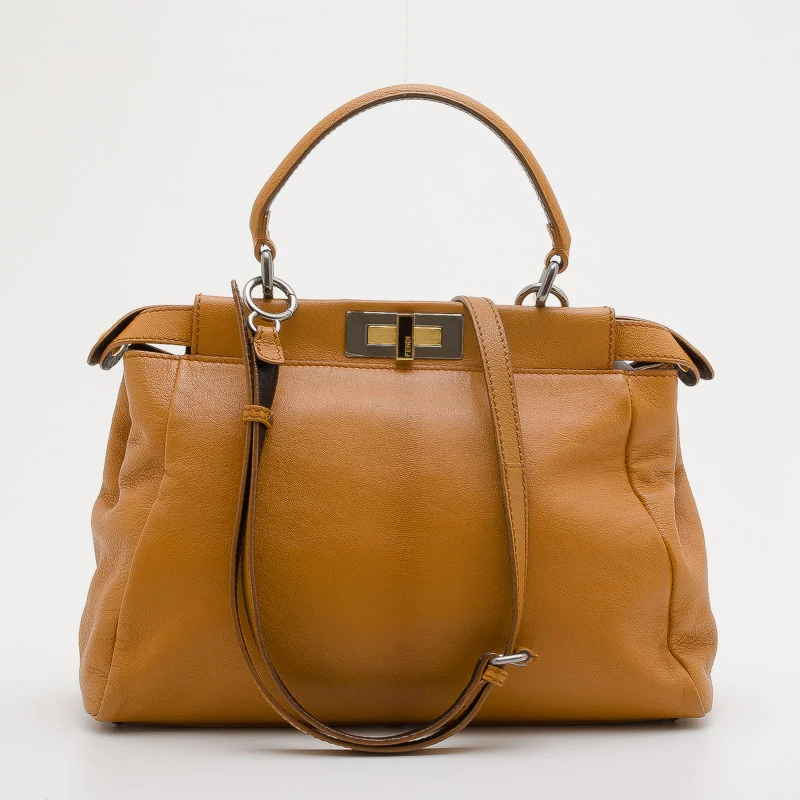
The Peekaboo entered the world in Fendi’s Spring/Summer 2009 collection, at a moment when the handbag market was saturated with logo-driven It bags. Silvia Venturini Fendi took the opposite approach: a structured, minimalist silhouette with almost no external branding, built around a clever mechanical detail instead — two turn-locks that could be opened or closed independently.
That restraint is exactly why it aged well. Bags defined by heavy logo print from that era look dated now; the Peekaboo, built around shape and hardware rather than monogram, still reads as current. Fendi leaned into that longevity by expanding the design methodically rather than flooding the market — regular and mini sizes, then the oversized “Peekaboo X-Lite,” then seasonal collaborations with artists and illustrators that used the bag’s front panel as a canvas.
By the mid-2010s, the Peekaboo had settled into the same tier as the Baguette: a permanent house icon rather than a seasonal product. It’s shown up consistently on runways and red carpets since, worn by figures from Kim Kardashian to Sarah Jessica Parker, and it remains part of Fendi’s core collection rather than a rotating trend piece — which matters if you’re buying it as a long-term investment rather than a fashion moment.
Signature Details: Turn-Lock, Lining, and Craftsmanship #
The Peekaboo’s identity comes down to three things: the lock, the lining, and the leather.
The turn-lock closures #
Two brass or palladium turn-locks sit at the top of the bag, each opening independently. This isn’t just a styling gimmick — it’s the functional core of the design. Closed, they give the bag a clean, almost architectural front. Open, they reveal the interior lining, which is often in a contrasting color or exotic skin. Check these locks closely on a pre-owned bag: they should turn smoothly with a firm, quiet click, not grind or stick. A loose or wobbly lock is one of the first things to inspect before buying secondhand.
The contrast lining #
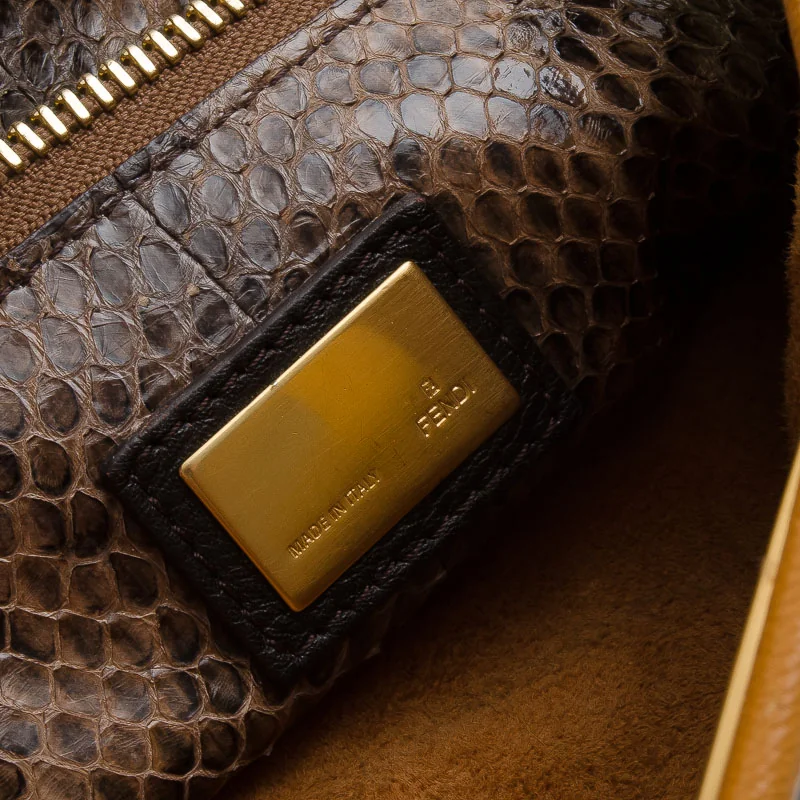
This is the detail most casual reviews skip past, but it’s the emotional payoff of the whole design. Fendi frequently lines the Peekaboo’s interior in a different leather or exotic skin from the exterior — a beige leather exterior with python or snakeskin lining is a classic combination, and one I still think is the most flattering pairing Fendi offers. The contrast is what makes the “open” styling work; without it, the bag would just look unzipped.
Materials and craftsmanship #
The Peekaboo has been produced in calfskin, nappa leather, patent leather, and exotic skins including python, crocodile, and ostrich, plus seasonal fabrications like raffia or shearling for limited runs. Exotic-skin versions carry noticeably higher price tags and typically ship with CITES documentation, which matters both for resale and for legal import/export in some countries. Construction is structured rather than slouchy — a rigid base, reinforced corners, and a top handle with enough stiffness to let the bag stand upright on its own. That structure is part of why the bag holds shape well over years of use, but it also means it’s less forgiving if it’s overstuffed or dropped hard.
One Bag, Two Moods: Styling the Peekaboo Open or Closed #
This is the bag’s real party trick, and it’s worth understanding before you buy, because it affects which color and lining combination makes sense for your wardrobe.
Closed, the Peekaboo is quiet and polished. The turn-locks sit flush, the silhouette is clean, and it reads as appropriate for client meetings, boardrooms, or conservative offices. A neutral leather exterior — beige, black, cognac — in this mode looks like a serious, grown-up bag rather than a statement piece.
Open, it’s a different bag entirely. Unlocking the turn-locks and letting the flaps fall open exposes the contrast lining, and suddenly a fairly conservative beige leather bag has a flash of python running through it. This is the version that works for evening, for dinner, for anything where you want the bag to do a bit of the talking. I’ve found this is genuinely useful in a way that a lot of “versatile” marketing claims aren’t — you’re not swapping straps or accessories, just flipping two locks, and the bag transforms in about five seconds.
If you only own one Peekaboo, this is the strongest argument for choosing a two-tone or contrast-lined version over a monochrome one. A single-color bag closed and open looks almost identical; a contrast bag genuinely gives you two distinct looks out of one piece.
What to Know Before You Buy: Value and Authenticity #
Price and sizing at a glance #
| Size | Approx. Dimensions | New Retail (Leather) | Pre-Owned Range |
|---|---|---|---|
| Mini | ~21 x 15 x 9 cm | $4,200–$4,800 | $2,200–$3,500 |
| Regular | ~29 x 21 x 13 cm | $5,200–$6,200 | $2,800–$4,200 |
| Large | ~34 x 24 x 15 cm | $5,800–$6,800 | $3,000–$4,500 |
These figures are approximate and shift with leather type, hardware finish, and current retail pricing, which Fendi has raised multiple times over the past several years. Exotic skins (python, crocodile) run substantially higher — often 1.5 to 3 times the leather price new, and they tend to hold value better on the resale market because supply is inherently limited.
Resale value trends #
The Peekaboo doesn’t hold value quite as aggressively as Hermès icons like the Kelly or Birkin, but it performs well against most other designer contemporaries. Classic neutral colorways (black, beige) in regular size with good hardware condition tend to retain 55–70% of retail value in good pre-owned condition. Limited editions, exotic skins, and rare collaboration prints can occasionally sell above original retail, particularly discontinued colorways. Mini and X-Lite sizes have softened somewhat in resale demand compared to five years ago, as buyer preference has shifted toward slightly larger everyday bags.
Authentication checkpoints #
Buying pre-owned is where most of the risk lives, and the Peekaboo is counterfeited often enough that a careful check matters:
- Turn-locks: Authentic hardware has crisp, evenly weighted engraving and a smooth, controlled turning action. Fakes often feel light, loose, or have shallow, blurry stamping.
- Interior stamp: Genuine bags carry a “FENDI Made in Italy” stamp with consistent font spacing and depth. Check for a serial number tag as well, though Fendi’s internal tracking has changed over the years, so absence alone isn’t conclusive — pair it with other checks.
- Stitching: Look for even, tight stitching along the base and handle attachment points. Fendi’s stitch count per inch is notably consistent; visibly uneven spacing is a red flag.
- Lining seam work: On contrast-lining bags, the seam where the exterior leather meets the lining should be clean and reinforced, not just glued or loosely stitched.
- Leather smell and texture: Genuine calfskin has a distinct, non-chemical leather smell and a slightly cool, dense feel. Fakes often use bonded or coated leather that feels plasticky.
- Weight: Authentic Peekaboos, especially in regular and large sizes, are heavier than expected because of the internal frame and hardware. A suspiciously light bag is worth a second look.
When in doubt, buy from a reseller who offers a written authenticity guarantee and, ideally, third-party authentication documentation — it’s worth the small premium for a bag in this price bracket.
The Story Behind ‘Peekaboo, I See You’: Name and Design Meaning #
The name isn’t just a cute marketing line — it describes exactly how the bag behaves. “Peekaboo” refers directly to the reveal-and-conceal function of the twin turn-locks: closed, the bag keeps its interior hidden; opened, it “peeks” out the contrast lining underneath. Silvia Venturini Fendi built the entire design brief around that idea of a bag with a secret, a hidden layer of personality tucked under a composed exterior.
That playfulness is easy to miss if you only see the bag in product photography, where it’s almost always shown closed and styled conservatively. In person, the name clicks the moment you open the locks and see a flash of python or a bold contrast color where you expected plain lining. It’s a small piece of branding that actually informs the design decision, rather than being tacked on after the fact — which is part of why the “open or closed” styling story has stayed relevant for over fifteen years rather than reading as a gimmick.
Real-World Review: Everyday Functionality and Interior Layout #
Marketing photography rarely shows how a bag behaves after six months of actual use, so here’s what matters day to day.
Opening width: The turn-lock mechanism means the bag doesn’t open as wide as a zip-top tote. Digging for something at the bottom of a Peekaboo, especially in the mini size, takes a bit more patience than a bag with a full-width zipper.
Interior organization: Regular and large sizes typically include a zippered center compartment flanked by two open side pockets, plus a smaller slip pocket. This center divider is genuinely useful — it keeps a phone or cardholder from sliding around loose with keys and lip balm — but it does eat into usable width, so the bag carries less than its exterior dimensions suggest.
Weight when loaded: Because of the structured frame, an empty Peekaboo already has some heft. Loaded with daily essentials (phone, wallet, sunglasses case, small pouch), the regular size sits comfortably on the shoulder for a few hours but starts to feel noticeable on longer wear days. If you’re prone to shoulder or back strain, the mini is lighter but sacrifices real capacity.
Top handle vs. strap: The signature top handle is short — meant for hand-carry or crook-of-the-arm wear, not shoulder wear. Most Peekaboos come with a detachable, adjustable shoulder strap, which is worth using regularly; carrying it exclusively by the top handle for long stretches puts uneven stress on the handle attachment points over years of use.
Base wear: The structured base means the bag stands on its own, which is convenient, but it also means the four corners and base edges take the brunt of daily wear. On pre-owned bags, base corner wear is one of the most reliable indicators of how gently (or roughly) a bag was actually used, regardless of what the seller claims.
FAQ: Your Fendi Peekaboo Questions Answered #
Is the Fendi Peekaboo a good investment bag? It holds value reasonably well, particularly in classic colors, exotic skins, and discontinued limited editions, but it doesn’t appreciate the way an Hermès Kelly or Birkin can. Think of it as a bag that depreciates slowly rather than one that gains value.
What’s the difference between the Peekaboo Mini and the Regular? Beyond the obvious size difference, the mini trades practical capacity for a more compact, evening-friendly silhouette. If you want an everyday bag that fits a tablet or larger wallet comfortably, the regular or large size is the better call.
How does the Peekaboo compare to the Fendi Baguette? The Baguette is smaller, softer-structured, and closer to a true evening or occasion bag, with its identity built around the elongated shape and often heavy embellishment. The Peekaboo is more structured and versatile for daily use, with its identity built around function (the turn-locks) rather than shape alone. If you need one bag that works for both office and evening, the Peekaboo is the more practical choice; the Baguette leans more decorative.
How does the Peekaboo compare to the Fendi By The Way? The By The Way is a more casual, less structured bag aimed at younger, everyday buyers, with a lower price point and simpler hardware. It doesn’t carry the same icon status or resale strength as the Peekaboo. If budget is a major factor and you want a Fendi bag for daily casual use, the By The Way is reasonable; if you want a piece with stronger long-term recognition and resale performance, the Peekaboo is the stronger buy.
What leather is easiest to maintain? Smooth calfskin in darker or neutral tones is the most forgiving for daily wear and shows less visible surface wear than lighter colors or exotic skins. Exotic skins like python require more careful handling and occasional professional conditioning, and they’re more sensitive to dryness and direct sunlight.
Where should I buy a pre-owned Peekaboo safely? Stick to resellers who provide authentication guarantees, clear high-resolution photos of the interior stamp and hardware, and a return policy. Avoid listings with only exterior photos or vague descriptions of “leather” without specifying the type — that’s often a sign the seller either doesn’t know or is avoiding scrutiny.
Related Articles #
- Fendi Baguette: History, Value & Buying Guide
- Hermès Kelly Clutch: Smartest Entry Into Luxury Bags
- 5 Fendi Baguette Bags Worth Buying Secondhand
- Dolce Gabbana Miss Sicily Bag: Why It Still Wins
- Best Hermès Birkin Bags to Invest in Right Now
Related guides
- Online Bag Authentication: What Photos Can and Cannot Prove
- Blue Crocodile Lady Dior Tote: Buying Guide
- Chanel Vintage Flap Bag Buying Guide: Navy Lambskin
- Louis Vuitton Palm Spring Backpack: Complete Buyer's Guide
- How to Buy an Authentic Luxury Bag from China Safely
- New vs Pre-Owned Luxury Bags: Which Route Is Right for You?
- Chanel Bag Guide: What to Know Before You Buy
- Luxury Bag Houses


Keyword index