Introduction #
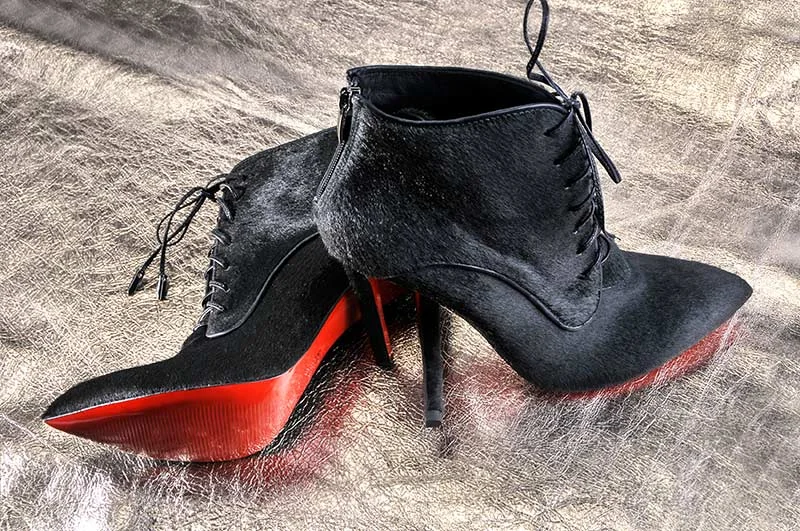
Flip over almost any statement pump on a red carpet and there’s a decent chance you’ll find a lacquered red sole staring back at you. That flash of color has become one of the most recognized design signatures in fashion, right up there with a Birkin’s turn-lock or a Kelly’s saddle stitching. Christian Louboutin built that recognition from nothing, and understanding how he did it matters for more than nostalgia. It’s a masterclass in brand-building through a single, obsessively protected detail, and it’s also a cautionary tale for anyone shopping resale markets, because nothing gets counterfeited faster than a symbol everyone can identify at a glance. This is the story of how a French designer with no formal training turned a museum warning sign, a bottle of nail polish, and a sharp legal team into a shoe empire, and what that history actually means when you’re trying to tell a real pair from a convincing fake.
Early Life and the Spark of Inspiration #
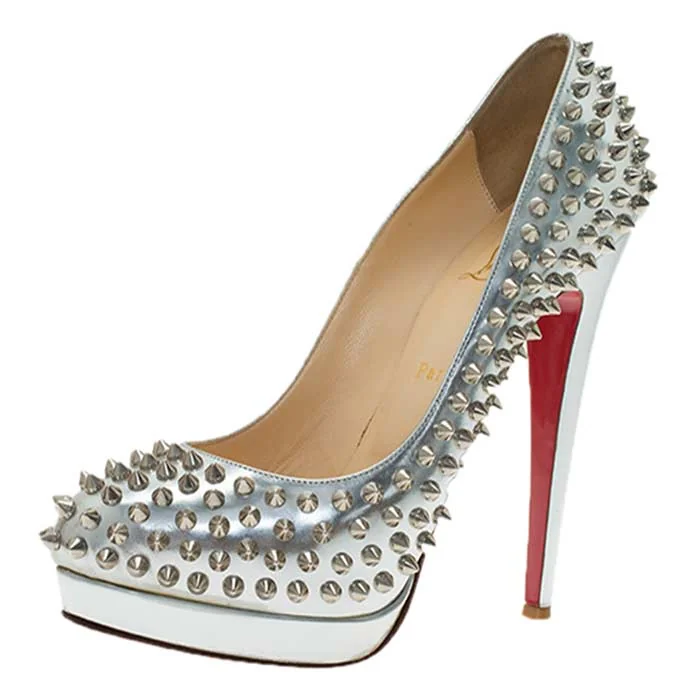
Louboutin grew up in Paris, raised by his mother alongside three sisters, in a household he’s credited with shaping his eye for femininity long before he ever picked up a last or a lacquer brush. School didn’t interest him much, and by his own account he was expelled multiple times, which is not the typical origin story you’d expect from a designer whose name now sits on flagship boutiques from Paris to Dubai.
The real turning point came almost by accident. On a visit to the Musée des Arts Africains et Océaniens, Louboutin noticed a museum sign, a woman’s stiletto with a red diagonal line struck through it, warning visitors not to wear heels that could damage the hardwood parquet floors. It’s a small, bureaucratic detail, the kind most people walk past without a second glance. Louboutin didn’t. He later said he’d never seen a shoe rendered quite that way, and the image stuck with him for years. He started filling notebooks with his own sketches of women’s shoes, and a book by Roger Vivier, the designer behind some of Christian Dior’s most sculptural footwear, gave him a second push toward the craft. Between a discarded family life, stints living abroad in Egypt and India, and an eventual return to Paris, the notebooks kept filling. That’s the part of the story that gets flattened in most brand bios: Louboutin wasn’t chasing a fashion career in any conventional sense. He was chasing a specific, half-formed image of a shoe that didn’t exist yet.
Learning the Craft: From Folies Bergère to Haute Couture Houses #
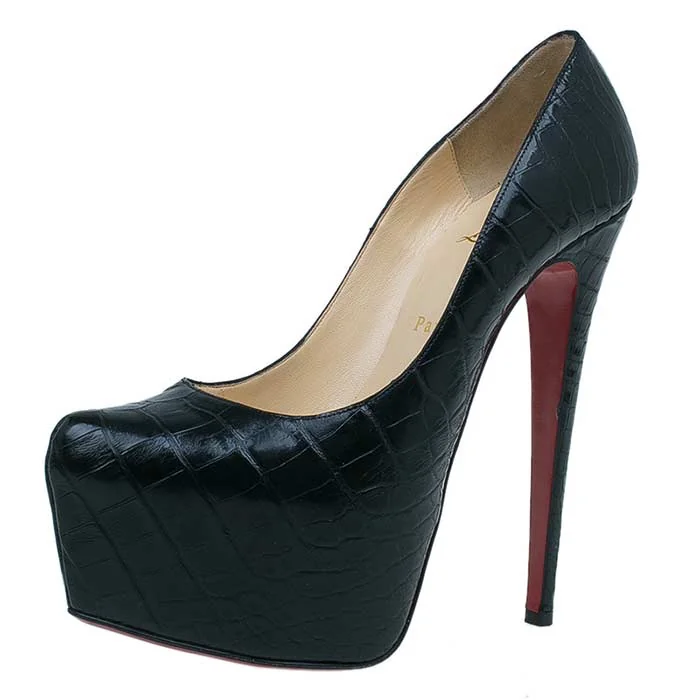
Design instinct doesn’t build a brand on its own, and Louboutin’s actual technical education came from an unlikely classroom: the Folies Bergère, the famed Parisian cabaret. He took odd jobs there, and one of them was designing and adjusting shoes for the dancers. Cabaret footwear has to survive things runway shoes never face, hours of continuous movement, extreme angles, repeated wear across a run of shows, and that gave Louboutin a practical education in construction and durability that a design school wouldn’t have offered.
That hands-on grounding led to a formal apprenticeship with Charles Jourdan in Romans, a manufacturer that was producing shoes for the house of Christian Dior at the time. From there, Louboutin moved into freelance work with three very different design houses: Chanel, [[Yves Saint Laurent](/buying-guides/designer-black-gowns-morticia-addams-goth-glamour/)](/buying-guides/best-ysl-bags-worth-the-investment-2025/), and Maud Frizon. Each house had its own construction logic and its own idea of what a shoe was supposed to do for a woman’s silhouette, and bouncing between them gave Louboutin a working vocabulary that few young designers get access to before launching their own label.
Oddly, he almost walked away from footwear entirely. He pursued landscape architecture for a stretch and wrote features for Vogue, and it’s worth sitting with that detour, because it tells you his relationship to shoe design wasn’t a straight, inevitable line. He came back to it because he missed it, not because it was the only path available to him.
The Birth of the Iconic Red Sole #
Louboutin opened his own boutique in the Galerie Véro-Dodat, a quiet, elegant arcade near the Louvre, with two friends backing the venture. The shoes were well made and well received, but for the first couple of years, they didn’t have the one detail that would eventually define the entire brand.
That detail arrived in 1993, roughly two years into the business, through pure improvisation. Louboutin was unhappy with a prototype he was working on, feeling it lacked the visual energy he wanted from the sole. His assistant happened to be painting her nails a bright red nearby. He grabbed the bottle and coated the sole of the prototype on the spot. The change was immediate and, in hindsight, obvious: a plain black or neutral sole is functional, but a lacquered red one turns the underside of a shoe into a signature, something meant to be seen when a woman crosses her legs, steps out of a car, or kicks up a heel on a dance floor.
Louboutin has been consistent about why red specifically stuck: it reads as confident, a little provocative, unmistakably alive in a way that neutral tones aren’t. What’s easy to miss in the retelling is how commercially strange the decision was at the time. Branding the bottom of a shoe, the one surface you’d assume nobody cares about, ran against every convention of shoe design, which is exactly why it worked. By the time the label caught on, that red sole had gone from a happy accident to the single most valuable asset the company owned.
From Paris Boutique to Global Icon #
A distinctive product only becomes a global brand when the right people start wearing it in public, and Louboutin’s rise tracks closely with a run of high-visibility celebrity adoption through the 1990s and 2000s. Red carpet appearances did more for brand recognition than any advertising campaign could have, because the shoes were doing exactly what they were designed to do: getting noticed the moment a heel lifted off the ground.
By 2011, Christian Louboutin had become the most searched footwear brand online, a milestone that reflects just how much cultural traction the red sole had built by that point. That kind of search demand is also, from a market-watching standpoint, a leading indicator of counterfeit activity. Whenever a brand’s visual signature becomes searchable shorthand for luxury, counterfeiters follow the demand curve almost immediately. The brand’s expansion into menswear, handbags, and accessories through the 2000s and 2010s widened that exposure further, giving the red sole a presence well beyond stiletto pumps, and giving counterfeiters more categories to target.
The lesson for shoppers isn’t subtle: cultural ubiquity and counterfeit risk rise together. The more recognizable a design element, the more valuable it becomes to replicate badly and sell as real.
Spotting the Real Deal: Authenticity Cues for Louboutin Red Soles #
This is where brand history turns into practical buying knowledge, and it’s the part most casual write-ups skip entirely.
The lacquer finish and wear pattern. Genuine Louboutin soles are coated in a specific lacquer that has a glassy, slightly glossy depth to it, not a flat, painted-on look. On a new or lightly worn pair, the color should be even and rich, without visible brush strokes or thin patches. On a worn pair, check how the color fades: authentic lacquer tends to scuff and thin at natural pressure points (the ball of the foot, the heel tip) rather than peeling in sheets or flaking off in large chips. Peeling paint in large flakes is one of the more reliable red flags for a cheap aftermarket dye job on a fake or a poorly re-soled real shoe.
Color consistency and tone. Louboutin’s red has a specific, somewhat orange-leaning warmth to it that’s stayed fairly consistent across decades of production. Counterfeits frequently get the shade wrong, either too bright and cherry, too dark and brownish, or too matte. If you’re comparing a pair against reference photos, look at the shoe in natural daylight, not under warm indoor lighting, which flatters almost any shade of red.
Sole material and stamping. Authentic soles have a slightly textured, almost leather-like grain beneath the lacquer, and genuine pairs carry clear, evenly spaced size stamps and a “Christian Louboutin” or “Loubi” branding stamp with crisp, consistent lettering. Blurry stamping, inconsistent font weight, or stamps that look pressed at an angle are common tells on counterfeit production.
Construction and stitching. Check the upper’s stitching for even spacing and tension, and look at how the sole meets the upper. Louboutin’s construction is generally clean and tight at this seam. Gaps, visible glue residue, or uneven stitch length suggest a rushed counterfeit build.
Weight and insole details. Genuine Louboutins tend to have a consistent, somewhat substantial weight to the construction, and the insole lettering, leather quality, and logo placement should match verified reference images for that specific style and season, since Louboutin has changed labeling details over the years.
None of these checks are foolproof in isolation, which is exactly why serious authentication services cross-reference multiple points, stitching, stamping, lacquer texture, hardware where applicable, and known production details for that specific model and release year, rather than relying on any single tell. If you’re buying pre-owned and the price seems unusually low for the style, treat that as a prompt to authenticate before you buy, not after.
The Red Sole Trademark: Legal Precedent and What It Means for Fashion #
The red sole isn’t just a design flourish, it’s a registered trademark, and defending that trademark required one of the more closely watched fashion IP cases of the past two decades.
In 2011, Louboutin sued Yves Saint Laurent after YSL released a collection of monochrome shoes that included an all-red style with a red sole. Louboutin argued the red sole was a protected trademark and that YSL’s shoe infringed on it. YSL countered that a single color used functionally within a design shouldn’t be monopolized by one brand, and a district court initially agreed, finding fashion color usage too broad to trademark on its own.
Louboutin appealed, and the Second Circuit Court of Appeals reached a more nuanced outcome in 2012. The court upheld Louboutin’s trademark, but narrowed its scope: the red sole is protected specifically when it contrasts with a different colored upper. Because YSL’s shoe in question was monochromatic, red sole and red upper together, the court found no infringement in that specific case. Louboutin kept its trademark, YSL kept its monochrome red shoe, and fashion law got a clearer, if narrower, precedent.
That distinction matters beyond this one case. It set a workable standard for single-color trademarks in fashion, showing that a color can function as a brand identifier when it’s used in a distinctive, non-functional way, contrast being the key word, rather than as a blanket claim over a color itself. Other brands have since pointed to the case when litigating their own color or pattern trademarks, and it remains one of the standard teaching examples in fashion law courses on non-traditional trademarks. For shoppers, the practical takeaway is simpler: the red sole’s legal protection is specifically tied to that contrast presentation, which is one more reason counterfeiters try to replicate the exact tone and finish rather than just slapping red paint on any sole they can find.
FAQ #
Is Christian Louboutin a self-taught designer? Largely, yes. He had no formal fashion design degree. His training came from hands-on work designing shoes for cabaret dancers at the Folies Bergère, an apprenticeship with manufacturer Charles Jourdan, and freelance stints with Chanel, Yves Saint Laurent, and Maud Frizon before he opened his own house.
Why are Louboutin soles red? The color originated in 1993 when Louboutin, unsatisfied with a prototype’s plain sole, used a bottle of his assistant’s red nail polish to coat it on impulse. He kept the color because he associates red with energy and confidence, and it became the brand’s permanent signature from that point on.
Can you legally trademark a shoe color? Yes, but narrowly. Following Louboutin’s case against Yves Saint Laurent, U.S. courts confirmed the red sole trademark applies specifically when the red sole contrasts with a different colored upper, not to all-red shoes where the sole and upper match.
How can I tell if my Louboutins are real? Check the lacquer finish for depth and evenness rather than a flat painted look, compare the red tone against verified reference photos in daylight, inspect stamping and stitching for crisp, consistent quality, and check the insole branding against known details for that specific style and year. When in doubt, especially for a resale purchase, use a professional authentication service before finalizing the sale.
Does Louboutin only make women’s shoes? No. The brand has expanded well beyond its original women’s footwear into menswear, handbags, and accessories, though the red sole remains its most recognized signature across categories.
Where should I buy pre-owned Louboutin shoes safely? Stick to resale platforms and consignment sellers that offer third-party or in-house authentication and clear return policies if a pair fails verification. Cross-check listing photos against the authenticity points above before you buy, and be cautious of prices that sit well below typical resale value for that style and condition.
Related Articles #
- 5 Iconic Bags Named After Famous Women (Buying Guide)
- How to Spot Fake Christian Louboutin Shoes: Guide
- Ralph Lauren Brand History: The Story Behind the Icon
- Saint Laurent Opyum Pumps: Style, Fit & Resale Value
- Lady Dior Bag: The Story Behind Princess Diana’s Icon
Related guides
- Online Bag Authentication: What Photos Can and Cannot Prove
- Inside a Million-Dollar Closet: Pre-Loved Hermès & More
- Meet Marwa Azzam Aldabbagh: Kelly Bag Authentication Expert
- Luxury Handbag Authentication Process Explained
- How to Buy an Authentic Luxury Bag from China Safely
- New vs Pre-Owned Luxury Bags: Which Route Is Right for You?
- Chanel Bag Guide: What to Know Before You Buy
- Luxury Bag Houses


Keyword index