Introduction: A Glimpse Into the Million Dollar Closet #

A hotel suite at the Kempinski Mall of the Emirates doesn’t usually double as a vault, but that’s exactly what it became for one evening last week. The Luxury Closet turned a guest room into a staged version of a very well-off woman’s dressing room, complete with a Marchesa gown positioned like the centerpiece of a private collection. Editors, bloggers and a handful of fashion press moved through racks and vitrines that, added up, likely crossed seven figures in resale value.
We were on the guest list, and what struck us wasn’t just the volume of designer names in one room. It was the security. Guards stood next to specific pieces the way museums position them next to a Rothko, not next to a handbag. That alone tells you something about where the pre-loved luxury market in the UAE has landed: these aren’t cast-offs being liquidated, they’re assets being curated.
This recap walks through what was on display, why certain pieces (Hermès especially) draw that kind of protection, and — more usefully for anyone reading this because they’re actually shopping the pre-owned market — how to tell a real vintage Hermès bag from a convincing fake before you spend real money on one.
Inside the Suite: Designer Highlights From Hermès to Chanel #
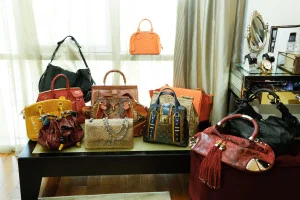
The room was organized less like a showroom and more like a survey of what currently moves in resale. Hermès and Chanel anchored the display, flanked by Dolce & Gabbana, Herve Leger, Valentino, Zuhair Murad and Chopard. Rather than list every tag, it’s more useful to group what these houses represent to a resale buyer:
- Hermès and Chanel — the two brands that hold value longest in secondary markets, largely because of controlled production and consistent demand outpacing supply.
- Herve Leger and Valentino — strong in eveningwear resale, where construction quality and limited seasonal runs keep pieces desirable years after release.
- Zuhair Murad — red-carpet-driven pieces that resell well specifically because of visibility (worn by someone photographed), not just craftsmanship.
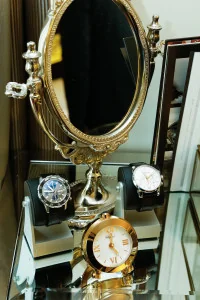
- Chopard — the fine jewelry and watch presence, which behaves more like an investment category than a fashion one.
One handbag, from Dior, was flagged as the only example of that particular style available anywhere in the UAE at the time. Scarcity like that is precisely what pushes a bag from “nice accessory” to “asset a security guard stands next to.” The room also had a strong showing of exotic skins — crocodile, ostrich, lizard — which carry their own authentication and care complications that are worth a separate conversation entirely.
Why Vintage Hermès Pieces Command Attention #
Of everything guarded that night, the vintage Hermès pieces got the most attention, and not by accident. Hermès has built its resale strength on three things that are hard to fake convincingly: leather sourcing, hand-stitching, and hardware.
The Kelly, in particular, is a useful case study for why these bags hold value decades after production. The turn-lock closure, the strap construction, the saddle-stitched seams — all of it was originally designed for function (the bag was named for a rider’s saddlebag lineage before it was named for Grace Kelly), and that functional design is exactly what’s difficult to replicate at scale. Cheap copies fake the silhouette. They rarely get the hardware weight, the stitch spacing, or the leather grain right.
Hardware is where a lot of vintage Hermès pieces get evaluated most closely by buyers who know what they’re looking at. Genuine gold and palladium-plated hardware has a specific heft and a plating that ages in a particular way — it dulls evenly rather than flaking or discoloring in patches. That’s part of why a well-kept vintage Kelly or Constance can command more attention (and more money) than a brand-new bag from a less established house. Age, on a genuine Hermès piece, reads as provenance rather than wear.
The Rise of Pre-Loved Luxury in the UAE #
Kunal Kapoor, CEO of The Luxury Closet, framed the event around a shift he’s watched happen in real time: UAE consumers moving from “buy new, discard old” toward treating designer pieces as things that hold and transfer value. In his words, people are increasingly comfortable seeing pre-loved luxury goods as legitimate purchases, not compromises.
That shift shows up on both sides of the transaction. Some clients bring in an entire wardrobe at once, either to swap for a fresher edit or to convert closet space into cash. Others come with a single item — a bag or a watch that barely left the box — looking for a straightforward sale.
For sellers, the process generally works one of two ways. Consignment means the platform lists and sells the item on the owner’s behalf, taking a commission once it sells, with the owner retaining ownership until then. A direct buyout means the platform purchases the item outright, on the spot or after inspection, for a set price — faster cash, typically at a lower payout than consignment because the platform is taking on the resale risk itself. Which route makes sense depends on how quickly someone wants to be paid versus how much they’re willing to wait for a better final price.
This regional appetite tracks with what’s happening globally: the secondhand luxury market has been growing faster than the primary luxury market for several years running, driven by younger buyers who see resale as the smarter entry point into brands like Hermès and Chanel rather than a discount bin.
How to Authenticate a Vintage Hermès Bag Before You Buy #
Counterfeiters have gotten good. “Good enough to fool someone who’s only glanced at a few Instagram posts” is a low bar; getting past someone who has handled dozens of authentic bags is a different story. A few checks matter more than others:
Blind stamp and date stamp. Every Hermès bag made since the 1970s carries a stamped letter (or letter combination) inside, indicating the production year, alongside a craftsman’s blind stamp. The font, spacing and depth of this stamp is consistent across genuine bags of the same era — shallow, uneven, or oddly spaced stamping is a red flag.
Stitching. Hermès uses a saddle stitch, sewn by hand with a single waxed thread pulled through from both sides. It’s slightly irregular by nature but even in tension. Machine-stitched lookalikes are too perfectly uniform or, conversely, sloppy in a different way than hand stitching is sloppy.
Hardware weight and plating. Pick it up. Genuine hardware has real heft because it’s solid metal with plating, not lightweight base metal. Fakes often feel noticeably lighter or have plating that looks too shiny and even, without the slight dulling genuine gold or palladium hardware shows with age.
Leather grain and smell. Hermès uses specific tanneries and leather types (Togo, Epsom, Clemence, box calf, among others) with recognizable, consistent grain patterns. A too-perfect, plastic-feeling grain, or a chemical smell instead of a leather one, is a warning sign.
Symmetry. Genuine Hermès bags are famously precise. Handles, straps and hardware placement should be perfectly even on both sides. Asymmetry, however minor, is one of the more reliable tells on a poorly made counterfeit.
None of these checks is foolproof on its own. Together, they’re the difference between a confident purchase and an expensive mistake.
Buying Advice: What to Look For in Pre-Owned Luxury Pieces #
The menswear side of the event — satchels, belts, loafers, a run of Rolex watches, and a set of designer trainers from Dior, [Alexander McQueen](/brands/alexander-mcqueen-brand-history/) and Jimmy Choo priced just under Dh1,000 — deserves its own set of buying instincts, since leather goods, watches and footwear each fail (or hold up) in different ways.
Leather goods (satchels, belts): Check the edges first. Genuine leather edge paint or burnishing wears in a specific, gradual way; bonded or coated leather cracks and peels rather than fading. Look at corners and handle attachment points, which take the most stress and show quality (or lack of it) fastest.
Loafers and footwear: Sole wear tells you more than the upper does. A resoled shoe, done well, is fine and often a sign the owner cared for a good pair. A resoled shoe done poorly, with visible glue lines or mismatched stitching, suggests either heavy use or a repair job that will need redoing soon.
Watches: This is the category where third-party verification matters most. Serial numbers, movement inspection, and box/papers (or lack of them) affect both authenticity confidence and resale value down the line. A Rolex without papers isn’t necessarily fake, but it is worth less and harder to verify quickly — factor that into any price you’re offered.
Trainers and accessories: Lower price points (like the sub-Dh1,000 trainers shown at the event) mean lower risk if something goes wrong, but it’s still worth checking box labels, stitching consistency, and sole texture against reference images from the brand’s official release, since sneaker counterfeiting is nearly as sophisticated as handbag counterfeiting at this point.
Across every category, condition grading matters more in resale than most first-time buyers expect. “Good condition” from one seller and “good condition” from another can mean very different things — ask for close-up photos of corners, hardware, interior lining and soles before you commit.
How to Authenticate a Pre-Loved Hermès Bag Step-by-Step #
Beyond the general checks above, here’s a more concrete sequence to actually run through when you’re evaluating a specific bag, whether you’re buying from a platform, a consignment boutique, or a private seller:
- Verify the stamp combination against the year. Cross-reference the letter (or letter pair, for bags made after 2015) inside the bag with published Hermès date stamp charts. If the seller’s stated age doesn’t match the stamp, that’s your first stop sign.
- Inspect the hardware for plating type. Ask specifically whether it’s gold, palladium, or another finish, then check that the color and wear pattern match. Palladium doesn’t tarnish yellow; if a “palladium” bag shows yellowing, something’s off.
- Examine the interior craftsman’s stamp. This is separate from the date stamp and identifies the individual artisan. It should be crisp and consistently placed — not smudged, doubled, or oddly centered.
- Feel the leather, don’t just look at photos. If buying online, request video, not just stills. Genuine Hermès leather has a specific give and grain depth that’s very hard to capture convincingly in a still photo but shows up in movement.
- Check turn-lock and clasp mechanism action. On a Kelly or Birkin, the lock should engage smoothly with a solid, satisfying click. Loose, sticky, or misaligned locks suggest either a low-quality counterfeit or serious wear that affects usability.
- Confirm stitch count and pattern at the base. Genuine bags maintain a consistent stitch density along seams. Irregular gaps or thread thickness changes mid-seam are common on factory counterfeits trying to save production time.
- Ask for or run third-party authentication. Services like Entrupy (which uses microscopic imaging and AI matching against a verified database) or Real Authentication (human expert review) offer a report for a flat fee, typically far cheaper than the cost of buying a fake. Most reputable resale platforms build this into their process before a bag is ever listed — which is worth confirming directly with any platform before you buy, since not all of them apply the same rigor.
- Review the provenance paperwork, if any exists. Original receipt, dust bag, box, or CITES documentation (required for exotic skins like crocodile) all add confidence and resale value, even though their absence doesn’t automatically mean a bag is fake.
Price Comparison: Fashionphile vs Vestiaire Collective vs The RealReal #
Once a bag has passed authentication, price is the next variable, and it shifts noticeably depending on where you shop. These three platforms are the most commonly compared by Hermès resale buyers, and each takes a different approach:
| Platform | Authentication approach | Typical pricing position | Seller payout model | Notable tradeoff |
|---|---|---|---|---|
| Fashionphile | In-house team of authenticators, physical inspection before listing | Generally the highest asking prices, reflecting curated inventory and buy-outright model | Direct buyout — sellers get paid upfront, platform absorbs resale risk | Fastest cash for sellers, but lower payout than consignment elsewhere |
| Vestiaire Collective | Combination of in-house checks and, for high-value items, a “Certified” authentication add-on | Wider price range, since it’s peer-to-peer with platform oversight | Consignment — seller sets price, platform takes a commission on sale | Best for finding a deal, but authentication rigor varies by price tier and item category |
| The RealReal | Dedicated authentication centers with trained specialists for handbags, jewelry and watches | Mid-to-high, generally between Fashionphile and Vestiaire | Consignment — commission scales down as item value goes up | Strong authentication track record, but commission structure can eat into payout on lower-value items |
The practical takeaway: if you want the highest confidence in authentication with minimal legwork, Fashionphile and The RealReal both build verification into every listing before it goes live. If you’re comfortable doing some of your own diligence (using the steps above) in exchange for potentially better pricing, Vestiaire Collective’s peer-to-peer model can turn up better deals, particularly on items that don’t qualify for their premium Certified service. None of these figures are fixed — fees and commission tiers change periodically on all three platforms, so it’s worth checking current terms directly before listing or buying.
How to Get Invited to Future Preview Events #
Events like The Million Dollar Closet aren’t advertised widely in advance — invitations tend to go out through platform newsletters, Instagram followings, and existing client relationships first. If attending one interests you, following the brand’s social channels and signing up for email updates is currently the most reliable way to hear about the next one before it’s fully booked.
FAQ #
Is buying a pre-loved Hermès handbag actually safe? Yes, provided it comes with real authentication, either from the platform’s own team or a third-party service like Entrupy or Real Authentication. The risk isn’t in buying secondhand — it’s in buying from a seller who skips verification.
Do vintage Hermès bags lose value over time? Rarely, and often the opposite. Well-maintained Birkins and Kellys have historically outpaced inflation and, in some cases, outperformed traditional investment assets, though past performance isn’t a guarantee of future value.
What’s the single biggest red flag on a counterfeit Hermès bag? Hardware that’s too light or too shiny, combined with a date stamp that doesn’t match the seller’s claimed age. Either alone is a caution; both together should end the transaction.
Should I pay more for a platform with in-house authentication versus a private seller? If you’re not confident running the checks yourself, yes. The premium you pay for a Fashionphile or The RealReal listing is largely a fee for someone else doing the verification work for you.
Related Articles #
- Replica vs Pre-Owned Bags: Which Is the Smarter Buy?
- Luxury Fashion Investment: Why Pre-Loved Pays Off
- Hermès Leathers Guide: Togo, Epsom, Exotic Skins Explained
- 5 Luxury Handbag Accessories Every Collector Should Know
- Why the Chanel Crossbody Bag Never Goes Out of Style
Related guides
- Online Bag Authentication: What Photos Can and Cannot Prove
- Meet Marwa Azzam Aldabbagh: Kelly Bag Authentication Expert
- Luxury Handbag Authentication Process Explained
- China TikTok Luxury Factory Claims: Fact vs Fiction
- How to Buy an Authentic Luxury Bag from China Safely
- New vs Pre-Owned Luxury Bags: Which Route Is Right for You?
- Chanel Bag Guide: What to Know Before You Buy
- Luxury Bag Houses


Keyword index