Introduction#
There’s a specific moment every luxury handbag shopper knows: you’re three hours deep into a Reddit thread that started with “best affordable designer bags” and somehow ended on a site selling a “1:1 mirror quality” [Chanel Classic Flap](/buying-guides/vintage-chanel-finds-top-picks/) for $180. The photos look sharp. The stitching looks even. The price is a fraction of retail. Your cursor hovers over “Add to Cart.”
That hesitation is worth listening to.
Replica bags have gotten genuinely good at faking the look. What they can’t fake is the material integrity, the legal safety, or the resale value — the three things that actually matter once the bag leaves your cart and enters your life. This guide isn’t here to shame anyone for being tempted; the temptation is rational, and the marketing around “superfakes” is designed to be persuasive. Instead, we’re going to walk through exactly what you’re buying when you buy a replica, what you’re buying when you buy authentic pre-owned, and why one of these paths tends to cost you more the longer you own it.
Replica or Pre-Owned Bags: The Temptation and the Trade-Off#
Let’s start with the honest part: replica bags exist because they solve a real problem. A Louis Vuitton Neverfull retails north of $2,000. A Chanel Classic Flap has crossed $10,000. For a lot of people who love the aesthetic of these houses but not the price tag, a $150 “dupe” that photographs well on Instagram feels like a reasonable compromise.
And today’s high-tier counterfeits — the ones sellers market as “superfakes” — aren’t the crooked-logo, peeling-vinyl knockoffs from a decade ago. Some use real leather. Some get the hardware weight close to right. A few have fooled authentication services, at least on camera.
That’s exactly why this comparison matters more now than it did five years ago. The better replicas get at mimicking the surface, the more important it becomes to understand what’s happening beneath it — legally, materially, and financially. A replica and a pre-owned authentic bag might look similar in a product photo. They are not remotely similar in what they cost you over the time you own them, or in what happens if you ever want to sell.
That’s the trade-off this article is built around: upfront savings versus long-term value, and risk you can see versus risk you can’t.
What Exactly Is a Replica Bag? (And How It Differs from a Dupe)#
Terminology gets thrown around loosely in resale forums and TikTok comment sections, and the loose language hides some real legal distinctions. Worth being precise here.
- Counterfeit bag — A product that uses a brand’s actual trademarks, logos, or trade dress without authorization, manufactured to pass as the genuine article. Illegal to produce, import, or sell in nearly every jurisdiction, including the US and EU.
- Replica / fake bag — Functionally identical to counterfeit. “Replica” is the marketing euphemism; legally, it’s treated the same way. If a listing uses a brand’s monogram, hardware stamp, or design silhouette without a license, it’s counterfeit regardless of what the seller calls it.
- Superfake — A counterfeit built with higher-grade materials and tighter manufacturing tolerances, marketed as being close to indistinguishable from the authentic version. The quality tier changes; the legal status does not. A superfake is still a counterfeit, full stop.
- Dupe (inspired-by design) — A genuinely different, legal category. A dupe borrows a general silhouette or aesthetic without using the brand’s logo, monogram, or trademarked hardware. A quilted flap bag with no CC clasp is a dupe. A quilted flap bag with a fake CC clasp is a counterfeit.
This distinction matters because most of what gets sold under “replica designer bags” or “1:1 quality” listings is counterfeit merchandise, not the legally gray dupe category people sometimes assume it falls into. If a listing name-drops the brand or shows the logo, you’re not looking at a dupe — you’re looking at a counterfeit luxury bag, with all the risk that category carries.
The Real Risks of Buying a Replica Bag#
Replica sellers and the forums promoting them tend to focus on one metric: how close the fake looks to the real thing in photos. Here’s what that framing leaves out.
It’s illegal to buy in more places than people assume. Enforcement varies by country, but the direction of travel is toward stricter penalties, not looser ones. France and Italy have both prosecuted individual buyers, not just sellers, for purchasing or importing counterfeit goods — with fines that can run into thousands of euros per item. In the US, importing counterfeit goods can result in seizure at customs and, in some cases, civil penalties. “Everyone does it” is not a legal defense, and enforcement has been trending upward as luxury houses invest more in anti-counterfeiting litigation.
Customs seizure is common, and you don’t get a refund. Packages flagged as counterfeit at the border are typically destroyed, not returned. Sellers based overseas rarely offer compensation once that happens, and you have essentially no consumer protection to fall back on, because the transaction itself is not one that consumer protection law is built to cover.
The materials are unregulated, and that’s not a small detail. Authentic supply chains are subject to chemical safety regulations — REACH in the EU, similar frameworks elsewhere — that govern dyes, adhesives, and tanning agents. Counterfeit manufacturing sits entirely outside that oversight. Independent testing on seized counterfeit accessories has repeatedly found elevated levels of substances like lead, phthalates, and other skin irritants. This is a bag you carry against your body, often daily. That’s not a place to gamble on unregulated materials.
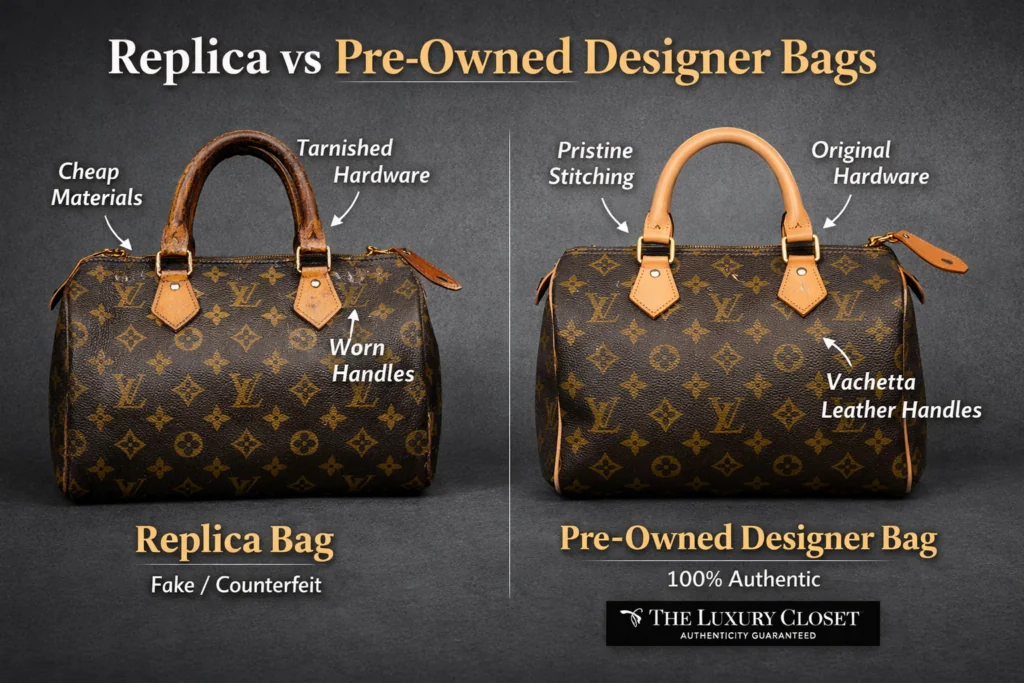
Quality degrades fast, and unevenly. Even the better superfakes tend to fail in the same predictable spots: hardware that dulls or discolors within months, edge paint that cracks, glue-based construction (rather than stitched) that comes apart at stress points, zippers that stick or fail within a year of regular use. You’re not buying durability. You’re buying a look that has a shelf life.
There’s a real ethical dimension too. Counterfeit manufacturing has documented links to underpaid, unregulated labor, and in some investigated cases, to organized crime financing. This isn’t a scare tactic — it’s been reported by outlets including the OECD and EUIPO in their work tracking counterfeit trade. It’s worth factoring in even if you don’t personally worry about the legal exposure.
And the resale value is zero. A replica bag has no secondary market that isn’t itself illegal. You cannot consign it, you cannot list it on a reputable resale platform, and you cannot recover any of what you spent. Whatever you paid is a sunk cost from day one.
None of this is to say replica buyers are careless people. It’s that the actual cost of a replica — legal exposure, material risk, ethical weight, zero resale value — rarely gets mentioned in the same threads that praise the stitching.
Why Authentic Pre-Owned Bags Are the Smarter Investment#
This is where pre-owned enters the picture, and it’s worth being upfront: pre-owned isn’t magic. It requires slightly more research than a one-click replica purchase, and truly rare or highly sought pieces can still command steep prices even secondhand. But the trade you’re making is fundamentally different, and it’s a trade that favors you.
You’re buying real craftsmanship, not a simulation of it. A pre-owned Bottega Veneta bag in intrecciato leather, even one that’s five or six years old, still has the supple hand-feel that comes from the tannage and weaving process the house is known for. A pre-owned Louis Vuitton Monogram canvas piece is often still structurally sound decades after production, because the coated canvas was engineered to resist exactly the kind of wear that sinks a counterfeit within a year. You’re not paying for the idea of quality. You’re paying for quality that’s already proven itself over years of actual use.
Authentication is verifiable, not a matter of trust. Reputable pre-owned platforms authenticate every piece using in-house experts or third-party services before it’s listed. That’s a meaningful difference from a replica listing, where “trust me, it’s 1:1” is the entire warranty.
The resale market actually works. Certain Hermès Birkins and Kellys have historically outpaced inflation and, in some years, appreciated faster than gold or the S&P 500, according to data tracked by resale platforms and reported by outlets like Business Insider and Baghunter’s own market indices. Even outside those headline cases, well-maintained bags from Chanel, Dior, and Louis Vuitton retain a meaningful percentage of retail value and can be resold or consigned. A counterfeit retains nothing.
There’s no legal exposure. You can import it, travel with it, sell it, and gift it without a single legal question attached.
It’s the more sustainable choice, materially and ethically. Buying pre-owned keeps an already-manufactured product in circulation rather than adding new counterfeit production — with its associated labor and environmental costs — into the market.
The honest caveat: entry price for authentic pre-owned is higher than for a replica. A pre-owned Chanel Flap will cost meaningfully more than a fake one. But “cost” and “cost over time” are different numbers, and that’s exactly what the next section breaks down.
Replica vs Pre-Owned: Comparing Price, Quality, and Resale Value#
| Factor | Replica / Counterfeit Bags | Authentic Pre-Owned Bags |
|---|---|---|
| Authenticity | Not authentic; often marketed as “replica” or “superfake” | 100% authentic, verified through professional authentication |
| Upfront price | Low ($50–$400 typically) | Moderate to high, but 20–60% below original retail |
| Craftsmanship | Inconsistent; simulated materials, glued construction common | Brand-grade leather, hardware, and stitching |
| Durability | Often degrades within 6–18 months of regular use | Built to last years, sometimes decades, with care |
| Legal risk | Real — customs seizure, fines, and in some countries, buyer liability | None |
| Material safety | Unregulated dyes, glues, and coatings; documented health risks | Manufactured under regulated safety standards |
| Buyer protection | None — no returns, no recourse if seized or defective | Return policies, authentication guarantees, condition disclosures |
| Resale value | None; no legal secondary market | Retains significant value; some styles historically appreciate |
| Long-term cost | Repeated repurchase as items degrade; zero recovery | One purchase, potential resale recovery of 50%+ of price paid |
The pattern that jumps out when you actually run the numbers over a three- to five-year ownership period: replicas are cheaper to buy and more expensive to own, because you’re paying for the item more than once and getting nothing back at the end. Pre-owned authentic bags cost more upfront and less over time, with the added option of recovering a substantial portion of your spend through resale.
How to Buy Pre-Owned Luxury Bags Safely#
Buying pre-owned isn’t riskless — the main risk just moves from “is this legal and safe” to “is this actually authentic and accurately described.” Here’s how to manage that.
Buy from resellers with in-house authentication, not marketplace listings alone. Platforms that employ trained authenticators or partner with third-party authentication services (Entrupy, Real Authentication, etc.) are a meaningfully safer bet than peer-to-peer marketplaces where anyone can list anything. Look for a stated authentication process on the seller’s site, not just a badge.
Check the condition grading system before you buy. Reputable resellers use consistent grading language — typically something like Pristine/Excellent/Good/Fair — with specific notes on corner wear, hardware tarnish, interior lining condition, and any repairs. If a listing has no condition detail beyond stock photos, that’s a red flag.
Ask for date codes, serial numbers, or microchip verification. Louis Vuitton and Gucci use date codes; Chanel and newer LV pieces increasingly use microchips; Hermès uses blind stamps that indicate year and workshop. A seller who can share or verify these details is generally more trustworthy than one who can’t or won’t.
Compare the price against known resale benchmarks. If a Chanel Classic Flap in “excellent” condition is listed dramatically below what similar verified listings are going for elsewhere, that’s worth questioning before it’s worth celebrating.
Confirm the return and authentication guarantee in writing. A legitimate reseller will offer a return window if the item fails independent authentication after purchase. If a seller resists offering that, walk away.
Start with more common, well-documented styles if you’re new to pre-owned. A Louis Vuitton Speedy or a Chanel WOC is easier to authenticate and price-check than a rare limited-edition piece, and it’s a lower-risk way to get comfortable with the process before moving to higher-value bags.
Factor in accessories and box/dust bag completeness. They don’t affect authenticity, but full sets typically hold resale value better and can be a useful (though not definitive) signal of how the previous owner cared for the piece.
FAQ#
Is it illegal to buy a replica designer bag for personal use? It depends on the country, but the trend is toward stricter enforcement, and in some places — including France and Italy — buyers, not just sellers, have faced fines for purchasing counterfeit goods. Even where personal-use purchases aren’t actively prosecuted, importing a replica can result in customs seizure with no compensation.
What’s the difference between a superfake and a regular replica? Manufacturing quality, not legal status. A superfake uses higher-grade materials and more precise construction to look closer to the authentic item, but it’s still an unauthorized copy of a trademarked product — legally, it’s counterfeit either way.
Is buying a dupe bag the same as buying a replica? No. A true dupe doesn’t use the brand’s logo, monogram, or trademarked design elements — it’s a legal, independently designed piece that’s simply inspired by a silhouette or aesthetic. A “dupe” that includes a brand’s logo or hardware stamp is actually a counterfeit, regardless of how it’s marketed.
Do pre-owned designer bags actually hold their value? Many do, particularly from Hermès, Chanel, and Louis Vuitton. Iconic styles in good condition regularly resell for 60-80% of original retail, and certain Hermès bags have historically appreciated over time. Trendier or limited seasonal pieces tend to hold value less reliably than core, permanent-collection styles.
How can I tell if a pre-owned bag is authentic before buying? Check date codes or serial numbers, examine stitching consistency and hardware weight, and ideally buy from a reseller offering professional authentication. If you’re buying independently, third-party authentication services can verify a bag before or after purchase for a fee.
Are counterfeit luxury bags always lower quality than pre-owned authentic ones? Materially, yes, even the best superfakes use simulated leather treatments, adhesive-based construction in places where authentic bags are stitched, and hardware that tarnishes faster. A pre-owned authentic bag, even a well-used one, is still made from the brand’s genuine materials and construction methods.
Related Articles#
- Best It Bags to Buy This Year: A Definitive Guide
- Sell Designer Handbags in 2025: Maximize Your Payout
- How Pre-Owned Luxury Fashion Is Reshaping the Industry
- Designer Handbag Trends 2025: What’s Actually Worth Buying
- Best Designer Handbag Brands Worth the Investment 2025
Related guides
- Online Bag Authentication: What Photos Can and Cannot Prove
- Fake Goyard Bag Guide: How to Spot Real vs Fake (2026)
- How to Spot a Fake Chanel Flap Bag: Authentication Guide
- How to Spot a Fake Hermès Birkin: Expert Checklist
- How to Buy an Authentic Luxury Bag from China Safely
- New vs Pre-Owned Luxury Bags: Which Route Is Right for You?
- Chanel Bag Guide: What to Know Before You Buy
- Luxury Bag Houses


Keyword index