Introduction: An Orange Birkin for the Season #
There’s a specific kind of thrill that comes with an orange Hermès box landing on a desk. Anyone who’s spent time around a luxury resale floor knows it: the box gets passed around, someone photographs it before it’s even opened, and if there’s a Birkin inside, the room stops for a minute. That reaction isn’t manufactured hype. It’s earned, bag by bag, over four decades.
Orange feels particularly right for this time of year. It’s the color of turning leaves, of pumpkin pie, of Hermès’ own signature packaging — and it happens to be one of the house’s most requested Birkin colorways going into the fall and winter buying season. But an orange Birkin is more than a seasonal accessory. It sits at the intersection of everything that makes this bag the most talked-about handbag in the world: scarcity, craftsmanship, and a resale market that behaves less like fashion and more like an asset class.
This piece is for two kinds of readers: the ones who want to understand why the Birkin earned its reputation, and the ones actively shopping for one — new or pre-owned — and trying to buy smart. We’ll cover both.
The Story Behind the [[Hermès Birkin](/buying-guides/how-to-buy-your-first-hermes-birkin/)](/buying-guides/best-birkin-bags-to-invest-in-right-now/) #
The Birkin’s origin story has been repeated so often it’s practically industry folklore, but it holds up because it’s true. In 1984, actress and singer Jane Birkin was on a flight from Paris to London when the contents of her straw tote spilled across the cabin. The passenger seated next to her, who happened to be Jean-Louis Dumas, then artistic director and later CEO of Hermès, watched the scene unfold. Birkin reportedly complained that she’d never found a leather bag with enough pockets to travel properly. Dumas sketched a design on an airplane sickness bag on the spot, and within a few years the Hermès Birkin existed as a production model.
What’s worth noting, from an industry perspective, is what happened next: Hermès didn’t chase volume. The house kept production deliberately small and craftsman-driven, which is the single biggest reason the Birkin still commands multi-year waitlists forty years later. Most luxury houses scale up when demand spikes. Hermès has consistently done the opposite, and that restraint is the entire foundation of the bag’s resale value today.
Craftsmanship: What Goes Into Every Birkin #
A Birkin is not cut and assembled on a line the way most leather goods are. Each bag is built start to finish by a single artisan, a practice Hermès maintains across its leather ateliers in France. Depending on the leather and size, a Birkin involves roughly 2,800 hand stitches and can take up to 48 hours of skilled labor to complete, not counting the training required to get an artisan to that skill level in the first place — Hermès leather craftsmen typically train for years before they’re permitted to work solo on a Birkin.
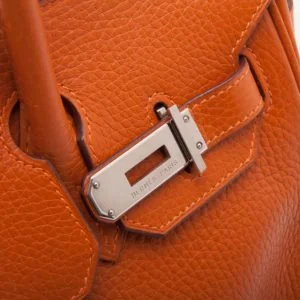
The saddle stitch is the detail authentication experts and long-time owners look at first, and for good reason. It’s done by hand with two needles working in opposite directions through the same holes, which produces slightly uneven but structurally reinforced stitching — if one thread breaks, the seam doesn’t unravel. Machine stitching, by contrast, is mechanically uniform and runs in a single direction. On a genuine Birkin, you’ll see this hand-stitch character on the handles, base, and gussets. It’s one of the fastest tells between a real bag and a well-made counterfeit.
Leather choice is where the craftsmanship conversation gets more nuanced, and it matters directly for buyers because leather type affects price, durability, and daily usability:
- Togo – Grained calfskin with a slightly pebbled texture. Scratch-resistant, holds its shape well, and is the most common leather on the resale market. It’s the practical, everyday choice.
- Epsom – Coated, stamped-grain leather. Extremely structured, lightweight relative to Togo, and highly resistant to scratches, which makes it a strong pick for first-time buyers worried about wear.
- Clemence – Softer and more slouchy than Togo, with a looser grain. Beautiful drape, but it shows scratches and watermarks more readily and requires more careful handling.
- Exotic skins (crocodile, alligator, lizard, ostrich) – Porosus and niloticus crocodile are the most sought-after and the most expensive, followed by lizard and ostrich. These require CITES documentation for legal cross-border resale, which is a detail buyers frequently overlook until they try to ship or import one.
None of these leathers is objectively “best.” Togo suits someone who wants low-maintenance daily use. Epsom suits someone hard on their bags. Clemence suits someone who prioritizes softness over structure and is willing to baby the leather. Exotics are a different conversation entirely — collector-grade, and priced accordingly.
Hardware and Color: Why the Orange Birkin Stands Out #
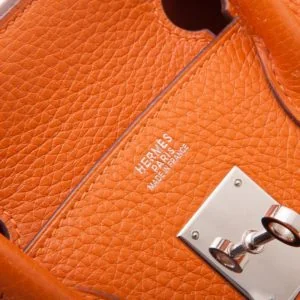
Hermès Birkins come with two standard hardware finishes: gold-tone (GHW) and palladium, a silver-tone plating that doesn’t tarnish the way older silver hardware could. Palladium hardware against a saturated orange leather is a specific, sought-after pairing — the cool tone of the metal offsets the warmth of the leather rather than competing with it, which is likely why this combination shows up so often on collectors’ wish lists.
Orange itself carries outsized brand weight because of Hermès’ packaging. The house’s boxes have been orange since World War II, reportedly because that was the only cardstock stock available at the time, and the color stuck as an accidental signature. A Birkin in orange leather is, in effect, the bag matching the brand’s own wrapping — which is part of why it photographs so well and resells so consistently. It’s a color that reads as “Hermès” from across a room, without a single visible logo.
Price and Value: What Makes a Birkin Worth the Investment #
Retail pricing for a new Birkin starts around $9,000–$10,000 USD for a 25cm or 30cm in Togo or Epsom leather with palladium or gold hardware, and climbs from there based on size, leather, and hardware finish. Exotic skins push well past $30,000 at retail, and rare combinations — matte crocodile, diamond-encrusted hardware, limited color releases — can exceed $100,000, particularly on the secondary market where availability, not manufacturing cost, sets the price.
That secondary market is where the “investment” conversation actually plays out. Several independent studies and auction house data (Christie’s and Baghunter’s long-running Birkin price index among them) have tracked Birkin resale values outperforming gold and the S&P 500 over extended periods, largely because retail supply is capped while demand keeps growing. That said, a few honest caveats matter here:
- Not every Birkin appreciates. Common sizes and leathers in oversaturated colors (black, etoupe) tend to hold value rather than dramatically climb.
- Condition drives resale price more than almost anything else. A pristine Togo Birkin will outsell a lightly worn one by a meaningful margin, even in the same size and color.
- Exotic skins and rare hardware (rose gold, diamond) see the sharpest appreciation, but they’re also the most expensive entry points and the hardest to authenticate confidently without expertise.
- The market has cooled slightly since its 2021–2022 peak as overall luxury resale demand normalized, so treat “guaranteed appreciation” claims with skepticism.
For most buyers, the more realistic framing is that a Birkin retains value exceptionally well compared to virtually any other handbag, rather than that it’s a guaranteed climbing asset.
Authenticity Checkpoints Before You Buy #
This is the section that matters most if you’re buying pre-owned, because counterfeit Birkins have gotten sophisticated enough that price and seller reputation alone aren’t sufficient checks. A few things to physically inspect:
- Stitching – Saddle stitching should be slightly irregular, diagonal, and consistent in thread tension. Perfectly uniform machine stitching is a red flag.
- Blind stamp – Every genuine Birkin has a craftsman’s blind stamp and a date stamp (a letter inside a shape, e.g., a square or circle) stamped into the leather near the top of the bag, under the flap. Post-1997 bags use letter-in-shape date codes; pre-1997 used a two-letter system. A missing, smudged, or misaligned stamp is a serious warning sign.
- Leather grain – Togo should show a natural, slightly irregular pebble pattern; Epsom’s embossed grain should be crisp and even. Counterfeits often use a grain pattern that’s too uniform or too shallow.
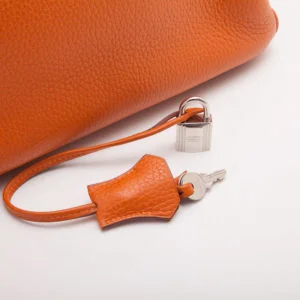
- Hardware weight and engraving – Genuine palladium and gold hardware has noticeable heft and clean, deep engraving (including on the tiny clochette and lock). Lightweight, shallow-stamped hardware is common on fakes.
- Interior smell and lining – Genuine Hermès leather has a distinct, mild leather scent, not a strong chemical one. Lining stitching should match the exterior’s quality standard.
- Turn-lock mechanism – The sangles (straps) and clochette should move smoothly; the lock should turn with resistance but no grinding.
For anything above a few thousand dollars, the safer route is a third-party authentication service or a reputable reseller with in-house authentication (many established platforms, including The Luxury Closet, authenticate every bag before listing). It’s a small added cost against a potentially total loss if the bag turns out to be counterfeit.
Orange Birkin Shades Explained: Orange H vs Feu vs Potiron vs Abricot #
Hermès has released several distinct oranges over the years, and they’re easy to confuse in photos, especially under different lighting.
- Orange H – The house’s flagship, most saturated orange, closest to the packaging color. Bold, slightly warm, and the most recognizable.
- Feu (“fire”) – A deeper, more red-leaning orange, richer and slightly darker than Orange H. Reads almost burnt-orange in low light.
- Potiron (“pumpkin”) – A muted, earthier orange with brown undertones, less neon than Orange H. This is the shade most people picture for a genuinely autumnal look.
- Abricot (“apricot”) – The lightest of the four, a soft, pale peachy-orange. More versatile for year-round wear since it doesn’t skew as seasonal.
If you’re shopping pre-owned and a listing photo makes the color hard to pin down, ask for a photo in natural daylight — screen and studio lighting shift orange tones more than almost any other Hermès color family, and it’s a common point of buyer disappointment.
FAQ #
How long is the Hermès Birkin waitlist, and can you actually request one? Hermès no longer runs a formal, transparent waitlist the way it once did. In practice, Birkins are allocated by sales associates to established clients based on purchase history with the brand — a system often referred to informally as the “quota” system, since it’s tied to how much you’ve spent on other Hermès categories (ready-to-wear, jewelry, home goods) before a bag is offered. There’s no official application form, and Hermès doesn’t guarantee a timeline; anecdotally, it can take one to several years of relationship-building with a specific boutique. This is the core reason the pre-owned market exists at the scale it does.
What’s the size difference between a 25, 30, 35, and 40cm Birkin? The number refers to the bag’s width in centimeters. The 25cm is the smallest, more of an evening or occasion bag with limited capacity. The 30cm is the most popular everyday size, balancing capacity and proportion for most body types. The 35cm is roomier, often chosen as a work or travel bag, and was historically the original size Jane Birkin herself requested. The 40cm is the largest, less common, and generally used for travel or as a weekend/overnight bag rather than daily carry.
Is it safe to buy a pre-owned Birkin online? Yes, if you follow a few steps: buy from a reseller that offers in-house or third-party authentication and a written authenticity guarantee, request close-up photos of the blind stamp, date stamp, and interior stitching before purchase, check the return policy in case authentication concerns arise after delivery, and pay through a method with buyer protection rather than a direct wire transfer to an unverified individual seller. Avoid deals that seem significantly below market price for the size and leather — that’s the most common signal of a counterfeit or stolen item.
Do Birkin prices actually go up over time? Often, yes, particularly for exotic skins, rare hardware, and discontinued colors, but it’s not universal. Common leathers in popular neutral colors tend to hold value rather than sharply appreciate, and overall resale prices softened somewhat after the 2021–2022 luxury resale peak. Condition and completeness (box, dust bag, original receipt) affect resale price as much as color or leather in many cases.
What’s the real difference between a genuine and counterfeit Birkin at a glance? Stitching quality and the blind/date stamp are the two fastest checks. Genuine hand-stitching is slightly irregular in spacing; the leather grain, hardware weight, and engraving depth are also frequently off on counterfeits. When in doubt, professional authentication is worth the fee before you commit to a purchase of this size.
Related Articles #
- Hermès Leathers Guide: Togo, Epsom, Exotic Skins Explained
- Hermès Retail vs. Resale: Which Should You Choose?
- Hermès Leathers Guide: Togo, Epsom, Exotic Skins Explained
- Louis Vuitton Crocodile Lockit PM: Rare Bag Buying Guide
- Hermès Color Guide: Codes, Shades & Resale Value
Related guides
- Online Bag Authentication: What Photos Can and Cannot Prove
- Blue Crocodile Lady Dior Tote: Buying Guide
- Chanel Vintage Flap Bag Buying Guide: Navy Lambskin
- Louis Vuitton Palm Spring Backpack: Complete Buyer's Guide
- How to Buy an Authentic Luxury Bag from China Safely
- New vs Pre-Owned Luxury Bags: Which Route Is Right for You?
- Chanel Bag Guide: What to Know Before You Buy
- Luxury Bag Houses


Keyword index