Introduction #
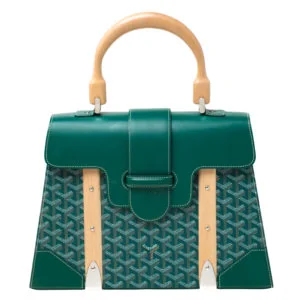
This week’s spotlight lands on a bag that rarely gets the attention it deserves outside of Goyard forums and resale marketplaces: the Saigon MM. It doesn’t have the waitlist mythology of a Birkin or the logo recognition of a Speedy, and that’s precisely the point. Goyard built its entire identity on being the brand people who already know, know. The green coated canvas and leather Saigon MM we’re featuring here is a good entry point into why this bag has quietly held its ground as one of the house’s most requested top-handles, and why buying one secondhand requires a sharper eye than most shoppers expect.
We’ll walk through where the Saigon comes from, what actually makes the construction worth the price tag, how it stacks up dimensionally against the St. Louis and Anjou, and what to check before you hand over money for a pre-owned one.
The House of Goyard: A Legacy of Discretion #
Goyard’s roots go back further than most people assume. The business started in 1792 as the House of Martin, founded by Pierre-François Martin as a trunk-maker and packing specialist in Paris, at a time when hard-sided luggage was a genuine engineering problem, not a fashion category. Martin eventually passed the business to Louis-Henri Morel, and when Morel died in 1852, François Goyard took the helm and put his name on the door.
What makes Goyard unusual today isn’t just longevity, it’s the refusal to play the modern luxury marketing game. No e-commerce, no seasonal ad campaigns, no influencer seeding, and product drops that happen without press releases. A Goyard spokesperson summed up the philosophy to Hypebeast in 2017: “Luxury is a dream, and revealing too much of what goes on behind the scenes would spoil the magic.” That deliberate silence has become its own form of brand equity. Where other houses chase visibility, Goyard has built scarcity and mystique into the operating model, and it’s part of why the brand has survived intact as one of the oldest luxury names still standing, while plenty of louder competitors have been absorbed into conglomerates or reinvented themselves multiple times over.
For buyers, this matters practically: there’s no official lookbook, no published size chart, and no price list you can screenshot for reference. Almost everything the resale market knows about Goyard comes from boutique visits, word of mouth, and bags changing hands. That opacity is exactly why authentication and pricing research take more legwork with Goyard than with brands that publish catalogs.
The Saigon: A Bag Born from Love #
The Saigon’s backstory is one of the more genuinely charming origin tales in luxury leather goods, and it’s not manufactured marketing copy. In the early 1950s, a French gentleman living in Saigon commissioned a special-order bag from the house as a birthday gift for his wife. There was no product line behind it, no plan to scale it. It existed as a single, personal piece.
Goyard sat on that design for decades. It wasn’t until 2002, roughly fifty years after the original commission, that the house revived the Saigon and folded it into its permanent collection. That’s a meaningful detail for anyone evaluating the bag as a purchase: unlike some “reissue” pieces that get dressed up in nostalgia language for a marketing push, the Saigon has now been in continuous production for over two decades, with the same silhouette. It’s not a limited run or a seasonal reinterpretation, it’s a house staple, which also means the used market has had plenty of time to develop, and plenty of time for counterfeiters to catch on.
Design and Craftsmanship of the Green Saigon MM #
The green coated canvas and leather Saigon MM is a good showcase of what separates Goyard from brands that also use coated canvas as a signature material. The shape is a distinctive trapezoid with a firm, structured base, gently pyramid-shaped side gussets, and a tuck-in flap closure rather than a lock or clasp. It reads as understated from a distance, which is deliberate, but the details reward a closer look.
The canvas itself is Goyardine, developed by Edmond Goyard in 1892. It’s often mistaken for a coated leather, but it’s actually a woven blend of hemp, linen, and cotton finished with a natural coating. The chevron-style pattern was originally hand-painted piece by piece; today it’s produced through layered etching, though the process is still far more involved than a printed canvas. That’s part of why Goyardine holds up so well structurally over decades of use, and also why it’s one of the harder textures to convincingly fake, more on that below.
Open the bag and the interior is lined in Goyard’s signature mustard yellow canvas, roomy enough for genuine daily use rather than being purely decorative. But the feature that actually defines this bag is the wood. The hand-carved wooden top handle and the two wood trim accents on the front aren’t just a styling choice, they’re a direct nod to Goyard family history: generations of Goyard men worked as log drivers, floating timber down inland waterways for transport. It’s a rare instance of a luxury house building literal family history into hardware, rather than inventing a heritage story after the fact. That wood detailing is also the first thing to inspect for wear and the first thing counterfeiters tend to get wrong, the grain, the carving precision, and the way it’s fitted to the leather straps are difficult to replicate cheaply.
Authenticating and Buying a Pre-Owned Goyard Saigon #
Because Goyard doesn’t sell online, doesn’t stamp bags with visible serial numbers the way some houses do, and doesn’t offer public authentication services, buying pre-owned requires more diligence than most luxury handbag categories. A few things worth checking before you commit:
- The Goyardine pattern alignment. On an authentic bag, the chevron pattern is continuous and symmetrical across panels, including where the canvas wraps around the base and gussets. Misaligned or oddly cropped chevrons at the seams are a red flag.
- The wood handle and trim. Check for consistent grain, a smooth hand-finished carve, and tight, even fitting where the wood meets the leather straps. Cheap reproductions often use painted or laminated wood substitutes that look slightly too uniform or too glossy.
- Stitching and edge painting. Goyard’s stitch count is dense and even, and the edge paint on the leather trim should be smooth with no bleeding onto the canvas.
- Interior canvas and lining. The mustard yellow interior should match the exact shade Goyard uses consistently across the collection; a lining that’s too orange, too pale, or made from a different material altogether is a warning sign.
- Hardware weight and finish. Any metal fittings should feel substantial, not lightweight, with a consistent brushed or polished finish that hasn’t flaked.
- Provenance and documentation. Since Goyard doesn’t issue receipts the way some brands do with authenticity cards, ask sellers for original purchase receipts, boutique tags, or dust bags, and be wary of listings with no history at all, especially at prices that seem too good relative to current retail.
If you’re buying through a reseller, favor platforms that offer in-house authentication and return policies over peer-to-peer marketplaces with no recourse. Goyard’s relative obscurity compared to Chanel or Hermès sometimes lulls buyers into a false sense of security, but that same obscurity means fewer buyers know what to check, which makes it an appealing target for counterfeiters banking on exactly that gap in general knowledge.
Goyard Saigon MM: Size, Sizing Chart, and How It Compares to PM/GM #
The Saigon comes in three sizes, PM, MM, and GM, and the differences matter more than they might seem from photos alone, since Goyard’s product pages rarely spell out precise measurements.
- Saigon PM: roughly 10.5" W x 7" H x 4.5" D. This is the size most often carried as an evening or occasion bag, it holds a phone, cards, and basic essentials, but isn’t built for daily overload.
- Saigon MM: roughly 12.5" W x 8.5" H x 5.5" D. This is the size featured here, and it’s the most commonly chosen for everyday use. It comfortably fits a slim wallet, phone, sunglasses case, and small pouch, with enough structure to keep its shape whether it’s half full or packed.
- Saigon GM: roughly 14" W x 10" H x 6" D. This is the version people reach for when the bag needs to double as a light work or travel bag, it can hold a tablet and a few more daily items without looking overstuffed.
Compared to Goyard’s other top-handle staples, the sizing logic tracks differently. The St. Louis is a tote, not a structured top-handle, so it’s a poor apples-to-apples comparison on capacity but a useful one on use case: the St. Louis wins for beach days, errands, and anything that needs to swallow bulk. The Anjou, a tote with handles and an optional pouch, sits in a similar casual category. The Saigon MM, by contrast, is the more “put together” option of the three, structured, trapezoidal, and better suited to being your one bag for a day that includes both errands and a dinner reservation. If you’re deciding between a Saigon MM and an Anjou PM, the honest answer is that they’re not really competing for the same trip, the Saigon is the more formal, harder-shelled option, while the Anjou flexes and slouches more like a market tote.
Price History and Current Retail Price #
Tracking Goyard pricing over time is genuinely difficult, and that’s not an accident. The house doesn’t publish price lists, doesn’t announce increases, and prices can vary slightly between boutiques and regions. What we can say from tracking listings and boutique visits over the past several years: the Saigon MM in Goyardine canvas has climbed from roughly the $2,000 to $2,200 range in the mid-2010s to current retail generally landing between $2,800 and $3,100 depending on region and any leather or exotic trim variations. Increases have tended to happen quietly, sometimes twice in a year, with no public notice, which is part of why so many buyers only discover the new price when they walk into a boutique expecting the old one.
On the pre-owned market, well-maintained Saigon MM bags in classic colorways (black, brown/cognac, this green) typically resell in the $1,400 to $2,200 range depending on condition, canvas wear, and whether the original dust bag and receipt are included. Limited or discontinued colorways can command more, while heavily worn examples with visible fraying at the corners or discoloration on the mustard interior sell for noticeably less. Buying pre-owned generally saves 25 to 40 percent off current retail, but the savings shrink fast if the bag needs handle or trim restoration, since Goyard’s own repair turnaround and cost for wood or leather work isn’t cheap either.
Color and material variations matter for [[[resale value](/prices-and-value/luxury-price-hikes-2026-resale-impact/)](/brands/celine-luggage-tote-guide-sizes-history-resale-value-1/)](/brands/celine-luggage-tote-guide-sizes-history-resale-value/) too. Goyardine canvas in the standard black, brown, and this green tends to hold value most consistently because it’s the most recognizable and easiest to authenticate. All-leather Saigon editions and special colorways exist but are less common on the resale market and can be harder to verify without direct comparison to boutique stock.
FAQ #
Is the Goyard Saigon MM a good everyday bag? Yes, within reason. The structured base and trapezoid shape hold up well to daily use, and the interior fits the essentials most people carry. It’s not built for heavy loads the way a tote is, so if you regularly carry a laptop or bulky items, the GM or a different silhouette entirely may serve you better.
Why doesn’t Goyard sell online? It’s a deliberate brand decision, not a logistics limitation. Goyard has built its reputation on scarcity and in-person retail experience, avoiding the visibility and price transparency that e-commerce brings. It reinforces the exclusivity the brand has cultivated since it distanced itself from mainstream luxury marketing.
How can I tell if a Goyard Saigon is fake? Focus on the chevron pattern alignment, the quality and fit of the wood handle and trims, stitch density, edge paint finish, and the exact shade of the mustard interior lining. When in doubt, buy from a reseller offering professional authentication rather than relying on photos alone.
Does Goyard increase prices often? Yes, and without formal announcements. Price increases have occurred multiple times over the past several years, sometimes more than once annually, which is a big part of why resale demand stays strong, buyers who missed an increase often look to the pre-owned market instead.
How does the Saigon MM compare to the St. Louis for daily use? They serve different purposes. The St. Louis is an open tote, better for volume and casual days. The Saigon MM is structured and closed, better suited to occasions where you want a more finished look without sacrificing daily practicality.
What should I pair with a green Saigon MM? The green Goyardine reads as a neutral in practice, closer to olive or forest than a bold statement color, so it pairs easily with camel, cream, black, and denim. It works well as the “elevating” piece in an otherwise simple outfit, structured tailoring, a plain white shirt, or a monochrome look all let the bag’s wood details stand out rather than compete for attention.
Related Articles #
- Hermès Retail vs. Resale: Which Should You Choose?
- Why the Chanel Crossbody Bag Never Goes Out of Style
- Replica vs Pre-Owned Bags: Which Is the Smarter Buy?
- Chanel Flap Bag Buying Guide: Sizes, Prices & Deals
- Chanel Handbag Prices: Iconic Styles & What They Cost
Related guides
- Online Bag Authentication: What Photos Can and Cannot Prove
- Chanel 2.55 History, Details & How to Spot a Fake
- Private Bag Edit: Hermès Kelly Authentication Blog
- Hermès Date Codes & Stamps Explained: Full Guide
- How to Buy an Authentic Luxury Bag from China Safely
- New vs Pre-Owned Luxury Bags: Which Route Is Right for You?
- Chanel Bag Guide: What to Know Before You Buy
- Luxury Bag Houses


Keyword index