Introduction: The Legacy Behind the [[[Chanel Classic Flap](/buying-guides/vintage-chanel-finds-top-picks/)](/buying-guides/classic-and-chic-handbags-style-icons/)](/buying-guides/chanel-flap-bag-buying-guide/) #
Coco Chanel didn’t design handbags so much as dismantle the reasons women needed them at all. Her guiding line, “elegance is refusal,” wasn’t a slogan, it was a design brief. In the early 1950s, the only options for carrying anything were clutches and handheld purses, both of which demanded a free hand and constant attention. Chanel found that limiting.
Her answer, launched in February 1955, was the bag that now carries her initials on the lock: a quilted flap bag hung from a chain that could rest on the shoulder. It sounds modest by today’s standards, but at the time it was a genuine mechanical shift. Women could move, gesture, and work with both hands free. That single decision, chain over clutch, is the reason the Classic Flap still exists in nearly its original silhouette seventy years later. Very few handbag designs from that era survived contact with modern fashion. This one didn’t just survive, it became the reference point every quilted shoulder bag since has been measured against.
From Mademoiselle Lock to Interlocking CC: A Design Evolution #
The bag most people picture when they hear “Chanel Classic Flap” isn’t actually Coco Chanel’s original. It’s Karl Lagerfeld’s.
When Lagerfeld took over the house in 1983, he inherited a bag that, while beloved, hadn’t changed much since 1955. His 1980s revisions gave the Classic Flap the two features now treated as its signature: the interlocking CC turn-lock, replacing the earlier Mademoiselle twist lock, and a chain strap interwoven with leather, replacing the bare metal chain of the original prototypes.
This is more than trivia for collectors. It’s a practical authentication marker. If you come across a Classic Flap with a plain, unadorned chain and a rectangular twist closure instead of the CC lock, you’re either looking at a genuine vintage piece from before 1980, a later reissue styled after the original, or a fake that’s copied the wrong reference photo. Knowing which decade’s hardware you’re looking at is often the fastest way to sort a listing before you even get to stitching or leather.
This Week’s Feature: The Ombre Blue Maxi Classic Flap #
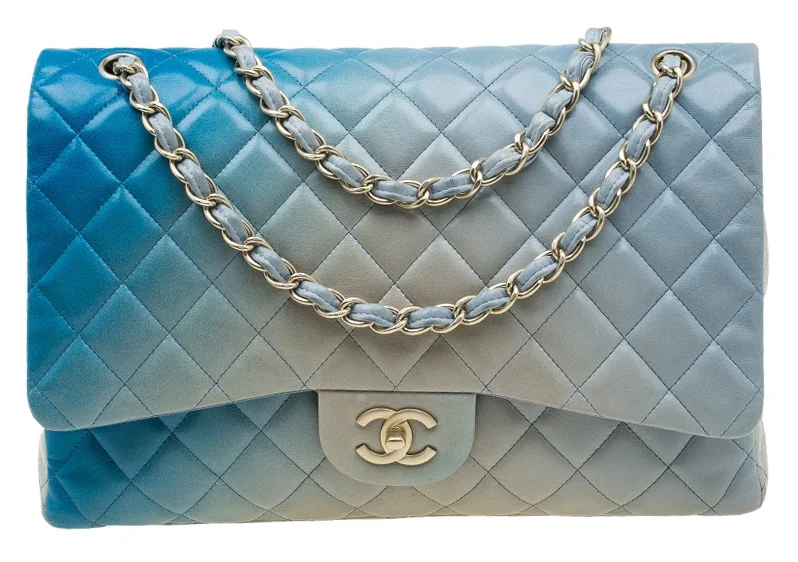
The piece we’re spotlighting this week is a Maxi single flap in an ombré blue that shifts from a deep, saturated blue at the base to a softer grey toward the top. It’s a colorway that reads as seasonal rather than classic, which is exactly its appeal, this is a bag built for spring and summer wear rather than year-round neutrality.
The quilting follows Chanel’s signature diamond pattern, a detail that traces back to the padded jackets worn by stable boys, and here it’s executed in a leather with enough structure to hold the shape at Maxi scale. Maxi is the largest size in the current Classic Flap line, and the interior reflects that: a fully leather-lined main compartment with genuine room for daily items, not just evening essentials.
Hardware-wise, this one checks the post-1980 boxes: the interlocking CC turn-lock at the front, a chain strap interlaced with leather for the shoulder carry, and a slip pocket on the back exterior, the spot Chanel historically designed for cash or coins you want to grab without opening the flap. The hardware is finished in polished gold-tone, which sits well against the cooler blue-grey tones of the leather rather than fighting them.
On price: Maxi Classic Flaps in good pre-owned condition with this hardware generation typically land somewhere in the mid four-figures to low five-figures range on the resale market, with exact pricing shaped heavily by leather condition, hardware wear, and whether the original authenticity card and box are present. A colorway like this ombré treatment, being less common than black or beige, tends to hold interest even when overall Classic Flap resale volume softens.
What to Check for Authenticity Before You Buy #
Chanel counterfeits have gotten good enough that surface impressions aren’t reliable anymore. What holds up is checking the details counterfeiters consistently get wrong.
Start with the turn-lock. On an authentic post-1980 Classic Flap, the interlocking CC sits flush, with clean, even edges and no visible seam where the two Cs meet. Fakes often show a slight lip or uneven casting where the metal was molded in two pieces. Run your thumb over it, you should feel nothing.
Next, the stitching around the quilting. Genuine Chanel quilting is stitched with consistent spacing and depth, and the diamonds should line up symmetrically across the front flap. Counterfeits frequently show slightly warped diamonds near the edges where the leather was stretched to fit a cheaper pattern.
Check the chain. The leather interlaced through it should be a single continuous strip pulled taut through each link, not glued or looped separately. Loose, sagging leather in the chain is one of the more common tells on lower-quality fakes.
Finally, look for the authenticity card, serial sticker inside the interior pocket, and the holographic sticker if the bag falls within the years Chanel used them (the house phased these out in 2021 in favor of new tracking methods). None of these alone proves authenticity, cards and stickers can be forged too, but their absence, or inconsistency with the bag’s claimed production year, is a reason to slow down. When in doubt, a professional authentication service that physically inspects hardware, stitching, and leather grain is worth the fee relative to what you’d lose on a fake.
Buying Advice: Is This Bag Right for You? #
The Maxi size is the honest consideration here. It’s roomier and more visually dramatic than the Medium or Jumbo, but it’s also heavier and less suited to being worn cross-body for a full day out. If you’ve tried a Maxi on before and found the scale worked for your frame, this colorway is a strong pick. If you haven’t, it’s worth trying one on in person before committing, sizing is the single most common regret purchase in this bag family.
The ombré blue is a statement colorway rather than a neutral. It pairs cleanly with white, cream, denim, and grey, and it reads especially well in spring and summer wardrobes where black or beige Chanel can feel heavy. It’s a less obvious choice for someone wanting one Chanel bag to wear with everything, in which case a classic black or beige Medium would serve better.
On value: Classic Flaps, particularly Medium and Jumbo sizes in black caviar leather, have historically held resale value well and in many cases appreciated relative to original retail, partly driven by Chanel’s own repeated price increases. Maxi sizes and colored leathers like this ombré piece trade at a slight discount to those benchmarks in the resale market, they’re desirable but narrower in audience. That’s not a downside if you actually want to wear the bag rather than treat it as a pure asset, but it’s worth knowing going in if resale value is part of your decision.
Spotlight: The Chanel Ombré Blue Classic Flap #
This is the piece we’re putting in front of readers this week, and it earns the spot for a reason beyond its color. It’s a clean example of the post-1980 hardware generation, CC lock, interlaced chain, back slip pocket, in a leather and colorway that’s harder to source than the standard black or beige rotation.
Condition grading matters as much as the model itself when buying pre-owned. A bag graded “excellent” should show minimal corner wear, no cracking in the leather, and hardware with only light surface scratching under close inspection. “Good” condition allows for visible corner wear and light hardware tarnish but no structural issues, no sagging, no lock malfunction. Anything below that should come with a clear disclosure of what’s worn and photographic evidence, not just a grade label. For a piece like this, where the ombré finish is part of the value, checking that the color gradient hasn’t faded unevenly is its own condition check specific to this colorway.
Classic Flap Sizing Recap (Where This Piece Fits) #
The Classic Flap comes in four sizes that get confused often enough to warrant a straight comparison:
| Size | Approx. Dimensions (W x H x D) | Best For |
|---|---|---|
| Mini | 20 x 12 x 6 cm | Evening, minimal essentials |
| Small/Medium | 25 x 15.5 x 7 cm | Daily use, most versatile |
| Jumbo | 30 x 19 x 9.5 cm | Daily use with more capacity |
| Maxi | 33 x 22 x 10 cm | Work, travel, statement pieces |
The Maxi, which is the size featured here, sits at the top of the range. It’s roughly 8-10 cm larger in width than the Medium and noticeably deeper, which is why it can comfortably carry a tablet or small daily essentials that a Medium simply can’t. The tradeoff is weight and how it sits when worn cross-body, something worth testing in person if you haven’t worn a Maxi before.
FAQ #
How much does a Chanel Maxi Classic Flap cost pre-owned? Pricing varies with condition, hardware generation, and leather, but Maxi Classic Flaps in good pre-owned condition generally fall in the mid four-figures to low five-figures range. Rarer colorways and limited leathers can sit above that.
How can I tell if a Chanel flap bag’s hardware is real? Check that the interlocking CC lock has clean, seamless edges with no visible casting lines, and that the chain’s interlaced leather is a single taut strip rather than glued or sagging sections. Uneven or lightweight hardware is a common counterfeit tell.
What’s the difference between vintage and modern Classic Flap hardware? Bags made before Karl Lagerfeld’s 1980s redesign typically feature a rectangular Mademoiselle twist lock and a plain metal chain. Post-1980 bags feature the interlocking CC turn-lock and a chain interwoven with leather.
Which Classic Flap size should I buy? Medium suits most people looking for daily versatility. Maxi suits those wanting more capacity and a bolder presence, but it’s worth trying on in person given its size and weight.
Do Chanel Classic Flap bags hold their value? Black and beige Medium and Jumbo flaps in caviar leather have historically held or gained value on the resale market. Maxi sizes and colored leathers, like this ombré blue, tend to trade slightly below those benchmarks but remain in steady demand among buyers seeking something less common.
Related Articles #
- How to Spot a Fake Chanel Flap Bag: Authentication Guide
- Replica vs Pre-Owned Bags: Which Is the Smarter Buy?
- How to Spot a Fake Burberry Bag: Full Guide
- Why the Chanel Crossbody Bag Never Goes Out of Style
- Replica vs. Pre-Owned Bags: The Smarter Buy?
Related guides
- Online Bag Authentication: What Photos Can and Cannot Prove
- Inside a Million-Dollar Closet: Pre-Loved Hermès & More
- Meet Marwa Azzam Aldabbagh: Kelly Bag Authentication Expert
- Luxury Handbag Authentication Process Explained
- How to Buy an Authentic Luxury Bag from China Safely
- New vs Pre-Owned Luxury Bags: Which Route Is Right for You?
- Chanel Bag Guide: What to Know Before You Buy
- Luxury Bag Houses


Keyword index