Introduction #
When [[Jonathan Anderson](/brands/loewe-puzzle-bag-buying-guide/)](/brands/jw-anderson-pierce-bag-dark-green-suede-sold-out/) took over as creative director of Loewe in 2013, the house was a respected but sleepy name in Spanish leather goods, better known to heritage collectors than to the runway crowd. Within a few seasons, that changed. Anderson brought a sculptor’s eye to handbag design, treating leather less like fabric and more like clay, folding it, puffing it, stretching it into shapes that had no real precedent in luxury accessories. He paired that formal experimentation with a genuine curiosity about craft, collaborating with artists, ceramicists, and Colombian weavers rather than just chasing logo visibility.
The result was a run of bags that did something rare in the handbag category: they got talked about as design objects first, status symbols second. That’s a big part of why the pre-owned market for these pieces has stayed active even after Anderson’s departure for Dior. Buyers aren’t just chasing a brand name, they’re chasing a specific design era. This roundup covers the five bags that best capture that era, what they’re actually like to own and resell, and how to buy one with confidence on the secondary market.
The Puzzle Bag: Where It All Began #
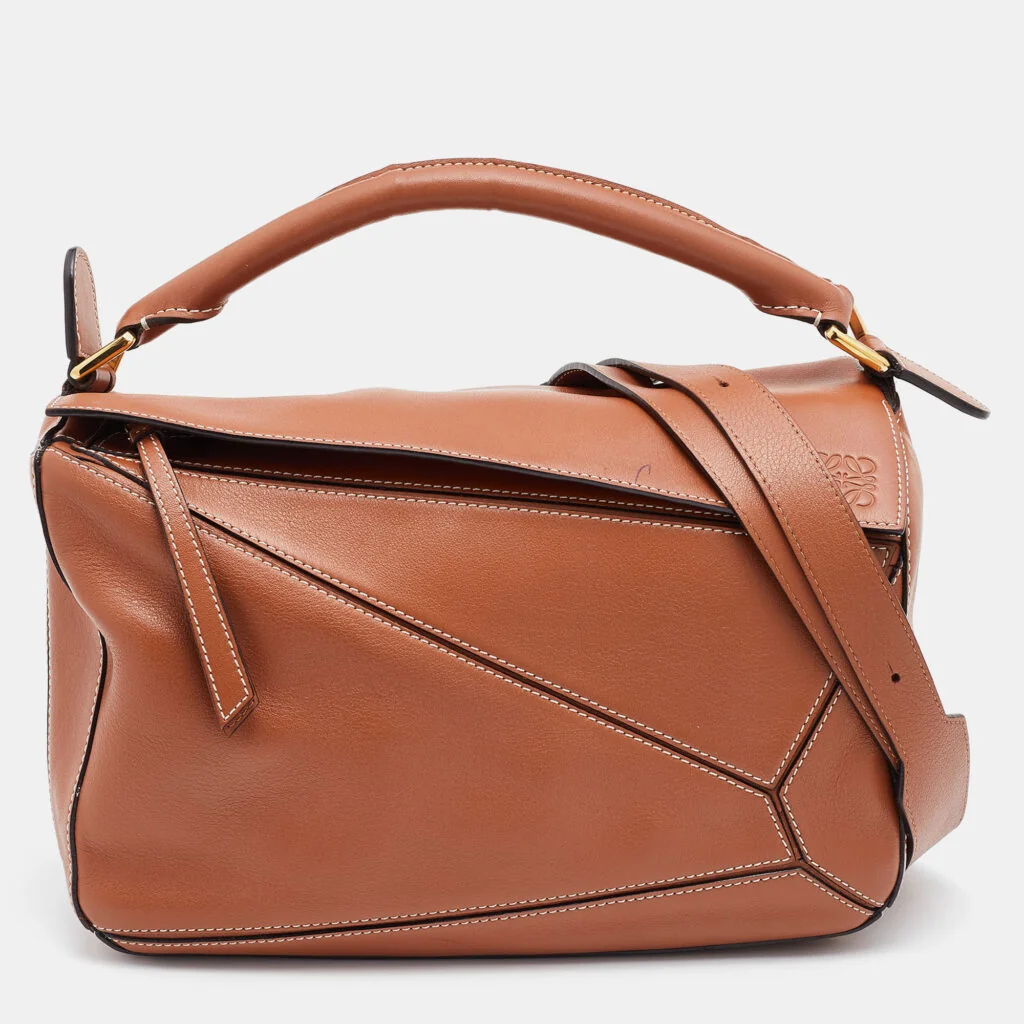
The Puzzle, released in 2015, was Anderson’s first bag for Loewe and the house’s first genuinely new silhouette since the 1980s. That alone tells you how much weight it carried. Instead of a rounded tote or a structured flap, he built a cuboid form out of flat leather panels joined at sharp, geometric seams, an origami reference that gave the bag its name and its now-famous asymmetrical profile when carried by the top handle.
Design and construction #
The panel construction isn’t just visual. It means the bag has almost no wasted leather and very few curved cuts, which keeps material use efficient but also means every seam has to be precise or the whole shape reads as sloppy. On a genuine Puzzle, the stitching on those geometric panels is dead straight, with even tension across every angle change. Loose or wavy stitching along the folds is one of the first things I check when evaluating a pre-owned piece, because it’s difficult for counterfeiters to replicate the pattern-cutting accuracy Loewe uses here.
Materials, sizes, and colors #
The Puzzle comes in classic and small sizes most commonly, with an occasional large or mini depending on the season, and it’s produced in smooth calfskin as the standard, with suede, grained leather, and exotic-effect finishes appearing in limited runs. Color-wise, Loewe leans into both quiet neutrals (tan, black, stone) and saturated seasonal colors, which is part of why it photographs so well and why certain colorways (like the original tan) hold value better than trend-driven shades.
Pricing and resale trends #
Retail on a small classic Puzzle sits in the low-to-mid $2,000s new. On the resale market, well-kept pieces in classic leather and neutral colors typically retain 55-70% of retail value, with tan and black performing best. Bold seasonal colors or suede versions depreciate faster because they show wear more visibly and appeal to a narrower buyer pool.
Anniversary editions #
For its tenth anniversary, Loewe launched Puzzle 10, a collection of 19 re-editions plus one new anniversary design, supported by pop-ups at Bergdorf Goodman and Harrods and gallery exhibitions in Beijing and Taiwan. That kind of institutional celebration is usually a signal that the design has graduated from “trend” to “house classic,” which is generally good news for long-term resale stability.
Styling notes #
The Puzzle’s structured base and top handle make it a desk-to-dinner bag rather than an everyday errand bag. It doesn’t do casual sling-and-go the way a hobo does. If your daily needs are more grab-and-run, this isn’t the most practical size in the lineup.
Sculptural Icons: Gate and Hammock Bags #
These two bags represent Anderson’s most architecturally ambitious phase at Loewe, the point where the design brief stopped being “how do we make a handbag” and became “how much can leather be pushed before it stops being a bag.”
Hammock Bag #
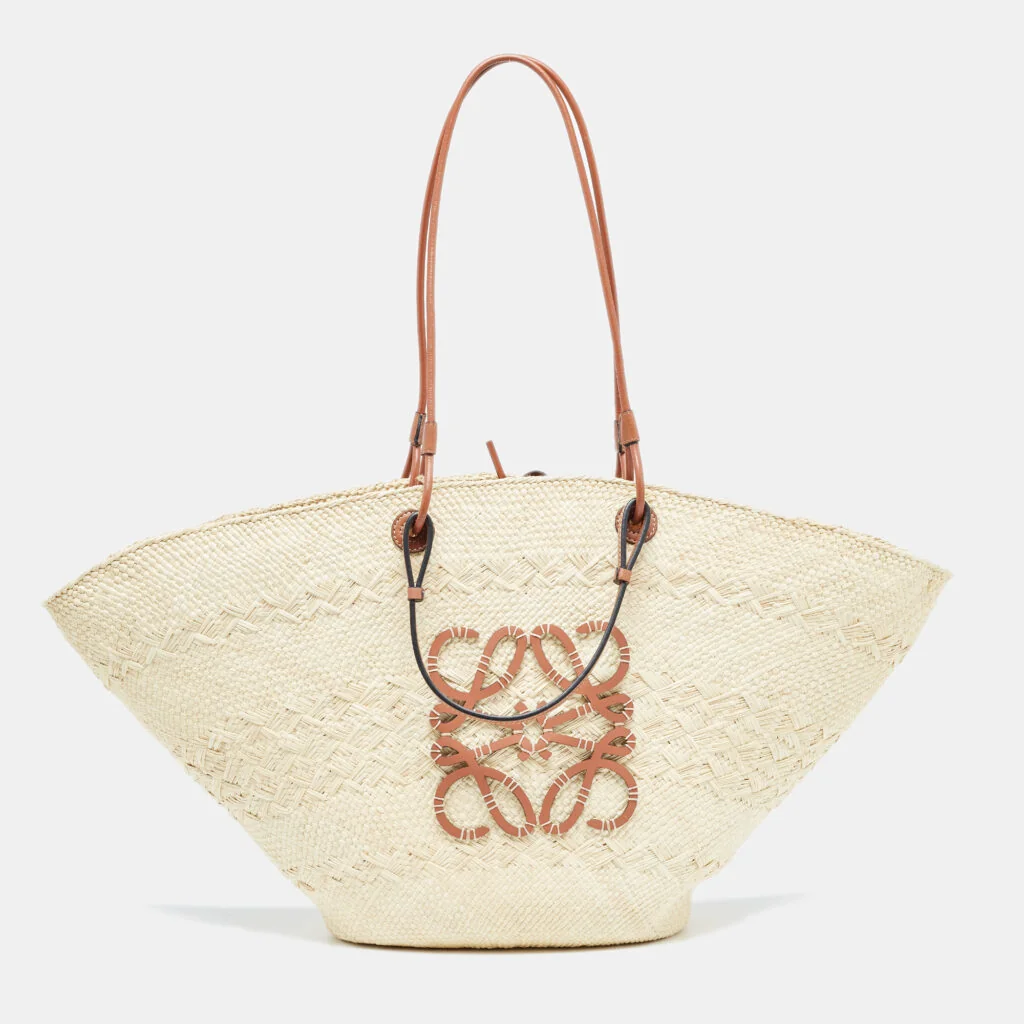
Introduced in 2016, the Hammock is built around a genuinely clever mechanism: unzip the side panels and the body relaxes into a soft, slouched hammock shape; zip it closed and it tightens into a more compact, structured form. That shape-shifting quality spawned several variants over the years, including the Hammock Nugget, the Compact Hammock, and the Hammock Slice, each adjusting the proportions or hardware slightly.
It’s made in soft, supple calfskin (stiffer leathers don’t drape correctly), usually in a compact or small size, with the top handle and a slim shoulder strap for versatility. Retail runs in the low-to-mid $2,000s depending on size and leather. Resale value holds moderately well, generally 45-60% of retail, though it’s more size- and condition-sensitive than the Puzzle since sagging or stretched leather is more visible on a bag whose whole appeal is its drape.
Honest downside: the mechanism that makes it interesting is also its weak point. The zips along the sides see heavy use every time the bag is reshaped, so on a pre-owned Hammock, check the zipper pulls and track closely for wear before buying.
Gate Bag #
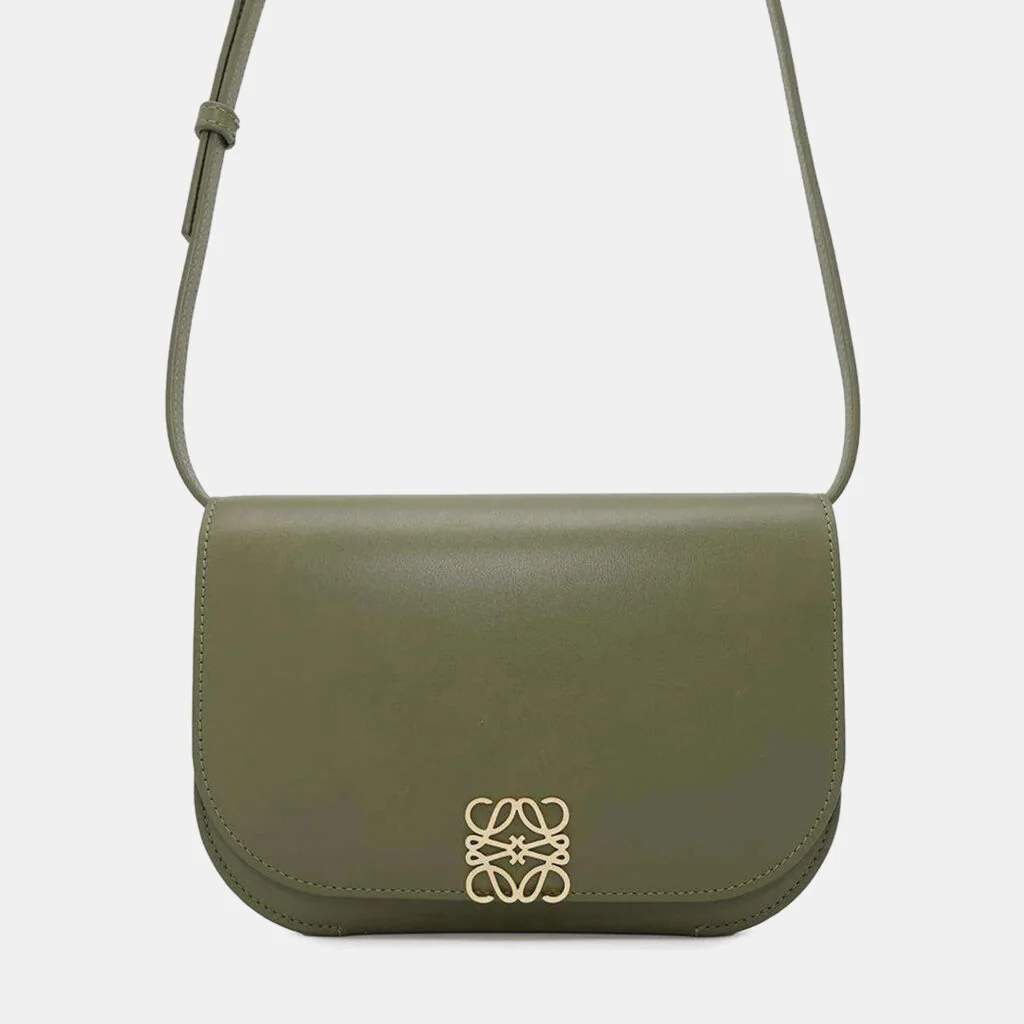
The Gate bag takes a more rigid architectural approach, built around a distinctive top handle and clasp inspired by the shape of a gate latch, with a boxier, more geometric body than the Hammock. Where the Hammock is about softness and movement, the Gate is about hard edges and formality. It typically comes in classic and mini sizes in smooth or grained calfskin, with retail pricing in a similar band to the Puzzle.
Placed next to each other, the two bags summarize Anderson’s dual instincts at Loewe: the Hammock proves leather can be soft and kinetic, the Gate proves it can be rigid and monumental. Owning either says something different about how you actually use a bag day to day. The Gate suits people who want structure and don’t mind a firmer, boxier silhouette on the shoulder; the Hammock suits people who want a bag that adapts to how much they’re carrying that day.
Puzzle, Hammock, Gate: At a Glance #
| Bag | Debut Year | Signature Feature | Common Materials | Retail Range (Approx.) | Resale Retention |
|---|---|---|---|---|---|
| Puzzle | 2015 | Origami-inspired cuboid panels | Smooth calfskin, suede | $2,200-$3,200 | 55-70% |
| Gate | 2018 | Architectural latch-inspired clasp | Smooth/grained calfskin | $2,300-$3,300 | 45-60% |
| Hammock | 2016 | Zip-adjustable slouch-to-structure shape | Soft calfskin | $2,100-$3,000 | 45-60% |
| Balloon | 2020 | Rounded, bulbous sculptural silhouette | Nappa leather | $1,900-$2,700 | 35-50% |
| Elephant | 2018 | Novelty animal-shaped charm bag | Calfskin, exotic-effect finishes | $1,200-$2,000 | 30-45% |
Playful Reinventions: Balloon and Elephant Bags #
Not everything Anderson designed for Loewe was serious architecture. Some of the most memorable pieces leaned fully into whimsy, and that’s arguably where his personality as a designer came through most clearly.
Balloon Bag #
The Balloon takes its name literally: a rounded, inflated-looking leather body that reads almost like a piece of soft sculpture rather than a conventional handbag. It’s made in nappa leather to get that pillowy, air-filled look without actual padding, which means the leather quality has to be excellent to hold shape without collapsing over time. It comes mostly in compact and small sizes, since the rounded volume gets impractical to carry at larger scale.
This is a bag people either love on sight or find genuinely strange, and that polarized reaction shows up in resale. It moves slower than the Puzzle or Hammock and retains less value on average, generally 35-50%, because the buyer pool is narrower. If you’re buying pre-owned specifically as an investment piece, this isn’t the strongest choice in the lineup. If you’re buying it because you love the look, it’s a legitimately fun bag to wear, but go in with the resale expectations set correctly.
Elephant Bag #
The Elephant belongs to a small family of novelty charm bags Anderson introduced during his Loewe tenure, playful animal shapes rendered in the house’s fine leatherworking. It’s a smaller-format bag, closer to a top-handle mini or pouch, made in calfskin with detailed stitching to define the animal’s features, sometimes with exotic-effect leather accents.
These pieces built cultural momentum less through runway presence and more through celebrity and street-style photos, and Loewe’s ongoing collaborations with Studio Ghibli, Suna Fujita, and other artistic partners reinforced that same appetite for storytelling objects rather than purely functional bags. As a resale category, novelty bags like the Elephant depreciate faster than the core structural bags, generally 30-45% retention, because their appeal is tied to a specific cultural moment. That doesn’t make them bad buys, but it does mean you should treat them as fashion pieces, not long-term value holds.
Anderson’s Lasting Legacy on Loewe’s House DNA #
Across these five bags, a clear pattern emerges: Anderson never let Loewe settle into a single signature shape the way some houses do with one flagship bag repeated in different colors for a decade. Instead, he built out a design vocabulary, geometric folding, tension and release, sculptural volume, narrative charm, and let each bag explore one part of that vocabulary fully.
That approach reshaped how the industry talks about Loewe. Before Anderson, the house was known for exceptional leather quality without much design risk. After him, Loewe became a reference point for conceptual bag design, sitting alongside houses like Bottega Veneta and Jacquemus in conversations about where luxury accessories were headed creatively. As Anderson moves to Dior, the real test for Loewe will be whether the house can keep that design ambition alive without the specific sensibility that generated it. For buyers, that uncertainty is actually part of why demand for these five bags, as artifacts of a defined creative era, has stayed firm rather than fading the moment he left.
How to Buy and Authenticate a Pre-Owned Loewe Bag #
Buying any of these five bags pre-owned can mean real savings, but it also means the burden of authentication falls on you or your seller, not a boutique. Here’s what actually matters when evaluating a listing.
Check the leather and stitching first #
Loewe’s calfskin has a specific weight and grain, neither too stiff nor too plasticky. Counterfeits often use leather that’s too glossy or too soft with no structure. On structural bags like the Puzzle or Gate, uneven panel seams or stitching that doesn’t sit flush at corner folds is a strong red flag, since that precision is genuinely hard to fake at scale.
Inspect the hardware and logo #
Loewe’s anagram hardware should have crisp, evenly weighted lettering with no soft edges from a worn mold. Zipper pulls, clasps, and feet should carry consistent branding and a substantial, non-hollow feel. On the Hammock and Gate specifically, check that the clasp or zip mechanism moves smoothly, cheap replicas often use stiff or scratchy hardware that catches.
Verify interior details #
Genuine bags have a clean interior leather or suede lining, an embossed or debossed date/production code stamp (format and placement vary by bag and era, so cross-reference against verified examples of that specific model), and consistent font on any interior branding. Blurry stamping or inconsistent font weight is a common tell on fakes.
Buy from sellers who offer authentication guarantees #
For pieces like these, buying from a specialized [pre-owned luxury](/buying-guides/luxury-handbag-trends-2024/) platform that authenticates every item before listing removes most of the guesswork, especially for less common variants like the Hammock Nugget or Elephant bag, where reference photos online are limited. Ask for close-up photos of the stamp, hardware, and stitching before purchase, and be cautious of listings priced dramatically below the resale ranges noted above, that gap is rarely a bargain.
New vs. pre-owned availability #
The Puzzle and Gate remain part of Loewe’s current collections in updated colors and sizes, so they’re available new through Loewe boutiques and the brand’s own site. The Hammock appears periodically in newer variants but isn’t always in active production. The Balloon and Elephant are largely discontinued from their original runway seasons, which makes pre-owned platforms the primary, and sometimes only, route to owning them now. That scarcity is part of why condition and authentication matter even more for those two.
Craftsmanship and Materials #
Loewe’s leather goods, including every bag on this list, are manufactured in Spain, largely out of the house’s workshops in Getafe near Madrid, where the brand has maintained leatherworking expertise since the 19th century. Anderson leaned into that heritage deliberately rather than moving production toward mass-market efficiency, which is part of why these bags command real resale value instead of collapsing to fast-fashion pricing once they leave the boutique.
The leather itself is primarily sourced calfskin, tanned and finished to Loewe’s own specifications, chosen for a balance of structure and softness that suits both the rigid pieces (Puzzle, Gate) and the more fluid ones (Hammock, Balloon). Novelty and exotic-effect finishes are used selectively rather than as the default, keeping the core lineup grounded in classic materials that age well with proper care.
That craftsmanship shows up in wear patterns too. Genuine Loewe calfskin develops a soft patina and creases naturally at stress points rather than cracking or peeling, which is one more thing to check on a pre-owned bag, unnatural cracking or peeling at the surface, rather than smooth creasing, usually points to a bonded or coated leather rather than the genuine full-grain calfskin Loewe uses.
FAQ #
Which Loewe bag by Jonathan Anderson holds its value best on resale? The Puzzle, particularly in classic sizing and neutral colors like tan or black. Its status as Anderson’s debut design and its ongoing place in Loewe’s current collection give it the strongest resale floor of the five.
Is the Loewe Puzzle bag still being made? Yes. It remains part of Loewe’s core collection, refreshed with new colors and occasional size updates each season, alongside the Puzzle 10 anniversary re-editions.
How can I tell if a Loewe bag is authentic before buying pre-owned? Focus on stitching precision along structural seams, hardware weight and lettering crispness, interior stamp consistency, and overall leather feel. When in doubt, buy through a platform that authenticates items before listing rather than relying on your own inspection alone.
Are Loewe bags from the Jonathan Anderson era a good investment? Structural, still-in-production designs like the Puzzle and Gate tend to hold value better than novelty pieces like the Elephant or niche shapes like the Balloon. Buy those for the design, not the resale math, and expect a lower return.
What happens to these bags’ value now that Anderson has left for Dior? So far, demand has stayed steady or increased slightly, since these pieces are now tied to a defined, closed design era rather than an ongoing collection. That tends to support, not hurt, long-term collector interest.
Where is Loewe leather made? Primarily in Spain, with much of the house’s leather goods production rooted in workshops near Madrid, reflecting Loewe’s origins as a Spanish leather house predating its current fashion positioning.
Related Articles #
- 5 Iconic Gucci Bags Every Collector Should Own
- 5 Iconic Bags Named After Famous Women (Buying Guide)
- 5 Luxury Handbag Accessories Every Collector Should Know
- Bottega Veneta Stingray Lido Tote: The Rare 100-Piece Bag
- Why the Chanel Crossbody Bag Never Goes Out of Style
Related guides
- Online Bag Authentication: What Photos Can and Cannot Prove
- How to Spot a Fake Designer Bag: Authentication Guide
- So Kate Pumps Authentication Guide: Spot Real vs Fake
- Blue Crocodile Lady Dior Tote: Buying Guide
- How to Buy an Authentic Luxury Bag from China Safely
- New vs Pre-Owned Luxury Bags: Which Route Is Right for You?
- Chanel Bag Guide: What to Know Before You Buy
- Luxury Bag Houses


Keyword index