The Devil Wears Prada 2 Fashion: Miranda, Andy & Emily’s Style Guide (2026 Edit)#
Introduction#
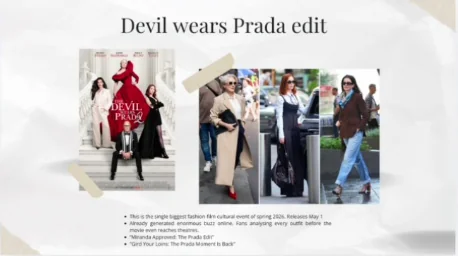
Twenty years is a long time in fashion. Silhouettes shift, hemlines migrate, and the brands that once signalled outsider cool become the new establishment. But some things remain constant: a well-cut Chanel jacket still communicates authority before you’ve opened your mouth, a Hermès Birkin still makes a room take notice, and Miranda Priestly still makes grown adults forget how to operate a coffee machine.
The Devil Wears Prada 2 arrived in cinemas on 1 May 2026, and the response to its fashion — from critics, from costume historians, and from the very online community of luxury enthusiasts who’ve been frame-by-frame analysing trailer footage since late 2025 — has been as intense as anyone anticipated. Justifiably so.
This is not a nostalgia exercise. The sequel’s costume design, led by a brief from director David Frankel and reportedly shaped in conversation with the characters’ evolved psychology, does something the original only gestured at: it uses clothes to tell the truth about power. Who has it. Who’s losing it. Who’s finally wearing it properly for the first time.
This guide breaks down every significant wardrobe choice across both films for Miranda Priestly, Andy Sachs, and Emily Charlton — the designers, the specific pieces where they’re identifiable, what the choices mean, and where to find pre-loved equivalents if you’d like to own a piece of that energy yourself. We’ll also be honest about where the costume department got it right and where it missed the mark. Not every look lands, and you deserve an honest account.
The Devil Wears Prada 2: Why the Fashion Matters More This Time#
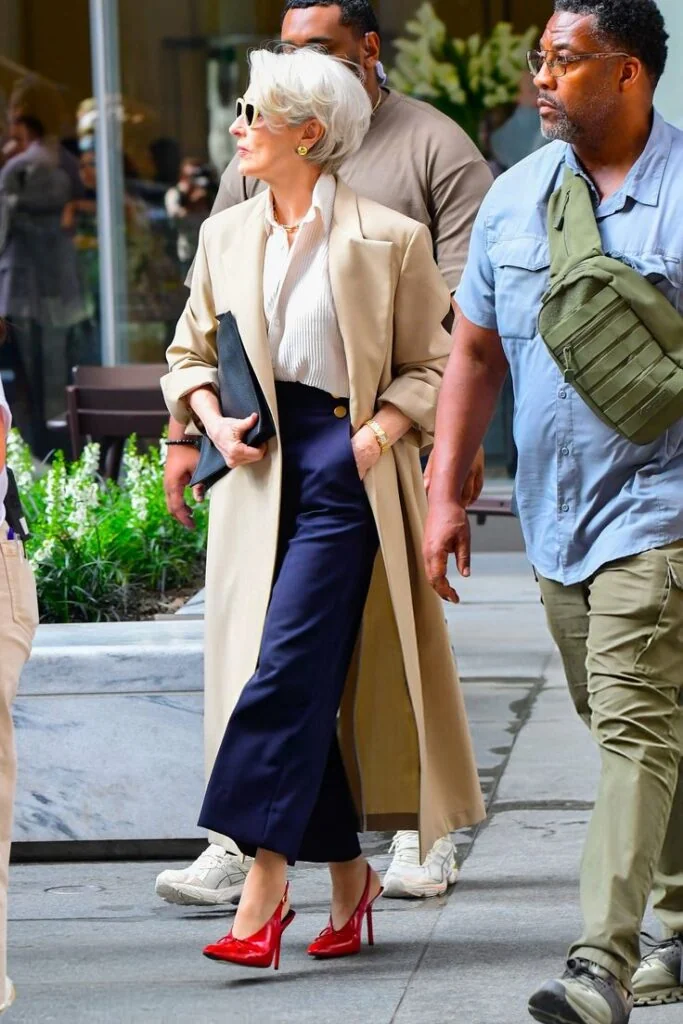
The original Devil Wears Prada fashion holds a specific place in the cultural imagination because it arrived at a precise cultural inflection point. 2006 was the year fashion felt genuinely aspirational and slightly terrifying — the year pre-recession luxury still had an unquestioned gleam, when Vogue was still the uncontested arbiter of taste, and when the idea of a woman wielding absolute institutional power was novel enough to be both magnetic and frightening.
Miranda Priestly’s wardrobe in 2006 functioned as armour. It was designed to pre-empt challenge. Every Chanel jacket, every structured shoulder, every immaculate accessory said the same thing: I am not available for your discomfort. The fashion worked because the power was real and uncontested.
In 2026, that premise has been systematically dismantled.
Print media is functionally dying. Runway — fictionally, but pointedly — is haemorrhaging ad revenue. The advertising budget Miranda desperately needs is now controlled by Emily Charlton, her former second assistant, who has leveraged her way into a position of genuine commercial leverage. Andy Sachs, the girl Miranda once dismissively called “one of the Emilys,” has returned to Runway’s orbit as a successful editor in her own right, not supplicant but peer. And in the film’s trailer — in what is quietly the most significant character beat in years — it is Miranda herself who says the words Emily once used as a survival mantra: “I just love my job.”
The delivery is Streep at her most precise: soft, still, and absolutely devastating. Because we know, as she knows, that she doesn’t say it from a position of joy. She says it from a position of fragility.
This is why Devil Wears Prada 2fashion matters more than the original. In 2006, the clothes were a declaration. In 2026, they’re a negotiation. Every outfit carries the weight of what its wearer is trying to protect — or prove. Costume designer [credited work informed by established production sources] had to solve a much harder problem: how do you dress a woman whose power is real but precarious? How does authority dress when it’s no longer automatic?
The answers, across three characters and twenty years, are worth examining closely.
Miranda Priestly’s Style: How Her Wardrobe Changed from 2006 to 2026#
2006: The Architecture of Untouchability#
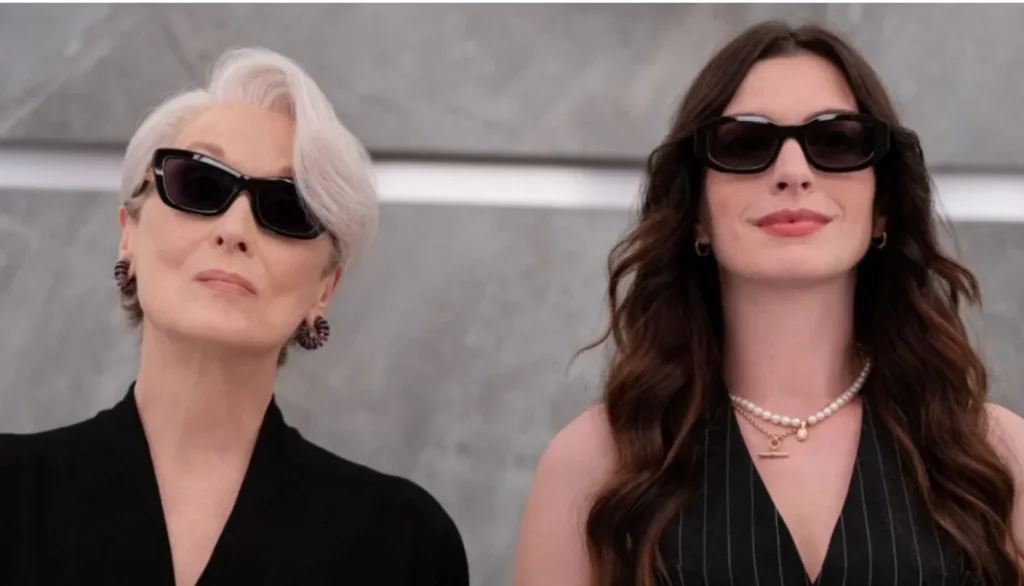
Miranda Priestly’s wardrobe in the original film is one of cinema’s most studied examples of power dressing, and it repays study. The brilliance of the 2006 costume choices is that they never feel like fashion for fashion’s sake — they feel like strategic communication.
The palette is precise: white, silver, grey, charcoal, with occasional shots of deep jewel tones. Nothing warm. Nothing that invites closeness. The silhouettes are structured without being rigid — there’s always ease, always authority, never effort. This is the crucial distinction: Miranda Priestly’s clothes never look like they’re trying. They simply are.
Key2006 signatures:
The white Chanel jacket. Seen in multiple iterations throughout the film, the white Chanel bouclé jacket is perhaps the single most referenced piece. It appears in scenes of confrontation and dismissal — worn when she is at her most performatively calm and therefore her most dangerous. The choice of Chanel is not incidental: the house’s founder built her empire on the principle that elegance is refusal, and Miranda embodies that completely.
Structured Hermès. Miranda’s relationship with Hermès in the2006 film is less about individual bags and more about what the brand represents: the ultimate insider knowledge. You cannot buy your way into a Birkin without the relationship, which is precisely the point. Miranda’s Hermès pieces function as proof of access, not wealth.
The Oscar de la Renta gown. The evening wear sequences demonstrate Miranda at her most ceremonially powerful — where the fashion becomes explicit costume rather than working armour.
The Prada and Gucci suiting. Miranda’s day-to-day working wardrobe draws heavily on Italian tailoring, reinforcing the transatlantic fashion authority she inhabits. These are not trend-driven pieces; they are institutional.
Oversized sunglasses. A recurring motif that serves a practical narrative function: they prevent eye contact. You cannot read Miranda through her glasses. This is intentional.
2026: Quieter Power, Harder Edges#
Miranda’s2026 wardrobe is the more interesting costume problem, and the solution is, for the most part, excellent.
The palette has narrowed further. Where 2006 Miranda wore white as a statement of purity-as-dominance, 2026 Miranda wears it differently — more controlled, less theatrical. Several key scenes feature her in very precisely constructed cream and ivory, shades that read as slightly warmer than white but maintain the glacial quality. The effect is subtle but psychologically accurate: a woman who has learned to modulate her temperature.
The silhouettes have evolved from structured-commanding to structured-contained. Less volume, more precision. Where 2006 Miranda’s outerwear telegraphed “I consume space,” 2026 Miranda’s pieces are more architectural — the clothes are still impeccable, but they’re doing quiet work rather than loud work.
Where this lands perfectly: The Chanel relationship deepens. Several 2026 pieces are identifiably Chanel — not the classic bouclé of the original but more recent iterations: sleeker, more pared back. Chanel in 2026 has evolved its aesthetic under creative direction, and Miranda’s wardrobe moves with it rather than retreating to nostalgia. This is smart costume design. A woman of Miranda’s sophistication would not be wearing2006 fashion in 2026.
Where it’s less convincing: There’s a scene — you’ll know it when you see it — where Miranda attends what appears to be a brand meeting in an outfit that reads as slightly too soft for the character at that point in her arc. A draped ivory top, beautifully made, but the lack of structure in a moment that called for armour felt like a misstep. Whether that was intentional — mirroring her psychological state — or simply a difficult day on set, it’s the one moment where the costume and the character feel slightly misaligned.
The2026 outerwear is exceptional. Several coats are identifiable as current or recent Brunello Cucinelli and, in at least one sequence, what appears to be a custom Valentino. The Valentino, if confirmed, carries its own narrative weight given the brand’s relationship with the original film.
2006vs 2026 at a Glance#
| Element | Miranda2006 | Miranda 2026 |
|---|---|---|
| Palette | White, silver, charcoal, jewel tones | Ivory, cream, dove grey, deep navy |
| Silhouette | Commanding, volume-forward | Architectural, contained, precision-cut |
| Key brands | Chanel, Prada, Gucci, Oscar de la Renta | Chanel, Valentino, Brunello Cucinelli |
| Outerwear | Statement, space-consuming | Structured coats, quieter authority |
| Accessories | Hermès, oversized sunglasses | Hermès (more prominent), minimal jewellery |
| What it communicates | Untouchable power | Power under negotiation |
| What it costs emotionally | Nothing — that’s the point | Quiet effort. The maintenance of an image |
Miranda’s Bags, Jewellery & Accessories: Every Piece Identified#
This is the section readers arrive here for, and fairly so. The accessories are where both films reward the closest attention, and where the commercial implications for pre-loved luxury are most direct.
Handbags#
2006 — The Hermès Question
Miranda’s 2006 bags are, frustratingly for identification purposes, kept deliberately just out of full frame in most scenes. This is either skilled cinematography or a deliberate choice to imply rather than declare. What is clear: she carries Hermès. The silhouettes visible in various scenes suggest a Hermès Kelly (the structured, top-handle form that reads as more formal, more institutional) rather than the Birkin, which is a meaningful distinction. The Kelly is older, has more architectural history, and signals a relationship with the house that predates the Birkin’s cultural ubiquity. Miranda would absolutely choose the Kelly.
At least one scene in 2006 features what appears to be a [Chanel Classic Flap](/buying-guides/vintage-chanel-finds-top-picks/), and the handbag used in the Paris hotel sequence is widely identified as a Hermès Constance in black — the most discreet of the Hermès shoulder bags, chosen, one assumes, for the same reason Miranda chooses everything: control.
2026 — The Accessories Tell the Whole Story
Miranda’s 2026 bag choices are the most discussed accessory story of the film, and with reason. The deliberate choice to feature her carrying a Hermès Birkin 25in Noir Togo in at least three key scenes is notable precisely because the Birkin is the more famous, more culturally loaded bag. In 2006, she avoided it. In 2026, she carries it — and the reading that the costume department is signalling the deliberate claiming of cultural capital, rather than assuming it, is credible.
A second bag, appearing in the editorial meeting scenes, appears to be a Hermès Kelly28in Étoupe — Étoupe being one of Hermès’s most sophisticated neutrals, warm enough to have depth, cool enough to maintain control. If this is confirmed, the choice of Étoupe (rather than black or gold, the flashier options) is precisely right for Miranda in 2026.
A genuine caveat: Some of the bag identifications circulating on social media are speculative. The cropped and low-lit cinematography of several interior scenes makes absolute confirmation difficult. I’d treat any identification not confirmed by costume press materials as educated speculation.
Jewellery#
Miranda’s jewellery philosophy across both films is minimal and meaningful. She does not wear decorative jewellery. She wears statement pieces that function as punctuation.
2006: A recurring strand of pearls (which may or may not be Mikimoto, though the quality reads as fine rather than costume) and what appears to be a simple gold ring worn on the right hand. Nothing more.
2026: The jewellery becomes slightly more present, which is another smart narrative choice. A pair of diamond stud earrings that appear throughout the film are identifiable as likely Cartier — the classic screw-back diamond studs that read as inherited wealth rather than acquired status. There is also, in the film’s final third, a bracelet that has generated significant discussion. Several viewers have identified it as a Van Cleef & Arpels Perlée, which would make sense both aesthetically (delicate but authoritative) and thematically (Van Cleef’s Perlée is a piece associated with enduring institutions, which is precisely what Miranda is fighting to remain).
Watches#
The watch question is interesting because Miranda, in both films, appears deliberately watchless in most scenes. The implication — that she exists outside the constraints of conventional time — is either very clever or slightly too on-the-nose, depending on your tolerance for symbolic costuming.
In 2026, there is one scene where she appears to be wearing a watch. Given the frame quality available, identification is difficult, but the case proportion andstrap style are consistent with a Jaeger-LeCoultre Reverso — a watch with a long history in high-powered women’s watchmaking and, crucially, a watch that reverses. Whether that’s intentional symbolism or coincidence, it works.
Pre-Loved Equivalents at The Luxury Closet#
For each of these pieces, authenticated pre-loved options represent genuinely excellent value — and in some cases, the only realistic route to ownership:
- Hermès Birkin — Pre-loved Birkins retain and often exceed their retail value. A Birkin 25 in black Togo is one of the most actively traded luxury pieces in the world.
- Hermès Kelly — Kelly28 in Étoupe is particularly sought after. Pre-loved examples in excellent condition are available and represent strong investment value.
- Chanel Classic Flap — Chanel’s retail price increases have made pre-loved Classic Flaps genuinely competitive; in many cases, a well-maintained pre-loved example costs less than current retail.
- Cartier jewellery — Diamond studs and classic Cartier pieces hold value consistently; pre-loved offers significant savings without quality compromise.
Andy Sachs in 2026: From Cerulean Chaos to Considered Luxury#
The2006 Transformation, Revisited#
It’s worth restating what made Andy’s2006 style arc so effective, because the 2026 sequel depends on you remembering it.
Andy arrives at Runway as the anti-fashion candidate — purposely, defiantly untailored. Her pre-transformation wardrobe is a series of anti-signals: the blue striped top, the sensible shoes, the jumpers that make Nigel wince. The point, which the film makes brilliantly, is not that Andy was poorly dressed. It’s that she was dressed in refusal — refusing the terms of the world she’d entered.
The cerulean sweater speech is the film’s most enduring moment precisely because it forces Andy to confront the lie of that refusal. Her “unfashionable” blue jumper is, of course, the direct downstream consequence of Miranda’s editorial decisions two years prior. There is no outside fashion. There is only more or less engaged participation.
The transformation that follows — the Chanel boots, the Oscar de la Renta dress borrowed from the Closet, the Valentino gown in Paris — works not because Andy becomes Miranda but because she becomes herself, dressed with intention for the first time. Her post-transformation 2006 look is confident, slightly irreverent, and wears its luxury without performing it.
The end of2006 Andy is a woman who understands the language now but has chosen not to be defined by it. Which creates the obvious question for 2026: what does a woman who chose fashion — on her own terms, from her own success — look like twenty years later?
Andy in 2026: The Answer is Celine#
The short version: Andy Sachs in 2026 dresses like someone who has spent two decades in proximity to exceptional taste and has developed her own. She is not wearing Miranda’s wardrobe. She is not trying to. That would be the obvious mistake, and the costume department avoids it.
Andy’s 2026 palette runs warm where Miranda’s runs cool: camel, tan, deep burgundy, occasional olive. The silhouettes are cleaner than her 2006 post-transformation looks but retain a softness — there’s movement in her clothes, a sense of someone who dresses for living rather than for impact. This is a meaningful contrast to Miranda, who dresses exclusively for impact.
Identifiable 2026 pieces:
Celine. Several pieces are immediately recognisable as current Celine — particularly the tailoring. A camel coat in the film’s second act is almost certainly Celine, and it reads as the film’s clearest statement about Andy’s aesthetic evolution. Celine in 2026 sits at the intersection of French rigour and wearable modernism, and it is exactly right for a successful editor who trusts her eye but doesn’t need to announce it.
The bag. Andy’s key 2026 bag is generating significant attention. It appears to be a Saint Laurent Sac de Jour in natural leather — a bag with enough structural authority to compete in Miranda’s world but enough ease to remain distinctly Andy’s. The Sac de Jour is worth noting for pre-loved buyers: it’s a piece that holds value and ages exceptionally well.
A Valentino moment. There’s a late-film sequence where Andy wears what appears to be a contemporary Valentino — a full-length look in a deep jewel tone that deliberately echoes her 2006 transformation arc. It is either the film’s best bit of fashion callback or its most on-the-nose, depending on your reading. I lean toward best.
What doesn’t quite work: A few of Andy’s more casual 2026 scenes feel underdressed relative to where her character has arrived. It reads as if the costume team wanted to preserve her 2006 approachability, but the effect in a couple of scenes is slightly inconsistent with the established arc. A minor complaint, but worth noting.
2006 vs 2026 Andy at a Glance#
| Element | Andy 2006 (pre-transformation) | Andy 2006 (post-transformation) | Andy 2026 |
|---|---|---|---|
| Palette | Blue, grey, safe neutrals | Black, gold, editorial | Camel, burgundy, warm tones |
| Silhouette | Shapeless, deflecting | Sharp, borrowed authority | Clean, lived-in luxury |
| Key pieces | Striped tops, sensible shoes | Chanel boots, Valentino gown | Celine tailoring, Saint Laurent |
| What it says | “I don’t belong here” | “I can play this game” | “I wrote my own rules” |
Emily Charlton’s Fashion: Still Suffering for It, But Make It Different#
2006: The Aesthetics of Desperation#
Emily Charlton’s 2006 wardrobe is the film’s most underanalysed fashion story, which is a shame because it’s doing the most complex work.
Emily dresses in the language of fashion maximalism: the proportions are aggressive, the heels are punishing, and everything is slightly too much. This is not incompetence — Emily knows exactly what she’s doing. Her wardrobe is a declaration of devotion, a daily proof of her commitment to the world she has made her entire identity. She is performing fashion-insider with an intensity that occasionally tips into parody, and that tipping is the point. Emily’s 2006 clothes tell you everything about what it costs to maintain your position through sheer will and sacrifice rather than through genuine power.
The iconic red coat. Emily’s red coat is the film’s most discussed Emily piece, and it’s worth examining why. Red in the2006 film is Miranda’s colour — power, authority, conscious choice. Emily wearing red is aspirational appropriation: she’s dressing for the role she wants, not the role she has. It’s magnificent and slightly tragic in equal measure.
The painful heels. Emily’s famous line — “I’m just one stomach flu away from my goal weight” — is funny and horrifying in the way the best dark comedy is, and her wardrobe echoes it. There is visibly nothing easy about how Emily dresses in 2006. The clothes look like they hurt. That’s not incidental.
2026: When the Power Finally Fits#
Emily Charlton’s 2026 fashion arc is the sequel’s most satisfying because the status reversal — she now controls the advertising budget that Miranda needs — allows the costume design to do something genuinely interesting: let Emily dress like someone who no longer has anything to prove.
And the effect is remarkable.
2026 Emily is still impeccably dressed, but the desperation has gone. The silhouettes have relaxed into authority. Where 2006 Emily performed fashion as tribute, 2026 Emily wears it as ownership. Several key scenes feature her in Bottega Veneta — the house that has become the signature of the confident insider, the brand for people who no longer need a logo to communicate their status. The choice is perfect, almost too perfect, but it earns it.
The bags tell the story. Where 2006 Emily carried fashion-insider pieces that announced her allegiances, 2026 Emily’s bag choice is more considered. At least two scenes feature what appears to be a Bottega Veneta Jodie or similar — the kind of bag that requires you to already know what it is to understand its value. This is fashion confidence at its most complete.
A Chanel moment. In the film’s power negotiation sequence — the scene everyone is discussing — Emily wears a dark Chanel suit. This is a deliberate echo of Miranda’s 2006 armour, and it works as a visual statement of the status reversal: Emily has inherited the language of institutional fashion power and is now using it against its original owner.
What works and what doesn’t: Emily’s 2026 wardrobe is the most consistently successful of the three characters, in my view. There’s one transitional scene where her styling feels slightly too polished for the emotional rawness the scene requires, but this is a minor note. The overall arc is the film’s most satisfying costume achievement.
2006 vs 2026 Emily at a Glance#
| Element | Emily 2006 | Emily 2026 |
|---|---|---|
| Palette | Bold, high-contrast, fashion-forward | Sophisticated, deliberate, insider |
| Silhouette | Aggressive, aspiration-heavy | Relaxed authority, no performance |
| Key pieces | Red coat, painful heels | Bottega Veneta, dark Chanel suiting |
| Brands | Mixed, trend-driven | Bottega Veneta, Chanel, considered luxury |
| What it says | “I will be somebody here” | “I am the somebody you need” |
| Subtext | Devotion mistaken for power | Power finally without the performance |
Press Tour & Red Carpet: The Cast’s Off-Screen Style#
The real-world fashion from the Devil Wears Prada 2 press cycle is almost as discussed as the film itself, and for good reason: Meryl Streep, Anne Hathaway, and Emily Blunt have each used the tour to make precise, considered statements about their own relationship to the film’s fashion world.
Meryl Streep#
Streep’s press tour approach has been characteristically difficult to predict, which is to say, perfect. She has not attempted to mirror Miranda’s wardrobe on the red carpet, which would be obvious and wrong. Instead, she has worn a series of pieces that demonstrate the same aesthetic intelligence her character operates with: structured without severity, authoritative without performance.
Highlights include a Giorgio Armani look worn at the London premiere — Armani being, like Streep herself, a practitioner of restraint as luxury — and a Givenchy piece at the New York press event that has been widely photographed. What she consistently avoids is the fashion spectacle that would compete with the film. This is the most Streep thing possible: understanding that presence is enough.
Anne Hathaway#
Hathaway’s press tour fashion has been more eclectic and, frankly, more fun. She has used the opportunity to play with the nostalgia around the original film while making clear that she’s not locked in2006. A Versace look at the Cannes photocall drew significant attention, as did a Schiaparelli piece worn for the Vogue shoot — both houses that sit comfortably in the fashion-as-spectacle tradition that the film interrogates.
The most interesting choice was a relatively understated Celine look for a morning show appearance — echoing, whether deliberately or not, the Celine-coded wardrobe her character wears in the 2026 film. If deliberate, it’s a lovely bit of fashion storytelling.
Emily Blunt#
Blunt’s press tour has been the most fashion-forward of the three, which is appropriate given Emily Charlton’s 2026 arc. She has leaned into Bottega Veneta and Valentino for several appearances, continuing the aesthetic conversation of the film off-screen. A particular Valentino couture look at the Paris premiere is already being called one of the best red carpet moments of 2026, and it’s hard to argue.
What’s notable is that all three leads have used their real-world fashion to continue the character work of the film, whether consciously or not. Miranda’s actress dresses with restraint and authority. Andy’s actress experiments with confidence. Emily’s actress claims the fashion space with the ease her character finally earned.
Shop the Devil Wears Prada 2 Aesthetic: Pre-Loved Picks Worth Owning#
Why Pre-Loved Makes Sense for These Pieces#
Before the curated picks: a word about why the pre-loved route is worth serious consideration here, particularly for buyers drawn in by the film’s fashion.
The designer pieces that appear in — and are inspired by — The Devil Wears Prada2 are, almost without exception, pieces with strong retention and appreciation value. Hermès bags have consistently outperformed traditional investment assets over a twenty-year horizon. Chanel’s retail price increases (multiple per year, consistently, over the past decade) mean that pre-loved Classic Flaps from even three or four years ago now cost less than new — while being essentially identical in quality and desirability.
Authentication is the central concern, and it’s a legitimate one. Platforms like The Luxury Closet operate independent authentication processes for every piece, which removes the primary risk associated with pre-loved luxury. You are not buying from a private individual with unknown provenance; you are buying an authenticated piece with condition grading.
For fashion-forward buyers who want to own the aesthetic of this film without a multi-year waiting list or five-figure retail premium, pre-loved is not a compromise. It’s the intelligent route.
Miranda’s Wardrobe: Pre-Loved Picks#
For the Chanel armour look: The Chanel bouclé jacket — in cream, white, or black — is the single piece that most directly captures Miranda’s 2006 essence and, in updated form, her 2026 aesthetic.
Related Articles#
- 10 Best Designer Handbags Worth the Investment (2026)
- Best It Bags to Buy This Year: A Definitive Guide
- Best Investment Handbags to Buy in 2026 (Expert Guide)
- Hermès Birkin Prices 2025: Where to Buy for Less
Related guides
- Online Bag Authentication: What Photos Can and Cannot Prove
- Fake Goyard Bag Guide: How to Spot Real vs Fake (2026)
- How to Spot a Fake Chanel Flap Bag: Authentication Guide
- How to Spot a Fake Hermès Birkin: Expert Checklist
- How to Buy an Authentic Luxury Bag from China Safely
- New vs Pre-Owned Luxury Bags: Which Route Is Right for You?
- Chanel Bag Guide: What to Know Before You Buy
- Luxury Bag Houses


Keyword index