Introduction: A Rented Coat and a Bigger Shift #

On January 1, 2026, at New York City’s mayoral swearing-in, held inside a decommissioned subway station just after midnight, the most interesting fashion moment wasn’t a gown or a designer name. It was a credit line.
Rama Duwaji, appearing alongside Mayor Zohran Mamdani, wore a vintage Balenciaga wool coat rented from the Albright Fashion Library, shorts borrowed from The Frankie Shop, vintage earrings, and Mista Shelley boots that were also on loan. Four pieces, none of them purchased new, all of them credited with a single quiet phrase: “on loan.”
I’ve sat through enough red-carpet fashion credits to know that most of them are engineered for maximum brand visibility. This one wasn’t. There was no headline gown, no exclusive first-look, nothing built for a viral moment. And yet it was, in its own way, the most talked-about look of the night among people who actually pay attention to how clothes get made and where they go afterward.
That’s the thesis of this piece: sustainable luxury fashion isn’t being led by the brands making the loudest sustainability claims. It’s being led by rental libraries, resale platforms, and vintage dealers who have quietly built a system that gets more value out of every well-made garment, without asking anyone to buy something new to prove it. Brand sustainability campaigns tend to focus on inputs — recycled fibers, “responsibly sourced” leather, carbon-neutral shipping. Pre-owned and rental models focus on the thing that actually matters: how many times a garment gets worn before it’s retired. That distinction is the difference between marketing and impact, and it’s worth unpacking properly.
What an “On Loan” Credit Really Signals #
I don’t think Duwaji’s stylist chose rented and vintage pieces to make a political statement about sustainability. I think they chose them because the pieces were right — well-cut, distinctive, appropriate for a midnight ceremony in a subway station. That’s actually the point. Nothing about the look read as a compromise or a substitute for “real” luxury.
That matters more than it sounds. For decades, the unspoken rule of high-visibility dressing was that important moments demanded new clothes — ideally with a designer’s name attached and a press release to match. Choosing archival or borrowed pieces for a swearing-in, rather than for a private dinner, signals that this hierarchy is loosening. Newness is no longer treated as a proxy for significance.
What’s replacing it is discernment. Anyone with enough money can buy a new Balenciaga coat. Fewer people know how to find a vintage one in excellent condition, or which rental library carries pieces worth borrowing for a specific occasion. That knowledge — knowing what’s worth owning, what’s worth renting, and what’s worth skipping entirely — is becoming its own form of status, arguably a more interesting one than simply owning the newest thing.
I’d also push back gently on the idea that this is purely virtuous. Renting and buying vintage are also just smart, occasionally more interesting choices. A well-preserved 1990s Balenciaga coat has a silhouette you can’t buy new right now. That’s not sacrifice. That’s taste.
The Economics of Sustainable Luxury: Why Circulation Beats Consumption #

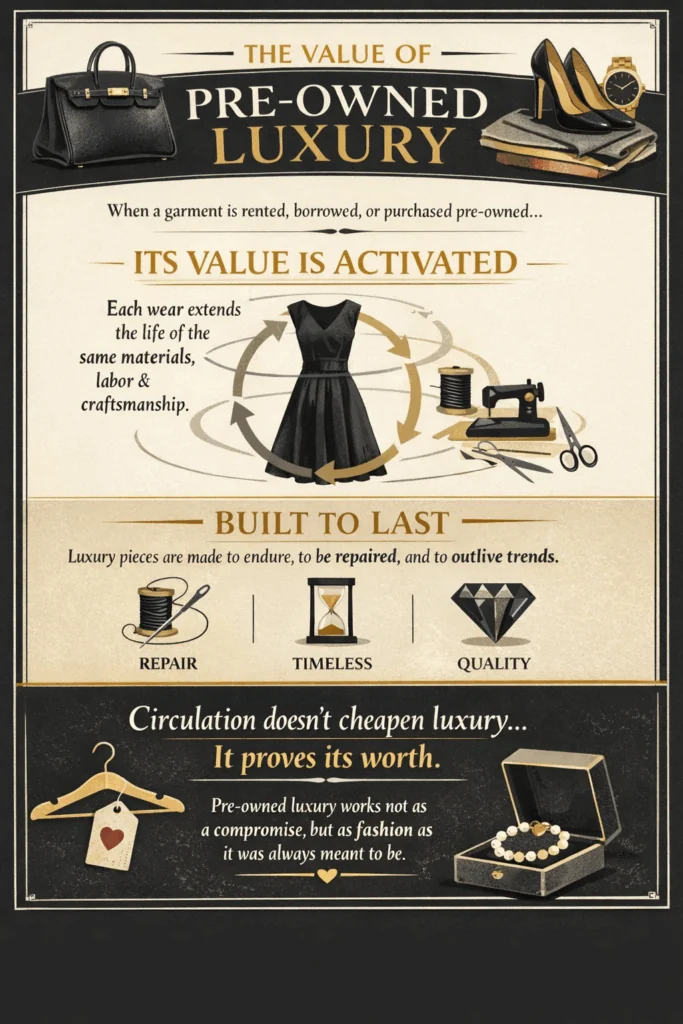
Here’s the part most sustainability conversations in fashion skip: the environmental and economic value of a garment isn’t fixed at the point of manufacture. It’s determined by how many times it gets worn.
A Chanel flap bag that sells once, gets worn twice, and then sits in a closet for a decade has extracted a fraction of the value embedded in its materials and craftsmanship. The same bag, resold, worn by a second owner, then a third, then rented out for events in between — that bag is doing its job. The tanning, the hardware, the hand-finishing, the transport emissions that went into making it: all of that gets amortized across far more wear.
This is why renting, borrowing, and reselling outperform most brand-side sustainability initiatives on a simple cost-per-wear and impact-per-wear basis. A brand can switch to a lower-impact tanning process and still sell a bag that gets worn ten times before it’s abandoned. A resale platform or rental library, by design, keeps that same bag moving for years. Circulation is a distribution problem, not a materials problem, and it’s one the resale and rental sector has solved far more effectively than most fashion houses have solved their supply chains.
There’s also a practical financial argument that I think gets undersold. Renting a statement piece for a single event, rather than buying it outright, is often the more rational financial decision — you get the piece, the photos, and the moment, without tying up capital in something you’ll wear once. Buying pre-owned, meanwhile, means you’re not paying the “new” premium that evaporates the moment a bag leaves the boutique. In both cases, you’re getting more utility per dollar than you would buying new and wearing rarely.
Greenwashing vs. Genuine Sustainability in Fashion Houses #
I want to be fair to the brands here, because the pressure they’re under is real. Luxury houses are being asked to rethink materials, modernize production, improve supply-chain transparency, treat artisan communities fairly, and shrink their environmental footprint — all while maintaining the craft standards that justify their prices. That’s a genuinely difficult list, and some brands are making real progress on parts of it.
But the gap between that effort and the marketing built around it is often wide, and it follows a fairly predictable set of patterns:
- Fibbing — claims that sound reassuring but don’t hold up under scrutiny.
- Vagueness — “eco-friendly,” “conscious,” or “green” language with no specifics attached.
- No proof — environmental claims with no third-party verification behind them.
- Lesser evils — a marginally improved product still marketed as though it’s a solution.
- Hidden trade-offs — one sustainable feature highlighted while ignoring everything else about how the product was made.
- Irrelevance — brands touting the absence of a material that was never used or already banned, framed as a bold sustainability move.
I’ve read enough sustainability pages on luxury brand websites to recognize most of these on sight. And I’d rather be direct about it than diplomatic: a lot of “sustainable capsule collections” are a rounding error against a brand’s total output, dressed up as a meaningful shift.
Set that against what a rental library or resale platform actually does. Albright Fashion Library doesn’t need a sustainability campaign — its business model is inherently one of extending a garment’s working life. The same is true of resale platforms like The RealReal or Vestiaire Collective. Their impact isn’t a marketing layer on top of the business; it’s the business. That’s the honest distinction, and it’s why I’d trust a well-run resale platform’s environmental case over most luxury brand sustainability reports without needing to fact-check every line.
None of this means brand-led sustainability efforts are worthless. Better materials, smaller batches, and repair programs are genuinely useful, and several houses (Chanel’s long-standing repair services, for instance) deserve credit. But they’re complementary to circulation, not a substitute for it.
Buying Pre-Owned as an Investment: What Holds Value #
If you’re buying pre-owned with resale value in mind — and at this price point, most people should be — condition and category matter more than brand name alone. Here’s what I’ve seen hold up, and what doesn’t.
Categories that retain value well:
- Hermès Birkin and Kelly bags remain the benchmark for value retention, and in some leather and hardware combinations, they appreciate over time. Waitlists on new bags push demand into the resale market, which supports pricing.
- [Chanel Classic Flap](/buying-guides/vintage-chanel-finds-top-picks/) and 2.55 bags hold value reliably, particularly in black caviar leather with gold hardware — the most liquid combination on resale platforms. Chanel’s periodic price increases on new bags have historically pulled resale prices up with them.
- Louis Vuitton monogram canvas pieces, especially discontinued shapes or collaborations, depreciate less than seasonal leather bags because canvas resists wear and the brand rarely fully retires monogram styles.
- Cartier Love bracelets and Van Cleef & Arpels Alhambra pieces in gold hold value well because the material value (gold, in particular) puts a floor under the price regardless of styling trends.
- Rolex and Patek Philippe watches in steel, particularly discontinued or waitlisted references, are the closest thing in this world to a genuinely investable pre-owned category — some models sell above retail on resale.
What doesn’t hold up:
- Seasonal or logo-heavy pieces tied to a specific trend cycle lose value fast once the trend passes.
- Exotic leathers (crocodile, ostrich) can be harder to resell despite higher original price tags — the buyer pool is smaller and condition sensitivity is higher.
- Anything with visible wear on corners, hardware, or handles takes a real hit. Buyers researching pre-owned designer fashion are paying close attention to condition photos, and rightly so.
- Limited runway or collaboration pieces are a gamble — some become collector’s items, most just become hard to sell.
The honest caveat: pre-owned luxury is not a reliable investment vehicle in the way people sometimes frame it. Most bags, even good ones, don’t beat inflation. What they do is retain a meaningful percentage of their value while giving you years of use — which is a very different, more realistic proposition than “investment,” and worth keeping in mind before you buy something on the promise that it’ll appreciate.
How to Start: Renting, Borrowing, and Buying Vintage Smartly #
If you’re new to this side of luxury, here’s how I’d approach it, based on what’s actually worked and what’s tripped people up.
For renting: Start with an event-specific need rather than trying to build a rental habit for everyday wear — it’s better suited to occasions than daily use. Platforms like Rent the Runway and Albright Fashion Library carry designer pieces, but always check the garment’s condition photos and read the most recent renter reviews, not just the older ones. Insurance or damage protection is usually offered for a fee; take it for anything with delicate embellishment or pale-colored fabric.
For buying pre-owned: Authentication is the single most important step, and it’s not something to skip even on platforms that claim to authenticate in-house. Cross-check:
- Serial numbers and date codes against the brand’s known formats for that era.
- Stitching consistency, particularly on logo placement and hardware alignment — counterfeiters have gotten very good at surface details but still struggle with proportion.
- Hardware weight and engraving depth, which is hard to fake convincingly.
Reputable platforms — The RealReal, Vestiaire Collective, Fashionphile, and Rebag among them — do their own authentication, but I’d still recommend a second, independent check (Entrupy or a specialist authenticator) for anything above a few thousand dollars. It’s an extra cost, but it’s cheap insurance against a very expensive mistake.
For vintage specifically: Condition matters more than age. A 20-year-old bag stored well, with intact hardware plating and no interior odor, is a better buy than a 5-year-old bag that’s been carried hard. Ask sellers directly about smoke exposure, sun fading, and any repairs — reputable vintage dealers will tell you upfront rather than let you find out after purchase.
FAQ: Pre-Owned and Rented Luxury Fashion #
Is pre-owned designer fashion as safe to buy as new? It can be, provided you buy from a platform or dealer with a real authentication process, not just a stated policy. Ask what method they use and whether it’s done in-house or outsourced to a third party. If a seller can’t explain their process clearly, that’s a red flag regardless of how polished the listing looks.
Do rented designer clothes lose their appeal after being worn by others? Not if they’re properly cared for between rentals. Reputable rental libraries clean, inspect, and sometimes repair pieces between each loan. The bigger practical concern is fit and condition consistency, not some sense of a garment being “used up” — clothing doesn’t work that way, and treating it as though it does is part of what drives overconsumption in the first place.
Which luxury resale value holds up best over time? As a category, hardware bags from Hermès and Chanel in classic colorways (black, especially) are the most consistent performers. Fine jewelry in gold and watches from brands with genuine waitlists (Rolex, Patek Philippe) also tend to hold value well. Trend-driven pieces, regardless of brand, are the least reliable.
Is it considered acceptable to wear a rented outfit to a formal or high-profile event? Increasingly, yes, and the mayoral swearing-in credit is a good example of that shift becoming visible at a fairly high-profile level. The etiquette concern that used to exist — that renting signals you couldn’t afford to buy — has largely faded as more people, including public figures, do it openly and by choice.
How do I know if a vintage designer piece is a good long-term buy rather than just an old bag? Look at whether the style has been discontinued or is likely to become harder to find, check that the leather or fabric is in genuinely good condition (not just “good for its age”), and confirm the hardware and lining match documented examples from that production era. A vintage piece is only a good buy if it would still be desirable independent of its age.
Does buying pre-owned instead of new actually make a meaningful environmental difference? Yes, more so than most brand sustainability initiatives, because it directly increases the number of wears extracted from materials and labor that have already been produced. It doesn’t offset all the impact of the fashion industry, but on a per-garment basis, it’s one of the more effective choices an individual buyer can make.
Related Articles #
- How Pre-Owned Luxury Fashion Is Reshaping the Industry
- Why the Chanel Crossbody Bag Never Goes Out of Style
- How to Sell Luxury Items Online: The Luxury Closet Guide
- 10 Best Designer Handbags Worth the Investment (2026)


Keyword index