Introduction: This Week’s Pre-Owned Pick #
Every Thursday, our handbags team pulls one piece from the vault worth talking about. Not the loudest bag, not always the newest — just one that earns its spot through design, rarity, or the kind of story that makes a bag worth owning twice.
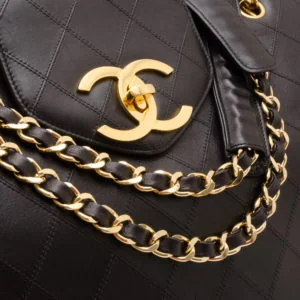
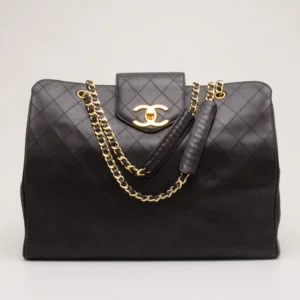
This week’s pick is a Chanel Vintage Jumbo Weekender Tote in quilted black leather, and it’s the rare vintage find that solves a real problem: most Chanel bags are built for evenings, not overnight trips. The Jumbo Weekender was made for carrying real things — a change of clothes, a toiletry bag, the paperback you never finish on a flight — while still looking like it belongs on your arm at baggage claim rather than in the hold.
If you’re new to buying pre-owned Chanel, this guide walks through what makes this piece worth considering, how to verify it’s genuine before you commit, and how it stacks up against another perennial resale favorite: the Hermès Kelly.
Why This Vintage Chanel Weekender Stands Out #
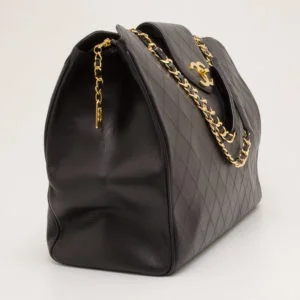
Chanel’s diamond quilting was designed in the 1980s under Karl Lagerfeld to modernize the house’s classic flap silhouette, and that same stitch pattern scales up beautifully on a larger tote. On the Jumbo Weekender, the quilting isn’t just decorative — it adds structure to a soft-sided bag, so it holds its shape whether you’re packing light for a weekend or stuffing it full for a work trip.
Size is the real differentiator here. Chanel’s smaller flap bags are built for evening use: a phone, cards, lipstick, done. The Weekender is a different category entirely — closer to a soft-sided overnight bag than a handbag, with enough depth to function as a genuine carry-on. That’s a rare combination in Chanel’s catalog, where most vintage pieces prioritize silhouette over capacity.
The honest tradeoff: a bag this size shows wear differently than a small flap. Corners, base, and handle drop are under more daily stress, so vintage examples need a closer look at structural integrity, not just surface condition. That’s the point of the authentication and buying sections below — a bag this useful only stays useful if it was built to last and has been cared for accordingly.
How to Authenticate a Vintage Chanel Bag #
Before getting into the Weekender specifically, it’s worth covering what actually separates a real vintage Chanel bag from a convincing fake — because the details that matter are consistent across eras and styles.
Serial stickers and authenticity cards. Chanel used sequential serial number stickers inside its bags from the late 1980s through 2020, each paired with an authenticity card bearing the matching number. Chanel retired this system in 2021 in favor of a microchip, so a bag claiming to be from the 1990s but chipped instead of stickered is an immediate red flag. The sticker itself should sit flat, with no bubbling, silvering, or peeling at the edges — reproductions often get the font weight or spacing slightly wrong.
Stitching. Genuine Chanel quilting is dense and even, typically eight stitches per diamond edge on Jumbo-sized pieces, with no loose threads or skipped stitches at the seams. Counterfeits frequently show inconsistent diamond sizing across the same panel, which is one of the fastest tells once you know to look for it.
Hardware. [Chanel hardware](/prices-and-value/chanel-handbag-prices-iconic-styles-cost/) should feel substantial, not light or hollow. The CC turnlock and any engraved logos should be sharp and centered, not shallow or slightly off-axis — a common flaw in counterfeit tooling. Vintage pieces will show real hardware from that period, which tarnishes differently than modern plating, so a turnlock that looks brand new on a bag claiming to be 30 years old deserves scrutiny.
Leather quality. Chanel’s lambskin has a soft, buttery hand feel with a fine, consistent grain. Caviar leather, used more heavily from the late 1990s onward, has a pebbled texture that should feel structured, not stiff or plasticky. Cheap leather substitutes tend to feel either too rigid or too rubbery — neither matches the real thing.
Vintage Chanel vs. Hermès Kelly: Comparing Investment Value #
For readers weighing pre-owned Chanel against an Hermès Kelly, it helps to understand that these two houses play by different rules in the resale market.
Hermès controls supply tightly through waitlists and limited production, which is the main driver behind the Kelly’s reputation for holding — and often exceeding — retail value on the secondary market. Rarer leathers, exotic skins, and discontinued colorways can command significant premiums well above what the bag originally cost.
Chanel operates differently. Production volumes are higher, and Chanel has raised retail prices aggressively over the past several years — in some cases more than doubling prices on classic styles since 2019. That pricing strategy has actually helped vintage and pre-owned Chanel appreciate in relative terms, since older bags purchased at lower original price points now sell for a fraction of current retail while remaining functionally identical to new pieces.
The practical takeaway: a Kelly is the stronger pure appreciation play, especially in rare configurations, but entry cost and waitlist access are real barriers. A vintage Chanel piece like the Jumbo Weekender offers a lower buy-in, more accessible availability on the resale market, and — because Weekender totes were never produced at the same scale as flap bags — a rarity factor that smaller Chanel styles don’t have. It’s a different kind of value proposition: less about outperforming retail, more about owning something increasingly hard to find at a price still well below what current-production Chanel commands.
Buying Advice: What to Look for When Purchasing Pre-Owned #
Beyond authentication, condition assessment is where most buyers either save money or get burned.
Corners and base first. On a bag this size, the base carries the most weight and shows wear fastest. Check for cracking, color transfer, or leather that’s gone stiff and brittle rather than supple.
Handle and strap drop. Vintage leather handles can dry out if the bag sat unused for years. Flex them gently — real cracking under flex is a sign of dried-out leather that will only get worse, not a cosmetic issue you can ignore.
Interior lining. Check for stains, tears, or a sagging lining, which is common in totes that carried heavier daily loads. A worn interior isn’t necessarily disqualifying, but it should be reflected in the price.
Condition grading matters more than a single photo. Reputable resale platforms grade pre-owned bags on a defined scale — typically ranging from pristine or “like new” down to well-loved with visible wear — and that grading should be paired with detailed, unedited photos of high-wear areas: corners, base, handle attachment points, and hardware. If a listing only shows flattering angles, ask for more before buying.
Choose sellers who guarantee authenticity, not just claim it. A multi-point inspection process, a clear return window, and buyer protection matter more than a low price. Vintage Chanel in this category typically sells in the low-to-mid four figures depending on condition and leather type — a wide range that makes seller trustworthiness the deciding factor, not just the number on the listing.
What Is a Chanel Jumbo Weekender Tote? #
The Chanel Jumbo Weekender is a soft-structured, quilted leather travel tote produced by the house primarily during the 1990s and early 2000s, built to function as an overnight or carry-on-sized bag rather than a daily handbag. It typically features Chanel’s signature diamond quilting across the body, dual top handles sized for shoulder or hand carry, a wide zip-top or open-top closure depending on the specific style year, and the CC turnlock or logo hardware associated with the era.
Unlike Chanel’s more iconic Classic Flap or Boy Bag — both designed around a compact, structured silhouette meant for evening or daily use — the Weekender prioritizes interior volume and a collapsible, duffel-like shape. It sits in a smaller production category than the flap bags, which is part of why well-preserved examples are less common on the resale market today. For buyers who want the quilting and craftsmanship Chanel is known for, but in a bag built for actual travel rather than a night out, the Weekender fills a gap the rest of Chanel’s catalog doesn’t really address.
How to Authenticate a Vintage Jumbo Weekender #
The general authentication principles above apply, but the Weekender’s size and construction introduce a few specific checkpoints.
Zipper and closure hardware. Larger vintage totes often used Lampo or Eclair zippers, both recognizable brand names stamped on the zipper pull itself on genuine pieces. A missing stamp or a generic, unbranded zipper pull is worth questioning on a bag of this scale.
Handle stitching under load. Because the Weekender carries more weight than a small flap, the stitching where the handles attach to the body takes more stress over time. On an authentic bag, that stitching is doubled or reinforced; on a fake, it’s often single-stitched and prone to separating.
Quilting scale consistency. Larger bags require the quilting pattern to be scaled proportionally across bigger panels without distortion. Check that the diamond pattern stays uniform across the full width of the bag — counterfeiters copying a smaller reference photo often stretch or compress the pattern unevenly on larger silhouettes.
Interior tag placement. The serial sticker and Chanel interior brand stamp should be positioned consistently with other pieces from the same production era — typically inside a interior pocket or along a side seam. Placement that looks improvised or off-center is a common counterfeit tell specific to larger bag styles, where fakers have less reference material to copy from accurately.
FAQ: Vintage Chanel Weekender Tote Questions #
Is a vintage Chanel Weekender a good investment compared to buying new? Vintage pieces generally sell well below current Chanel retail, since the brand has raised prices substantially in recent years. Whether it “appreciates” depends more on rarity and condition than guaranteed returns — treat it as a well-priced piece of craftsmanship rather than a speculative asset.
How do I know the condition grading on a listing is accurate? Look for platforms that pair a defined grading scale with detailed, unedited photos of high-wear zones — corners, base, handles, hardware. If a seller won’t provide close-up photos on request, that’s a signal to keep looking.
What’s the return policy if the bag doesn’t match the listing? Reputable pre-owned marketplaces offer a defined return window and buyer protection specifically for authenticity or condition discrepancies. Confirm this policy before purchase — it’s the safety net that makes buying vintage online workable.
Does a missing authenticity card mean the bag is fake? Not necessarily. Cards get lost over decades of ownership. It’s a downgrade to due diligence, not a disqualifier — lean harder on stitching, hardware, and serial sticker verification if the card is missing.
How should I care for vintage lambskin or caviar leather? Keep it away from direct sun and moisture, store it stuffed with acid-free tissue to hold shape, and avoid over-cleaning — vintage leather patinas naturally, and aggressive conditioning can do more harm than the wear itself.
Related Articles #
- Why the Chanel Crossbody Bag Never Goes Out of Style
- Chanel Royal Blue Boy Bag: Rare Pre-Owned Find
- Replica vs Pre-Owned Bags: Which Is the Smarter Buy?
- Hermès Retail vs. Resale: Which Should You Choose?
- Authentic vs Fake Hermès Kelly Bag: How to Tell
Related guides
- Online Bag Authentication: What Photos Can and Cannot Prove
- Blue Crocodile Lady Dior Tote: Buying Guide
- Chanel Vintage Flap Bag Buying Guide: Navy Lambskin
- Louis Vuitton Palm Spring Backpack: Complete Buyer's Guide
- How to Buy an Authentic Luxury Bag from China Safely
- New vs Pre-Owned Luxury Bags: Which Route Is Right for You?
- Chanel Bag Guide: What to Know Before You Buy
- Luxury Bag Houses


Keyword index