Introduction#
If you’re shopping for a pre-owned Hermès Kelly, you already know the stakes are high. This is one of the most counterfeited handbags on the resale market, and the difference between an authentic piece and a convincing fake often comes down to millimeters of stitching, the weight of a lock, or the shape of a zipper pull. Learning how to spot a fake Hermès Kelly bag isn’t about memorizing a checklist — it’s about understanding how the bag is actually built, so you can recognize when something feels off.
This guide walks through the construction details Hermès craftsmen obsess over, the hardware markings that change over time, and the practical red flags that separate a genuine Kelly from an imitation. Whether you’re buying your first Kelly or adding to a growing collection, this is the kind of Hermès Kelly authentication knowledge that will save you from an expensive mistake.
Product Overview#
The Hermès Kelly bag has been in continuous production since 1935, originally known as the “Sac à dépêches” before it was renamed after Grace Kelly in the 1950s. It’s produced in two main silhouettes — the structured Sellier and the softer Retourne — and a wide range of sizes, from the compact Kelly 20 to the roomier Kelly 35.
Every Kelly is made almost entirely by hand by a single artisan, from cutting the leather to the final stitch. Depending on the leather and hardware, retail prices typically range from $10,000 to well over $30,000, with exotic skins like crocodile or ostrich commanding significantly more. That price point, combined with limited retail availability, is exactly why the secondary market — and the counterfeit market alongside it — has grown so aggressively.
Design#
The Handle: A Craftsmanship Benchmark#
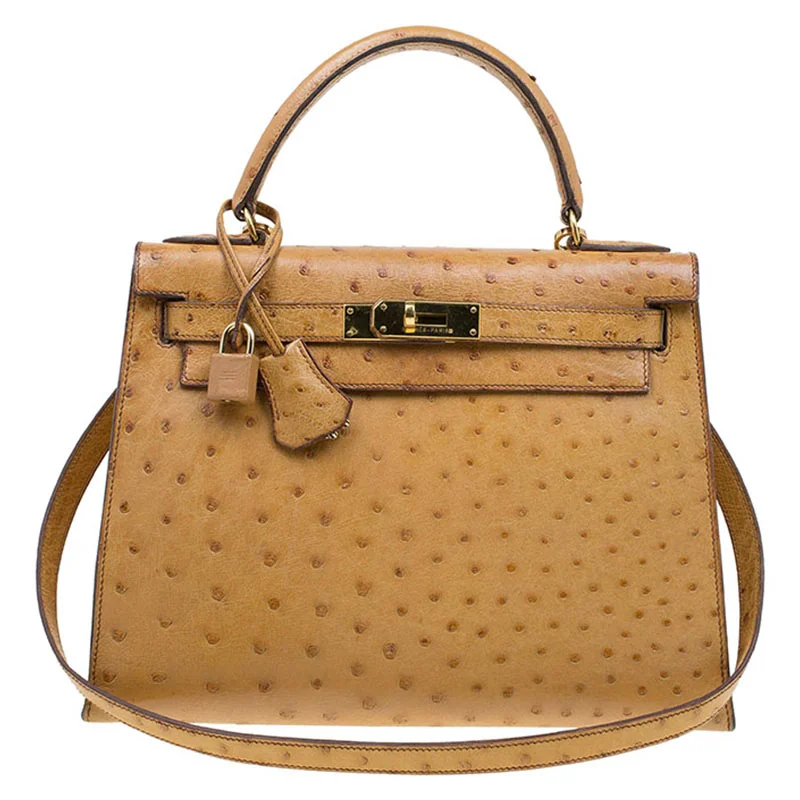
The top handle is arguably the hardest single component on the bag to replicate correctly. It’s built from six separate pieces of leather and takes a trained artisan roughly three and a half hours to complete — and Hermès reports that it can take a newer craftsman ten attempts before the proportions and rigidity meet standard. The result is a handle with a gently curved topside and a flat underside, giving it a firm, almost architectural stance rather than a floppy or soft feel. If the handle on a bag you’re inspecting looks uniformly rounded or feels spongy, that’s already a point of concern.
Hardware on the handle also tells a dating story. Kelly bags produced before 2001 use simple single D-rings connecting the handle to the shoulder strap. After 2001, Hermès switched to a split double D-ring design, with one ring anchored to the handle and the other to the strap. On an authentic bag, the shoulder strap will carry the exact same heat stamp, in the exact same foil color, as the rest of the bag — a detail that’s easy to overlook and easy for counterfeiters to get wrong.
Plaque, Spindle, and Sangles#
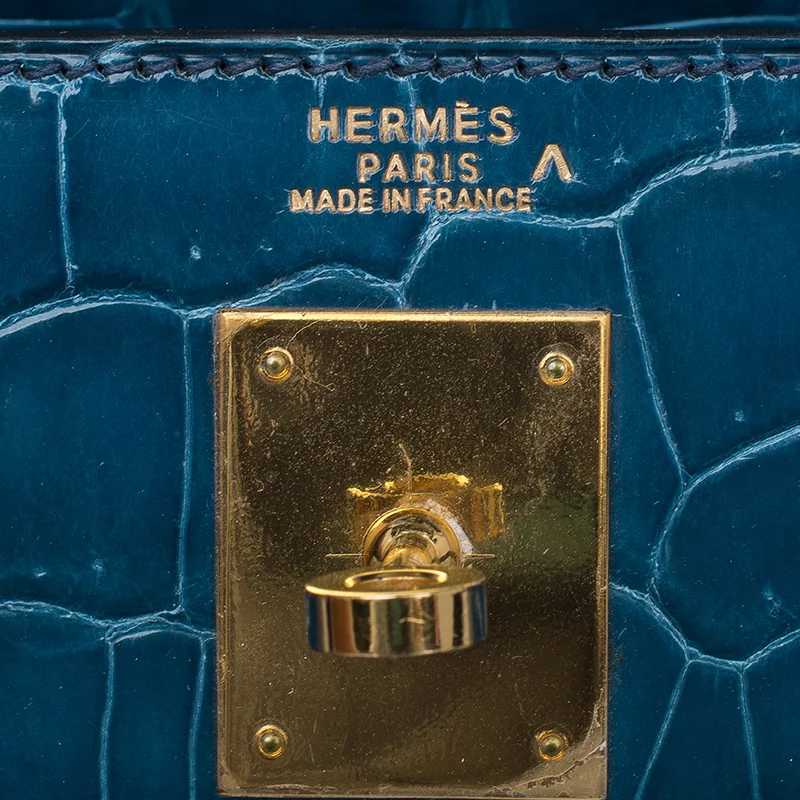
The front closure system — the plaques, spindle, and sangle straps — is where quality control becomes obvious under close inspection. The right-side plaque is engraved “Hermès – Paris,” though on vintage models “Paris” sits on its own line beneath the brand name. The spindle should turn with even, consistent tension all the way around its rotation. If it feels loose, gritty, or unusually tight in spots, that inconsistency is a manufacturing shortcut you won’t find on a genuine piece.
The Zipper System#
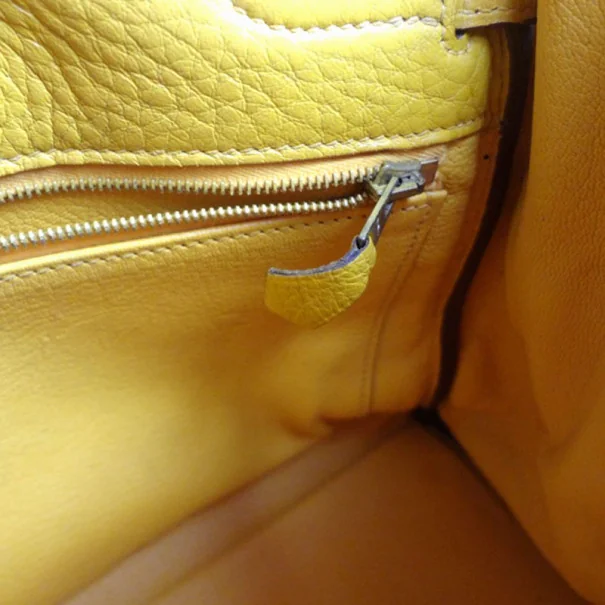
Hermès purchased the exclusive patent for the zippers used on the Kelly, so the components themselves are proprietary — not something a counterfeiter can simply source. On an authentic bag, the zipper pull sits parallel to the teeth at all times; it never dangles loosely into the interior pocket. The leather zipper tab matches the bag’s exact leather and color, and it’s cut into a distinctive diamond shape rather than a plain rectangle. The zipper track itself is stamped “Hermès,” and since 2001, the zipper has used an H-shaped tooth profile instead of the standard square tooth you’d find on a generic zipper.
Materials#
Leather Grain and Feel#
Beyond hardware, the leather itself is often the fastest tell. Authentic Hermès leather — whether Togo, Epsom, Clemence, or an exotic skin like porosus crocodile or ostrich — has a distinct density and grain pattern. Run your hand across the surface: genuine leather feels substantial, with a natural, slightly irregular grain, while leather on fakes often feels thin, artificially uniform, or plasticky. Ostrich leather in particular should show visible, evenly spaced follicle bumps; on fakes these are frequently printed rather than embossed.
Blind Stamps and Heat Stamps#
The Hermès blind stamp appears on the back of the right sangle and reads “Hermès – Paris.” Historically, Hermès dated its bags using sequential letters of the alphabet, but once that system became public knowledge among collectors and resellers, the house moved to a proprietary single-letter code with no discernible pattern — deliberately making it harder to date, and harder to fake convincingly.
Under the front flap, you’ll find the heat stamp, which reads “Hermès Paris Made in France.” This stamp is applied in gold or silver foil, or as a colorless debossed impression, depending on the leather and era. Vintage bags from the 1950s use an entirely different stamp design, so context matters — comparing a decades-old bag to a modern authentication guide without accounting for era can lead you to flag a genuine vintage piece as fake.
Lock and Key Hardware#
Every Kelly ships with a matching lock and set of keys, finished in the same gold-plated or palladium-plated coating as the rest of the bag’s hardware. Both the lock and keys carry a debossed numerical code that should match between the two pieces. On an authentic bag, these numbers are cleanly hand-engraved or etched — crisp, even, and precise. Blurry, shallow, or mismatched numbering is one of the more reliable signs of a counterfeit, since it’s a detail cheap manufacturing simply can’t reproduce accurately.
Stitching and Lining#
Hermès stitching follows a consistent, even pattern with saddle stitching visible at seams — a technique that uses two needles and a single waxed thread pulled through each hole from opposite sides. This creates uniform tension on both sides of the seam, something machine stitching on fakes rarely achieves. The interior lining should also match the quality and craftsmanship of the exterior; a rough, glued-looking lining is a strong indicator that the bag didn’t come from an Hermès atelier.
Pros and Cons#
Advantages:
- Exceptional resale value retention compared to almost any other luxury handbag category
- Handmade construction by a single craftsman, resulting in genuine artisanal quality
- Wide range of leathers, colors, and hardware finishes for long-term collectibility
- Timeless silhouette that hasn’t meaningfully changed in decades
Disadvantages:
- Extremely long waitlists and limited retail availability at boutiques
- High risk of encountering sophisticated counterfeits on the secondary market
- Structured Sellier versions can feel heavy and less forgiving for everyday carry
- Exotic skin versions require careful maintenance and are sensitive to humidity and handling
Who Should Buy#
The Hermès Kelly makes the most sense for buyers who see it as both a wardrobe investment and a long-term asset, not just an accessory. If you’re drawn to structured, formal handbags and don’t mind a firmer carrying experience, the Sellier is worth considering; if you want something softer and more relaxed for daily use, the Retourne is the better fit. First-time Hermès buyers on a tighter budget may be better served starting with a Kelly in classic Togo or Epsom leather rather than jumping straight into an exotic skin, both for cost reasons and ease of care.
Buyers who are still building their eye for authentication should strongly consider purchasing from a reputable pre-owned luxury platform with an in-house verification process, rather than private marketplaces, until they’re confident inspecting hardware and stitching themselves.
Alternatives#
If the Kelly’s price point or waitlist feels out of reach, a few comparable options are worth exploring. The Hermès Constance offers similarly handcrafted quality with a more casual, cross-body-friendly silhouette at a somewhat lower price. Outside the Hermès catalog, the Chanel Classic Flap and the Louis Vuitton Capucines both offer strong craftsmanship and resale value, though neither matches the Kelly’s combination of exclusivity and appreciation history. For buyers specifically drawn to the structured top-handle format, the Chanel Coco Handle is a reasonable stylistic alternative at a more accessible entry price.
FAQ#
How can I tell if a Hermès Kelly bag is real? Check the handle construction and D-ring style relative to the production year, inspect the blind stamp and heat stamp for correct wording and placement, confirm the zipper pull sits parallel to the teeth, and verify the lock and key numbers match and are cleanly engraved. No single detail is definitive on its own — authentication relies on multiple details lining up consistently.
What does the Hermès blind stamp look like? It’s a small engraving on the back of the right sangle reading “Hermès – Paris.” Modern bags use a single-letter proprietary date code rather than the older sequential alphabet system, so the exact stamp style varies depending on when the bag was made.
What’s the difference between vintage and new Hermès Kelly bags? Bags made before 2001 use single D-rings on the handle and different heat stamp designs, particularly on pieces from the 1950s. Post-2001 bags feature double D-rings and the H-shaped zipper tooth profile, which didn’t exist on earlier production.
How do I check if the Hermès Kelly lock and key are authentic? Confirm the lock and key hardware finish matches the rest of the bag, and check that the debossed numerical codes on both pieces match each other. The engraving should be crisp and hand-etched, not shallow or blurry.
Is buying a pre-owned Hermès Kelly a good investment? Historically, yes — Kelly bags in popular leathers and colors have held or increased in value over time, particularly compared to most other luxury handbags. That said, values vary by condition, rarity, and authenticity, so buying from a verified source matters as much as the bag itself.
Final Thoughts#
Authenticating a Hermès Kelly isn’t about spotting one obvious flaw — it’s about confirming that dozens of small details, from stitching tension to hardware engraving, are consistent with how the house actually builds these bags. The more familiar you become with genuine construction, the easier it becomes to recognize when something doesn’t add up on a bag you’re considering.
For most buyers, the safest path is pairing this knowledge with a purchase from a platform that authenticates its Hermès inventory before listing it. That combination — an informed eye and a trustworthy source — is what actually protects you from ending up with an imitation instead of the real thing.
Related Articles#
Related guides
- Online Bag Authentication: What Photos Can and Cannot Prove
- Fake Goyard Bag Guide: How to Spot Real vs Fake (2026)
- How to Spot a Fake Chanel Flap Bag: Authentication Guide
- How to Spot a Fake Hermès Birkin: Expert Checklist
- How to Buy an Authentic Luxury Bag from China Safely
- New vs Pre-Owned Luxury Bags: Which Route Is Right for You?
- Chanel Bag Guide: What to Know Before You Buy
- Luxury Bag Houses


Keyword index