Introduction: The Rise of [[[[Sustainable Luxury](/buying-guides/best-luxury-casualwear-brands-effortless-style-2025/)](/buying-guides/best-valentines-day-jewelry-gifts/)](/brands/stella-mccartney-white-mini-falabella-tote/)](/buying-guides/pre-owned-luxury-fashion-world-environment-day/) Fashion #
Ten years ago, “sustainable” and “luxury handbag” rarely showed up in the same sentence. Buyers wanted hides that patinaed beautifully, hardware that felt substantial, and a resale market that rewarded exotic skins. That calculus has shifted. Secondary-market data from resale platforms consistently shows rising search volume for “vegan leather,” “faux leather,” and “cruelty-free” alongside the usual Birkin and Kelly queries — a sign that the same collectors chasing hardware provenance on an Hermès bag are also asking harder questions about what their bags are made of.
Stella McCartney was building for this shift before it had a name. She launched her label in 2001 with a hard rule that no other major house at the time was willing to commit to, and two decades later that rule is the reason her brand gets cited whenever the industry talks about sustainable luxury. The Falabella — her shaggy, chain-strapped, faux-leather bag — is the clearest proof of concept: a bag that trades animal hide for engineered material and still commands real resale demand. This guide breaks down where the design came from, what it’s actually made of, how it compares to other sustainable houses, and what to check before you buy one, new or pre-owned.
Stella McCartney’s No-Leather, No-Fur Design Philosophy #
McCartney’s position is unusually absolute for a house operating at this price point: no leather, no skins, no feathers, no fur — not in mainline collections, not in collaborations, not in licensed products. That’s a stricter standard than most “vegan capsule” lines other luxury brands release once or twice a year while continuing to build the rest of their business on exotic skins and calfskin.
That commitment shapes sourcing decisions most shoppers never see. Refusing animal hide outright means the brand has to solve, at scale, for a material that can survive daily handling, structured hardware, and years of resale life without leather’s natural give. It also means the brand has taken on projects other luxury houses have mostly avoided — including early work with lab-grown mushroom-based leather alternatives (Mylo) and continued use of recycled and regenerated fibers across accessories lines. Not every experiment has scaled into mainline production, and that’s worth being honest about: material innovation in luxury faux leather is still catching up to genuine hide in long-term durability. But the philosophy isn’t a marketing veneer — it’s a sourcing constraint the brand has operated under since 2001, which is longer than most competitors have had a vegan line at all.
Inside the Falabella: Design, Materials, and Texture #
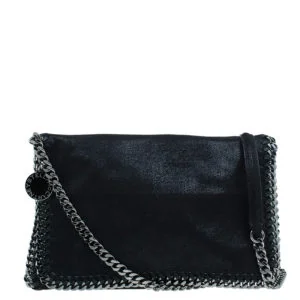
The Falabella launched in 2010 and became the bag that proved a faux-leather design could hold its own next to hide-based status bags. The signature version — “shaggy deer” — uses a long-pile faux fur-like textile face bonded to a technical backing, giving the bag a shimmering, almost brushed-metal sheen depending on the light and angle. It’s not trying to pass as suede or exotic skin; it reads as its own material, which is part of why it built a following independent of “leather substitute” positioning.
Structurally, the base fabric is typically a polyester microfiber substrate, coated or laminated to mimic leather’s hand-feel without PVC in current-generation production — PVC-free coating has become one of the brand’s stated material standards. The hardware carries the rest of the design: an aged brass-tone chain strap, a fold-over flap with a stud-and-D-ring closure, and often a subtle debossed logo instead of a large plaque. Compared to the architectural rigidity of something like a Kelly — box-cut corners, a locking turn-clasp, structured gussets — the Falabella is intentionally slouchy. That’s a design choice, not a durability shortcut, but it does mean the bag holds shape differently over time, and buyers coming from structured-leather bags should expect a softer silhouette from day one.
Why Sustainable Handbags Are Gaining Value Among Collectors #
Resale desirability for the Falabella doesn’t behave like resale desirability for an exotic-skin Hermès piece, and it shouldn’t be evaluated the same way. Exotic hide bags hold value partly because the material itself is scarce and durable across decades. Faux leather doesn’t have that built-in scarcity story — but it has a different one: brand-driven ethical positioning that’s increasingly a purchase criterion for a specific, growing buyer segment.
In practice, that shows up as steadier-than-expected resale pricing for well-kept Falabella bags relative to other faux-leather bags on the market, even though it trades below what a comparable-tier leather bag from the same release year would fetch. Collectors who prioritize sustainability are also more forgiving of surface wear if the bag’s provenance and care history are documented — a dynamic that mirrors how condition reports matter in the Hermès resale world, just with different failure points (more on that below). If you’re comparing sustainable options, Stella McCartney’s Falabella sits in a different tier than brands like Matt & Nat or Angela Roi, which are vegan-first but positioned well below luxury pricing; it’s closer in ambition to Gabriela Hearst’s lower-impact lines or Bottega Veneta’s more recent material experiments, though McCartney’s zero-animal-product rule remains stricter than either.
Caring for Vegan Leather and Faux Leather Bags #
Faux leather has a maintenance profile that’s different from hide, not automatically easier. The biggest long-term risk isn’t scuffing — it’s the coating layer cracking or peeling, which tends to happen with age, heat exposure, and friction rather than with normal careful use. Genuine leather can often be conditioned and restored; a cracked polyurethane or coated-microfiber surface generally cannot be fully repaired.
Practical care that actually extends the life of a Falabella or any faux-leather bag:
- Keep it away from direct heat and sustained sunlight — coated synthetics degrade and can crack faster than vegetable-tanned leather under UV and heat exposure.
- Wipe with a slightly damp, soft cloth only; skip alcohol-based cleaners or baby wipes, which can strip the coating’s finish over time.
- Stuff the bag lightly with acid-free tissue or a cotton bag pillow when storing, rather than collapsing it flat — this matters more on the shaggy deer texture, which can mat if compressed for long periods.
- Avoid overloading the bag beyond its intended capacity; the chain hardware and stitched attachment points bear more stress on a softer-structured bag than on a boxier, reinforced design.
- Rotate use rather than carrying it daily for years straight. Faux leather shows fold and crease wear at stress points (corners, handle drops) faster than most full-grain hides.
None of this makes the material fragile. It makes it different, and buyers who treat it like leather — heavy conditioning products, humid storage, aggressive cleaning — tend to shorten its life rather than extend it.
Buying Advice: What to Check Before Purchasing a Sustainable Designer Bag #
Authenticating a sustainable designer bag draws on the same instincts you’d use vetting an Hermès piece, applied to different details.
- Check the interior stamp and date code placement against known authentic references for the specific bag line and production year — counterfeiters replicate the Falabella’s silhouette more easily than its hardware finish.
- Inspect the “shaggy deer” texture up close. Authentic pile is dense, even, and consistently directional; counterfeit versions often use a shorter, sparser pile that looks flatter in photos and thinner in hand.
- Weigh the hardware. The chain strap and hardware on genuine pieces have a specific heft and a matte, slightly aged brass finish — cheap replicas tend to use lighter, shinier metal that tarnishes unevenly.
- On pre-owned bags, ask for close-up photos of the corners, strap drop, and closure stud specifically — these are the first places faux leather shows cracking, and sellers don’t always volunteer that detail unprompted.
- Verify the seller or platform’s authentication process for non-leather designer bags specifically. Some resale authenticators are leather-hardware specialists first and may be less rigorous on textile-based construction; ask what they check.
- Treat unusually low prices with more suspicion here than with leather bags, since material cost is lower to begin with — a steep discount on a faux-leather bag doesn’t have the same “found a deal” logic that it might on a hard-to-source exotic.
Buying pre-owned is genuinely a smart move on this bag category: since durability concerns center on visible surface wear rather than hidden structural issues, condition is something you can actually assess from photos and in-person inspection, unlike, say, verifying an exotic skin’s origin.
How the Falabella Bag Fits Into a Capsule, Sustainable Wardrobe #
The Falabella earns its keep in a smaller, more intentional wardrobe better than it does as a single flashy addition to a bag rotation. Its shimmering texture already does visual work, so it pairs best against simple, tailored pieces — a structured wool coat, straight denim, or a monochrome knit set — rather than competing with other textured or logo-heavy items. The chain strap and slouchy shape read equally well cross-body during the day and hand-carried at night, which is exactly the kind of versatility a capsule wardrobe is built around: fewer pieces, each doing more.
It also makes an honest case for itself as a “one ethical splurge” piece for shoppers building out a more sustainable closet without abandoning designer quality altogether — you get a recognizable, well-made accessory without a leather or fur supply chain behind it. That’s a different value proposition than a Kelly or Birkin, and it should be treated as one: buy the Falabella because you want what it is, not as a lower-commitment stand-in for a hide bag you’re not ready to buy.
FAQ: Stella McCartney and Sustainable Handbags #
Is the Falabella bag real leather? No. Stella McCartney has never used leather, skins, fur, or feathers in any product, including collaborations and licensed goods. The Falabella’s signature “shaggy deer” finish is a long-pile faux material over a coated microfiber base.
How durable is faux leather compared to real leather? It depends on the failure mode. Faux leather resists scuffs and water better in the short term but is more prone to coating cracks and peeling with age, heat, and heavy use. Genuine leather can typically be conditioned and repaired; degraded synthetic coating generally can’t be restored.
Does the Falabella hold resale value? Reasonably well for a faux-leather bag, especially in excellent condition with documented care. It won’t match the resale trajectory of exotic-skin Hermès pieces, but it outperforms most vegan-leather bags outside the luxury tier.
How can I tell if a Falabella is authentic? Check pile density and direction on the shaggy deer texture, hardware weight and finish, interior stamping against known references, and stitching consistency at stress points. When in doubt, use a resale platform with experience authenticating textile-based designer bags, not just leather goods.
What’s the best way to clean a faux-leather bag? A soft, slightly damp cloth for light surface cleaning. Avoid alcohol-based wipes, heavy conditioners meant for real leather, and prolonged heat or sun exposure, which accelerate coating breakdown.
Related Articles #
- Stella McCartney Falabella Bag: Luxury Vegan Fashion
- Bottega Veneta Quality Check: What to Know Before You Buy
- Fendi First Bag Guide: History, Design & Resale Value
- Why the Chanel Crossbody Bag Never Goes Out of Style
- Fendi By The Way Bag Review: Style, Cost & Resale Value
Related guides
- Online Bag Authentication: What Photos Can and Cannot Prove
- Blue Crocodile Lady Dior Tote: Buying Guide
- Chanel Vintage Flap Bag Buying Guide: Navy Lambskin
- Louis Vuitton Palm Spring Backpack: Complete Buyer's Guide
- How to Buy an Authentic Luxury Bag from China Safely
- New vs Pre-Owned Luxury Bags: Which Route Is Right for You?
- Chanel Bag Guide: What to Know Before You Buy
- Luxury Bag Houses


Keyword index