Introduction: Spotlight on the Bvlgari Leoni Shoulder Bag #
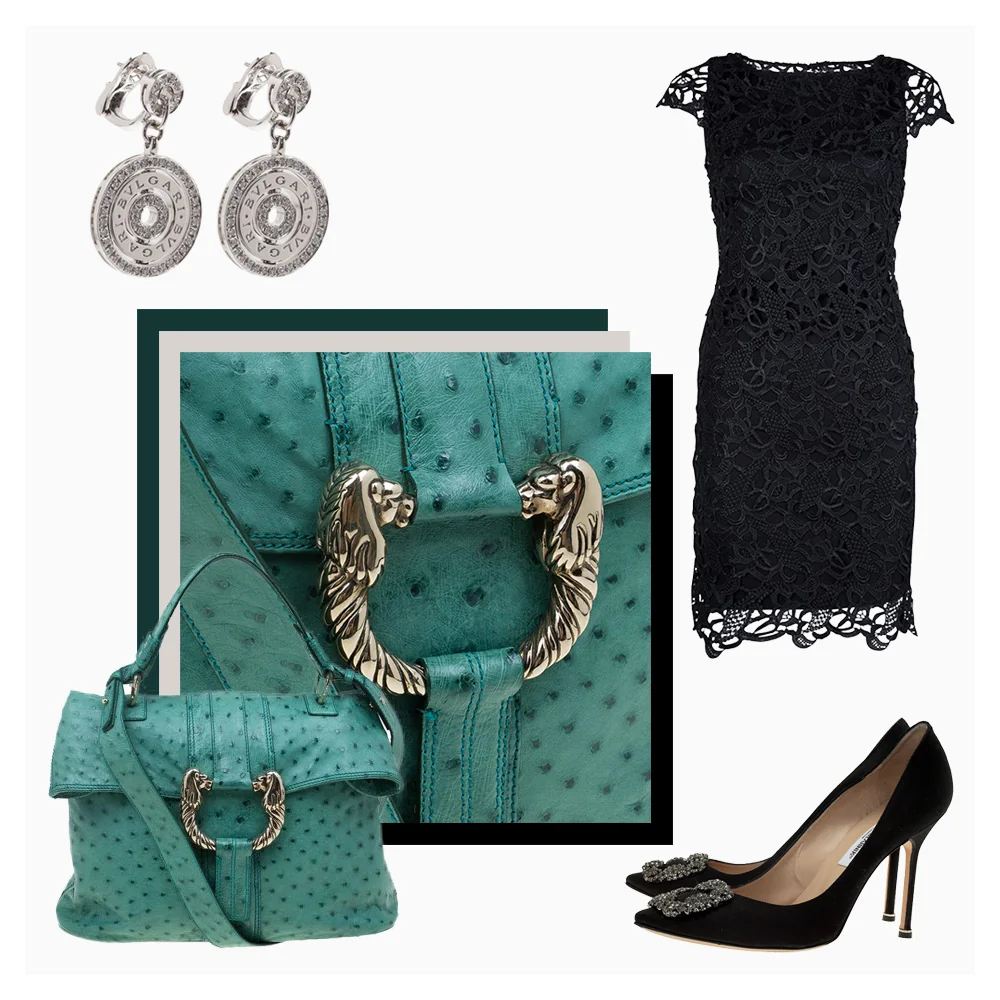
There’s a reason this week’s spotlight lands on a bag most collectors have never handled in person. The Bvlgari Leoni Shoulder Bag in green ostrich skin, currently listed at $5,880, sits at an unusual intersection: it’s rare enough to spark double-takes, historically grounded enough to justify the price, and exotic enough that most buyers need a primer before they commit.
Leoni bags don’t turn up often on the resale market, and even less frequently in ostrich. That scarcity is part of the appeal, but it also means most shoppers are evaluating this piece with very little reference material. This guide fills that gap: what the bag actually measures, what it originally retailed for versus what it’s asking now, how to read its condition and authenticity, and how it stacks up against Bvlgari’s better-known Serpenti Forever line. If you’re weighing a five-figure exotic-skin purchase, you want more than a product photo and a price tag.
The Leoni Collection: Heritage and Design Story #
Leoni translates from Italian as “lions,” and the collection’s design language leans fully into that: sculpted double lion-head hardware, structured silhouettes, and a color palette that ranges from muted neutrals to the kind of saturated jewel tones Bvlgari has built its jewelry house reputation on. It’s one of four core handbag families the brand has produced alongside Serpenti, Isabella Rossellini-era pieces, and later the B.zero1 bag line — Leoni’s identity is built entirely around the lion motif rather than a single hardware detail repurposed across products.
The lion choice isn’t decorative shorthand. Bvlgari was founded in Rome by a Greek silversmith, Sotirios Voulgaris, and the house has leaned on Greco-Roman iconography across its jewelry and accessories ever since — coin motifs, laurel details, and animal symbolism drawn from classical mythology. The lion, associated with strength and regality in both Greek and Roman visual tradition, gave Bvlgari a house symbol distinct from Hermès’ equestrian references or Chanel’s camellia. Leoni arrived as the handbag expression of that heritage, launched in the late 2000s and carried through several seasons before Bvlgari shifted its handbag focus more heavily toward Serpenti in the 2010s.
That shift is exactly why Leoni bags are harder to find today. Production ran for a limited window, exotic-skin versions were made in smaller numbers than calfskin, and Bvlgari’s marketing attention moved on. What’s left in circulation is largely what collectors held onto — which is part of why a well-kept example still commands real money.
Craftsmanship: Ostrich Leather and the Signature Lion Clasp #
The bag in question is finished in ostrich skin, identifiable by the distinctive raised quill follicle pattern across the surface — the same texture that makes ostrich instantly recognizable next to smooth calfskin or even crocodile. Ostrich is prized in exotic leathermaking for a specific reason: it’s naturally more flexible and lightweight than crocodile or alligator, which makes it comfortable in a shoulder bag format, but it’s also more prone to surface scuffing at the quill bumps if handled carelessly. Hermès and Mulberry both work with ostrich for the same reasons Bvlgari did here — it photographs beautifully and wears differently than other exotics, softening with use rather than staying rigid.
The green colorway on this piece leans toward a vibrant turquoise-green rather than a muted olive, which matters because exotic skins take dye differently than smooth leather; the quill follicles can hold pigment unevenly if the tanning process is rushed. A well-executed ostrich dye job shows consistent saturation across the follicles with no dye pooling or fading at the seams — that’s one of the first things to check in person or via close-up photos before buying.
Hardware is where Bvlgari puts its jewelry-house instincts to work. The double lion-head clasp is cast, not stamped, giving it dimension and weight rather than a flat decorative plate. On an authentic piece, the lion detailing should be crisp — mane texture, facial definition, and symmetry between the two heads — with a substantial, cool-to-the-touch metal weight when you lift the flap. Soft or blurred detailing, a hollow feel, or hardware that feels light for its size are common tells on counterfeit Bvlgari pieces, since replicating a cast clasp accurately is expensive and most counterfeiters skip straight to a cheaper mold.
From the Campaign: Julianne Moore and Bvlgari’s 2010 A/W Story #
Bvlgari’s Autumn/Winter 2010 campaign is the reason this bag has any cultural footprint outside collector circles. Shot by Mert & Marcus, the campaign cast Julianne Moore as a kind of regal jungle figure — largely undressed, dripping in jewelry, flanked by two lion cubs, with the Leoni bag positioned as the one fully-dressed object in frame. It was a deliberately provocative campaign for a house that had, up to that point, leaned on more restrained luxury imagery.
The pairing wasn’t arbitrary. Mert & Marcus were known at the time for high-glamour, slightly transgressive fashion imagery, and putting them behind Bvlgari’s campaign signaled the house wanted Leoni read as bold rather than quiet luxury. The lion cubs weren’t just a styling choice either — they reinforced the collection’s namesake in a way no product shot alone could. It’s the kind of campaign that ages well precisely because it was memorable rather than safe, and it’s a large part of why Leoni pieces still generate interest more than a decade later despite the line no longer being in active production.
How to Style the Leoni: A Complete Look #
An exotic-skin bag with cast lion hardware doesn’t need competition from the rest of the outfit — it needs a frame. A structured black piece works best: something like a scalloped lace or textured black dress keeps the palette quiet enough that the bag’s turquoise-green tone and hardware read as the focal point rather than fighting for attention.
Silver-toned jewelry, rather than gold, tends to echo the cool metal of the lion clasp more naturally. A pair of statement white gold earrings with diamond detailing — Bvlgari’s own Cerchi Astrale style is a good reference point — pulls the same jewelry-house sensibility through the rest of the look without duplicating the bag’s motif outright.
Footwear should stay in the same tonal family. Black satin pumps with subtle embellishment, like Manolo Blahnik’s Hangisi style, keep the evening register consistent. The formula that works across most exotic-skin statement bags: neutral base, metallic accents that echo the hardware finish, one focal piece. Anything more competes with the bag rather than supporting it.
Is the Bvlgari Leoni Worth the Investment? #
At $5,880 for a pre-owned ostrich Leoni, the immediate question is how that compares to what it cost new. Bvlgari’s exotic-skin handbags, including Leoni pieces in ostrich and crocodile, generally retailed in the $6,000–$9,000+ range depending on skin and size when they were in production, with crocodile versions sitting toward the top of that band. A price around $5,880 for ostrich puts this listing close to or only modestly below original retail — which is notable, since most leather goods depreciate meaningfully once resold. Exotic skins are the exception: ostrich and crocodile pieces from houses with strong resale demand tend to hold value far better than calfskin equivalents, and a discontinued collection like Leoni adds scarcity on top of that.
That said, “holds value well” only applies to pieces in genuinely good condition, and this is where buyers need to slow down rather than get swept up in the rarity. Before paying anywhere near retail for a pre-owned exotic piece, check:
- Follicle condition — look for cracking, flaking, or dryness at the raised quill bumps, which is the first place ostrich shows age or neglect.
- Hardware finish — the lion clasp should show minimal plating wear, no green oxidation around the edges, and no looseness in the closure mechanism.
- Color consistency — uneven fading, especially at edges and handle-contact points, suggests sun exposure or poor storage.
- Interior wear — lining stains or a strong odor often indicate the bag wasn’t stored in breathable conditions, which shortens the life of exotic skin.
- Seller documentation — reputable resale platforms should grade condition explicitly (excellent, very good, good, fair) and disclose any repairs, re-dyeing, or hardware replacement rather than leaving buyers to guess from photos.
On authenticity specifically: request close-up images of the interior stamping, the lion clasp detailing from multiple angles, and the leather tag or date stamp if present. Cross-check the font weight and spacing on any engraved logo against verified authentic references — Bvlgari’s engraving is precise and evenly spaced, and counterfeit pieces frequently get the kerning slightly wrong. If a seller won’t provide these images before purchase, that’s a reason to walk away regardless of how good the price looks.
The honest downside: ostrich is a maintenance-heavy material. It needs conditioning to prevent the follicles from drying and cracking, should be kept away from direct heat and humidity swings, and shouldn’t be stored in plastic dust bags long-term since exotic skins need airflow. If you’re not prepared to condition it periodically and store it properly, the value-retention argument weakens considerably — neglected exotic skin degrades faster than calfskin, not slower.
Leoni vs. Serpenti Forever: How Do They Compare? #
Serpenti Forever is the collection most shoppers compare Leoni against, since both are animal-motif bags built around Bvlgari’s classical-heritage branding. The differences matter more than the surface similarity suggests.
Serpenti Forever is built around the snake-head clasp and is still in active production today, meaning it’s easier to find, easier to authenticate against current catalog references, and backed by ongoing brand marketing. Leoni, by contrast, is a discontinued line — harder to source, but carrying more scarcity value as a result. Where Serpenti Forever bags come in a wide range of sizes and price points (including more accessible calfskin versions starting well under $3,000), Leoni was positioned closer to the top of Bvlgari’s handbag range from the outset, with exotic-skin versions like this one sitting at a genuinely investment-tier price.
For a buyer prioritizing everyday usability, easy resale liquidity, and lower long-term maintenance, Serpenti Forever in calfskin is the more practical choice. For a collector who wants something fewer people will recognize on sight, with a stronger scarcity story and a cultural reference point in the Julianne Moore campaign, Leoni in ostrich is the more interesting acquisition — with the understanding that it demands more care and a smaller resale pool if you ever decide to sell it on.
FAQ: Bvlgari Leoni Shoulder Bag #
What size is the Bvlgari Leoni Shoulder Bag, and how much can it hold? Leoni shoulder bags were produced in a mid-size structured silhouette, generally comparable to other Bvlgari top-handle and shoulder styles of the era — roughly in the range of 10–12 inches wide and 7–9 inches tall, depending on the specific version. Capacity is best suited to essentials: phone, cardholder, compact makeup, and keys, rather than daily work-bag loads. Always confirm exact dimensions with the seller before purchase, since Leoni was produced in a few slightly different body shapes across seasons.
How does $5,880 compare to the original retail price? Bvlgari’s exotic-skin Leoni bags generally retailed in the $6,000–$9,000+ range when new, so this pricing sits close to or modestly under original retail — unusually strong value retention for a pre-owned piece, and a sign of how scarce discontinued exotic-skin Leoni bags have become.
Is ostrich leather durable enough for regular use? Yes, but it needs more attention than calfskin. Ostrich is flexible and lightweight, which makes it comfortable to carry, but the raised quill follicles are vulnerable to scuffing and drying out. Regular leather conditioning, avoiding direct sun and heat, and breathable storage will keep it in good condition for years.
How can I tell if a Bvlgari Leoni bag is authentic? Focus on the lion clasp: authentic hardware is cast rather than stamped, with crisp mane and facial detailing and real weight to it. Check interior stamping for even, precise engraving, and ask for close-up photos of hardware, lining, and any date or leather tags before buying, especially when purchasing online.
Where is the safest place to buy a pre-owned Leoni bag? Stick to resale platforms that provide explicit condition grading, authenticate items in-house before listing, and offer return or authenticity-guarantee policies. Avoid marketplace listings with only distant, low-resolution photos or sellers unwilling to answer specific condition questions — that reluctance is often the biggest red flag with exotic-skin pieces.
Related Articles #
- Why the Chanel Crossbody Bag Never Goes Out of Style
- Hermès Retail vs. Resale: Which Should You Choose?
- Which Chanel Bag to Buy? Style Guide by Body & Budget
- Fendi By The Way Bag Review: Style, Cost & Resale Value
- How to Style a Chanel Bag: Outfit Guide
Related guides
- Online Bag Authentication: What Photos Can and Cannot Prove
- Blue Crocodile Lady Dior Tote: Buying Guide
- Chanel Vintage Flap Bag Buying Guide: Navy Lambskin
- Louis Vuitton Palm Spring Backpack: Complete Buyer's Guide
- How to Buy an Authentic Luxury Bag from China Safely
- New vs Pre-Owned Luxury Bags: Which Route Is Right for You?
- Chanel Bag Guide: What to Know Before You Buy
- Luxury Bag Houses


Keyword index