Introduction: Mulberry’s Heritage and the Bayswater’s Place in It#
Mulberry has spent more than five decades proving that British leather goods can hold their own against the French and Italian houses that usually dominate this conversation. Founded by Roger Saul in 1971, the brand grew into the UK’s largest manufacturer of leather goods, built on a straightforward premise: durable materials, honest construction, and designs that don’t chase every trend. Anyone who has handled a well-worn Mulberry piece knows the leather ages the way it’s supposed to, developing character rather than falling apart.
Within a catalogue that includes the Alexa, the Daria, and the Lily, the Bayswater remains the bag most people picture when they think of Mulberry. This week’s spotlight looks at the Bayswater in more depth than a typical shopping guide: the story behind its design, what the craftsmanship actually delivers up close, how it wears in real life, and whether it makes sense as a purchase you’re expecting to hold value on.
The Story Behind the Bayswater#
The Bayswater arrived in 2002 under the creative direction of Nicholas Knightly, at a moment when Mulberry was sharpening its identity as a house that could sit somewhere between heritage tailoring and modern city dressing. The name comes from the affluent West London neighbourhood, a nod that fit the brand’s very English point of view rather than borrowing from Paris or Milan the way so many “It bags” of that era did.
What made the Bayswater different from the slouchy, logo-heavy totes dominating the early 2000s was its structure. It read as a satchel first, a status bag second. That restraint is exactly why it’s outlasted most of its contemporaries: it was designed to function as a genuinely useful bag, and two decades later it still does. The Postman’s lock, which we’ll get into below, became the signature detail that let people identify a Mulberry from across a room without a single visible logo.
Design and Craftsmanship in Detail#
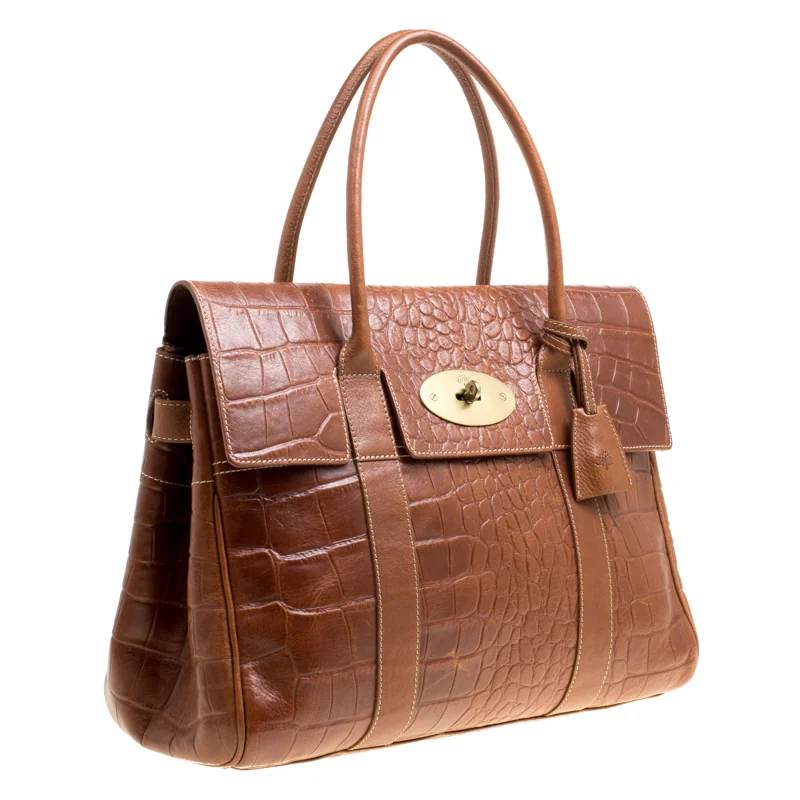
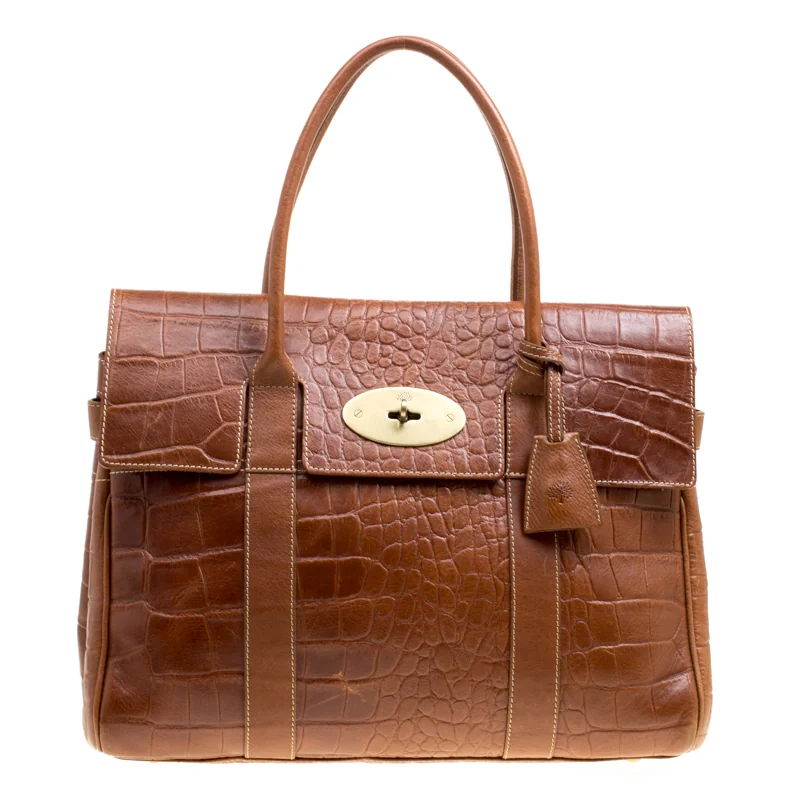
The piece we’re focusing on here is a croc-embossed leather Bayswater satchel in brown, and it’s a good representation of what the silhouette does well.
Leather and colour. The croc embossing is done on full leather rather than a bonded or coated substitute, which matters because embossed patterns tend to expose corner-cutting fast — cheap embossing flattens and cracks within a year, good embossing holds its texture for a decade. The brown sits within Mulberry’s core palette alongside oak, tan, and oxblood, and it’s a genuinely versatile shade rather than a seasonal one.
Construction. Mulberry’s most labour-intensive step is skiving and inking the edges by hand, and it shows. The edges on a well-made Bayswater are dense, evenly painted, and don’t fray at the seams the way lower-tier leather goods do after a year of regular use. The stitching throughout is tight and consistent, and the overall silhouette holds its shape rather than collapsing when the bag is half empty — a genuine advantage over softer, unstructured totes.
Hardware. Dual top handles carry an attached clochette with the brand’s tree emblem, and the front flap closes with the gold-tone Postman’s lock, Mulberry’s signature closure since the brand’s early years. It’s a satisfying, substantial mechanism, though worth noting: it’s slightly less convenient than a magnetic snap or zip if you’re in and out of your bag all day. It’s a small trade-off for the visual identity it gives the bag.
Interior and base. Inside is a suede-lined main compartment with a zip pocket and two slip pockets, enough organisation for daily essentials without over-compartmentalising. The base is protected by metal studs, a practical detail that keeps the leather off the ground. The one honest downside here: suede lining shows oil, ink, and makeup transfer more readily than a canvas or leather lining, so it demands a bit more care than buyers expect going in.
Styling the Bayswater#
The Bayswater’s structure is what makes it easy to style, but it also means it doesn’t flex to every look the way a soft hobo would.
For daily wear, it earns its keep as a work bag — the boxy shape holds a laptop sleeve and folders without warping, and the top handles work well over a coat sleeve in colder months. I’d steer away from pairing it with anything already visually heavy (chunky boots, oversized outerwear) since the bag itself reads as substantial; it looks best against simpler tailoring, a slim coat, or a monochrome outfit where it can be the focal point rather than competing with other statement pieces.
For dressier occasions, the croc-embossed brown leans smart-casual rather than eveningwear. It pairs naturally with tailored trousers or a midi skirt, but it’s not a bag that disappears at a black-tie event — it wants a daytime or early-evening context. If you’re after something for evenings specifically, the Bayswater isn’t the right pick; that’s really where a smaller Mulberry style, or a clutch from another house, does a better job.
Investment Value and Resale Potential#
This is where buyers should keep their expectations realistic. The Bayswater is a genuinely well-made bag, but it doesn’t perform in the resale market the way a [[Chanel Classic Flap](/buying-guides/vintage-chanel-finds-top-picks/)](/buying-guides/designer-must-have-bags/) or a Hermès Birkin does. Those bags benefit from restricted production and waiting lists that keep demand artificially high; Mulberry, by contrast, has always positioned itself as accessible luxury, and that accessibility caps how much a used Bayswater can command.
In practical terms: a Bayswater in strong condition typically resells for a meaningful percentage of its original retail price, especially in classic colourways like the browns and oxblood, but it won’t appreciate the way top-tier French houses can. Where it does hold up well is durability — a properly cared-for Bayswater from ten or fifteen years ago still functions as a daily bag today, which is more than can be said for a lot of “investment” handbags from trend-driven brands of the same era. If you’re buying purely to flip for profit, look elsewhere. If you’re buying a bag you’ll actually use for years and want reasonable resale value as a bonus, the Bayswater is a sound choice — just don’t expect Birkin-level returns.
Buying Advice: What to Look For#
Whether you’re buying new or pre-owned, a few checks separate a good purchase from a disappointing one.
Condition checks (pre-owned):
- Inspect the edges first — cracking, peeling, or dried-out edge paint is the clearest sign of age and poor storage.
- Check the Postman’s lock for smooth operation; a stiff or misaligned lock often means it’s been forced or replaced.
- Look inside the suede lining for staining, especially near the base and pockets — this is the area buyers overlook most often.
- Handles should show even wear and colour change (patina), not one side darker than the other, which can indicate uneven use or sun damage.
Authenticity red flags:
- Genuine Mulberry hardware has weight to it; lightweight, tinny hardware is a strong warning sign.
- The embossed croc texture should be crisp and consistent — blurry or shallow embossing usually means a lower-quality reproduction.
- Serial/date stamps and the interior branding should be cleanly printed, not smudged or misaligned.
- Stitching should be uniform in length and tension; irregular stitching is one of the most reliable tells on a counterfeit.
Where to buy: For new pieces, Mulberry’s own boutiques and website are the safest route. For pre-owned, stick to established [luxury resale platforms](/buying-guides/best-places-to-buy-luxury-accessories-online-2025/) that authenticate items in-house and offer detailed condition photography rather than marketplace listings with no verification — the Bayswater is popular enough that counterfeits and heavily “refurbished” fakes do circulate.
FAQ#
How much does a Mulberry Bayswater cost new? Pricing varies by leather and size, but expect it to sit within Mulberry’s mid-to-upper range, generally below the entry price of most Chanel or Hermès bags, which is part of its appeal as an accessible luxury purchase.
What size should I choose? The classic Bayswater is a structured, medium-to-large satchel suited to daily use and work. Smaller variations exist for those who find the original too boxy for evening or lighter everyday carry.
How do I care for the leather and suede lining? Keep it away from direct sun to avoid uneven fading, store it stuffed with tissue to hold its shape, and treat the suede interior with the same caution you would any light-coloured suede — avoid pens, makeup, and liquids near the opening.
Is the Bayswater a good first designer bag? Yes, and arguably one of the better ones. It’s durable, doesn’t scream logo, and holds its shape better than most bags at a similar price point.
How can I confirm a pre-owned Bayswater is authentic before buying? Cross-check the hardware weight, embossing quality, and stitching against the points above, and when possible, buy through a platform that offers professional authentication rather than relying on seller photos alone.
Related Articles#
- Best It Bags to Buy This Year: A Definitive Guide
- Popular Handbag Brands: Which One Is Right for You?
- 5 Most Popular Chanel Bags You Need to Know
- 10 Best Designer Handbags Worth the Investment (2026)
- How Pre-Owned Luxury Fashion Is Reshaping the Industry
Related guides
- Online Bag Authentication: What Photos Can and Cannot Prove
- Fake Goyard Bag Guide: How to Spot Real vs Fake (2026)
- How to Spot a Fake Chanel Flap Bag: Authentication Guide
- How to Spot a Fake Hermès Birkin: Expert Checklist
- How to Buy an Authentic Luxury Bag from China Safely
- New vs Pre-Owned Luxury Bags: Which Route Is Right for You?
- Chanel Bag Guide: What to Know Before You Buy
- Luxury Bag Houses


Keyword index