Introduction#
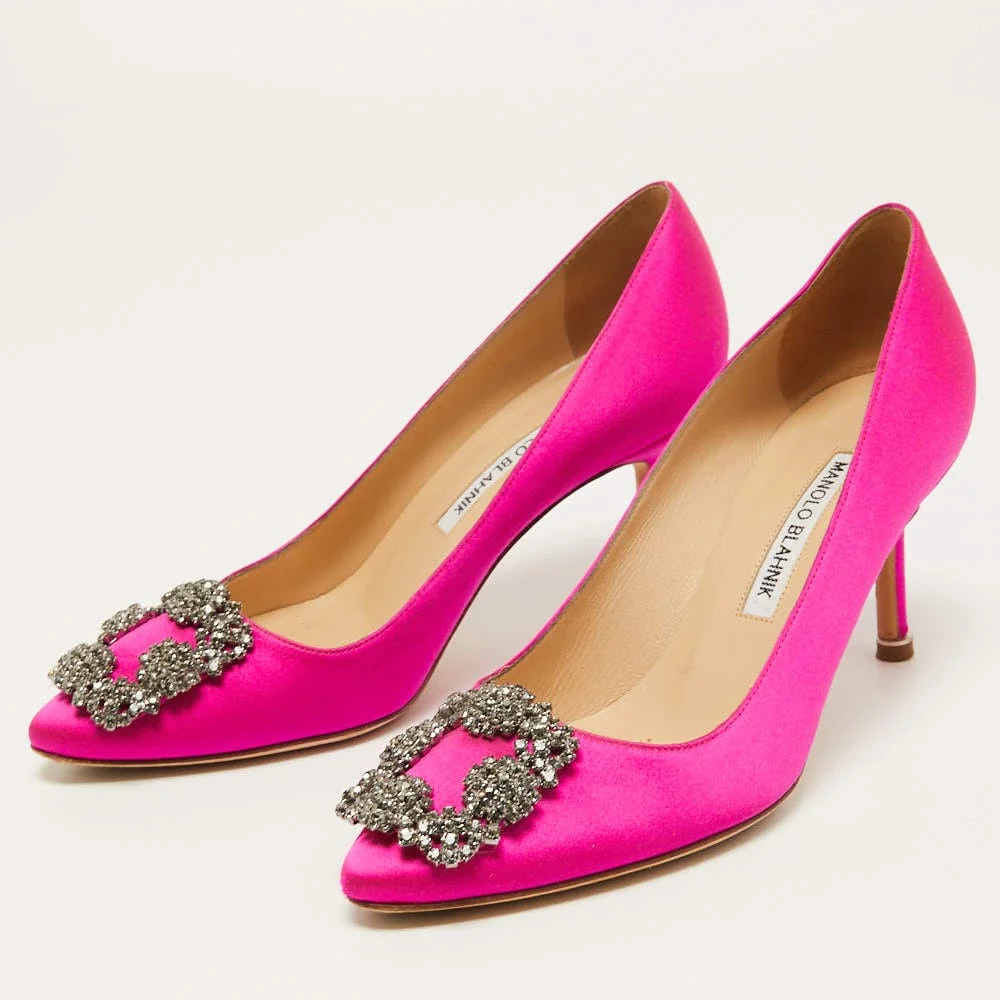
There’s a reason the Hangisi pump has outlived nearly every “it shoe” that came after it. Sarah Jessica Parker walked down the aisle in Carrie Bradshaw’s royal blue pair for the first Sex and the City movie in 2008, the same year Manolo Blahnik introduced the style, and the shoe never really left the cultural conversation after that. Kate Middleton wore an emerald green Hangisi for her first official portrait with Prince William. Countless real-life brides have worn them since as their something-blue. That kind of staying power comes at a cost, though — Hangisi pumps retail well into four figures, and resale prices for hard-to-find colorways can climb even higher.
That combination — high price, high demand, instantly recognizable silhouette — makes the Hangisi one of the most counterfeited Manolo Blahnik styles on the resale market. If you’re shopping secondhand or through a third-party seller, authentication isn’t optional. A convincing fake can pass a glance test in photos and still fall apart on the buckle attachment or the insole stitching. This guide walks through exactly what I look for when I’m vetting a pair, in the order I actually check them.
Craftsmanship and Overall Quality#
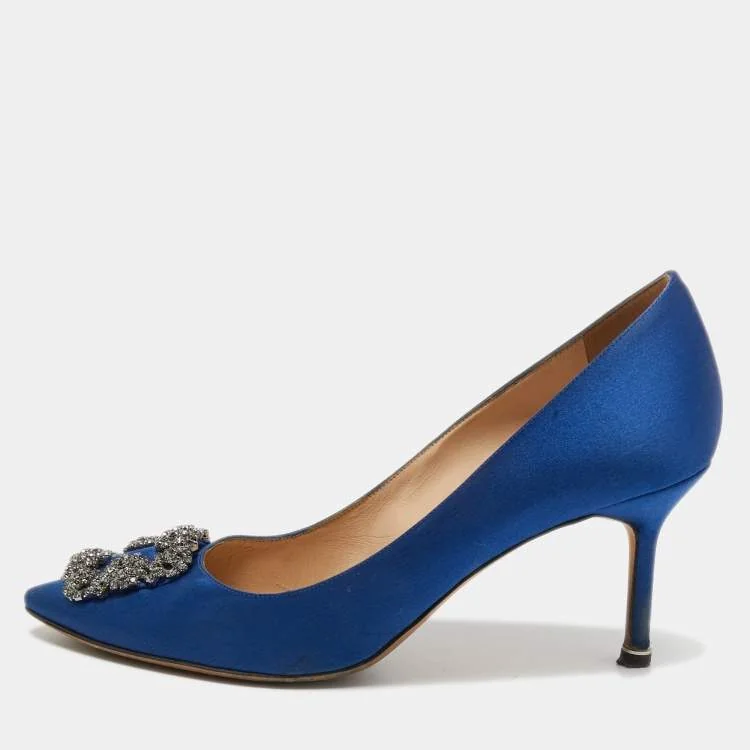
Before I even get to the buckle, I run my fingers over the satin. Manolo Blahnik uses a duchesse satin on the Hangisi that has real weight to it — it should feel smooth and slightly stiff, not thin or shiny in a synthetic way. Cheap satin puckers at the seams and picks up snags easily. On an authentic pair, the satin lies flat across the vamp with no visible pulling around the stitch lines.
Stitching is the next tell. Genuine Hangisi pumps are finished with tight, even stitching — you shouldn’t see wandering thread lines, loose ends, or visibly hand-finished repairs unless the shoe has been resoled or altered (which is worth asking about separately, since resoling doesn’t make a shoe fake, but it does affect [resale value](/buying-guides/sneaker-trends-2025-styles-worth-the-hype/)). Counterfeits often get the general shape right but rush the finishing, so look closely at where the satin meets the piping around the topline.
Crystal attachment is where a lot of fakes fall apart, literally. On authentic pairs, the crystals on the buckle and any embellished trim are set securely with no visible glue overflow, and they don’t wiggle when you press on them gently. If you can see dried glue around the edges of a crystal, or if stones are already missing on a “lightly worn” pair, that’s a real red flag — not just for authenticity, but for how the shoe was made in general.
Silhouette and Shape#
The Hangisi has a very specific silhouette, and it’s one of the harder things for counterfeiters to nail because it comes down to the mold, not the decoration. The toe should be subtly pointed — not a sharp stiletto point and not rounded. A lot of superfakes get this slightly wrong, making the toe either too sharp or too blunt.
The heel is a slim stiletto, typically around 105mm on the classic version, and it should sit centered under the heel counter without wobbling when the shoe is on a flat surface. Check the heel counter itself: on genuine pairs it has a gentle, continuous curve that hugs the back of the foot. Fakes sometimes have a heel counter that looks slightly boxy or has a visible seam where it shouldn’t be.
I’d also compare the overall proportions against a confirmed authentic pair if you can, either in person or through detailed photos from the seller. Manolo Blahnik’s lasts are consistent across production runs, so a shoe that looks “off” in silhouette, even if you can’t articulate exactly why, is worth pausing on.
The Signature Buckle#
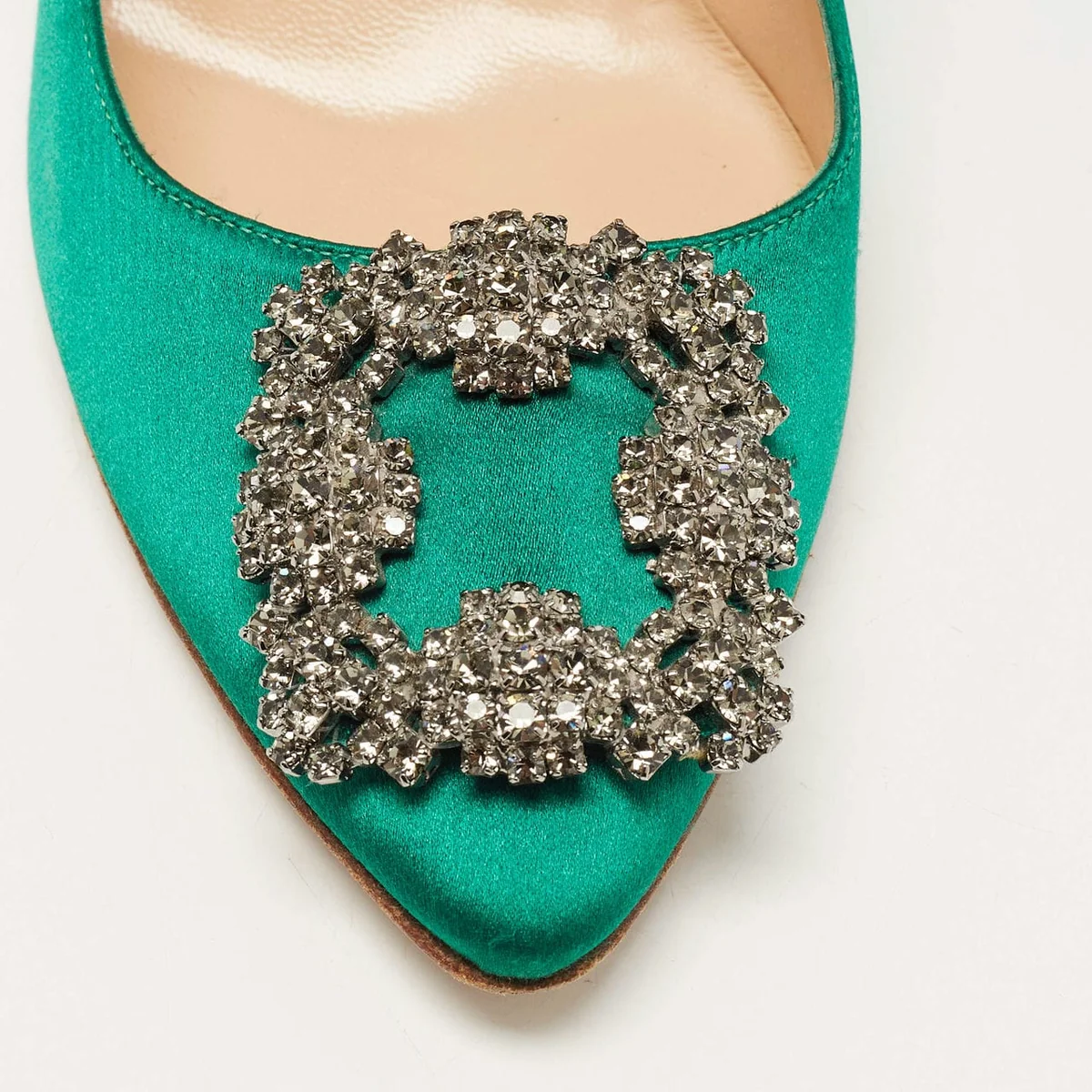
If I only had one checkpoint to rely on, it would be this one. The Hangisi buckle is a large, brooch-style ornament set in metal, inspired by 18th-century Bonaparte-era footwear buckles, and it’s genuinely the hardest element for counterfeiters to replicate well.
On an authentic pair, the buckle is substantial — it has real weight and sits securely against the satin with no gaps or lifting at the edges. The metal setting should be clean, without visible mold seams or rough edges around the crystals. Give it a gentle wiggle: it should feel firmly anchored to the shoe, not like it’s floating on a thin attachment point.
Embellishment quality matters just as much as attachment. Genuine crystals catch light with real depth and clarity. Counterfeit versions often use glass or plastic stones that look duller or slightly cloudy, especially in natural light. I’ve seen fakes where the buckle looks convincing in a dim product photo and immediately reads as wrong in person — so if you’re buying based on photos alone, ask the seller for close-up shots in natural daylight, from multiple angles, including a slight side angle to check how flush the buckle sits.
Packaging, Accessories and Documentation#
Authentic Hangisi pumps come in Manolo Blahnik’s signature packaging: a branded box and a dust bag, both carrying the brand name in a specific, consistent typeface. Before you rely on packaging as proof, though, know its limits — boxes and dust bags get separated from shoes, resold on their own, or reused by counterfeiters to dress up a fake pair. Packaging alone should never be your deciding factor, but its absence or an obviously wrong font is a red flag worth flagging with the seller.
Look closely at how the brand name is printed. Font weight, spacing, and letter shapes should match verified reference images. A logo that looks “close enough” but slightly bolder, slightly condensed, or oddly kerned is a sign the packaging (and possibly the shoe) isn’t legitimate.
Original receipts, care cards, or authenticity certificates from an authorized retailer add confidence, but plenty of genuine secondhand pairs get sold without them. I wouldn’t reject a shoe solely for missing paperwork if everything else — construction, buckle, insole — checks out. I would be more cautious buying a pair with no packaging, no history, and no return policy, especially at a price that seems aggressive for the style and condition.
Price, Logo Details and Seller Red Flags#
Price is an underrated authentication tool. Authentic Hangisi pumps hold value well on the resale market precisely because they’re desirable and produced in limited color runs each season. If a “barely worn” pair in a popular colorway is priced dramatically below typical resale comps — think less than half of what comparable authenticated listings are going for — that’s a signal to slow down, not a lucky find.
Flip the shoe over and check the insole. The white insole label should be sewn in, not glued, with stitching that’s symmetrical and even on both sides. The brand name and sizing should be stamped cleanly, without smudging, uneven depth, or inconsistent font between the left and right shoe — a detail people forget to compare. The outsole should be leather, stamped with “hand made in Italy,” along with sizing information. Blurry stamping, incorrect country of origin, or a sole material that feels more like rubber-coated leather are all inconsistencies I’d walk away from.
Seller reputation closes the loop. Look at how long the account has been active, whether they have a track record of luxury sales, and whether they offer any kind of return window or authentication guarantee. A seller who won’t provide additional photos on request, gets vague about the item’s provenance, or pressures you to complete the sale quickly is behaving exactly like someone trying to move a fake before it gets scrutinized.
Where to Buy Authentic Hangisi Pumps#
For a shoe at this price point, I’d stick to channels that build authentication into the transaction rather than leaving it entirely on the buyer. Authorized retailers and the Manolo Blahnik boutique or official site are the lowest-risk option if you want a specific new colorway, though selection can be limited outside of peak seasons.
For resale, reputable luxury consignment platforms that physically inspect and authenticate each item before listing — rather than just relying on seller photos — are worth the added cost over buying from an unverified marketplace listing. Ask specifically what their authentication process covers; a platform that only checks packaging and logos is doing a lighter review than one that inspects stitching, crystal setting, and insole construction. If a platform offers a condition report or return policy tied to authenticity, that’s a meaningful buyer protection, not just marketing language.
If you do buy from a peer-to-peer marketplace or a private seller, consider paying for an independent third-party authentication service before finalizing, especially for a purchase at this price point. It’s a small additional cost relative to the risk of ending up with a convincing counterfeit and no recourse.
FAQ#
How much do authentic Hangisi pumps cost new? Pricing varies by colorway and embellishment level, but current retail typically runs well over $1,000. Limited or heavily crystal-embellished versions price higher. If a “new with tags” listing undercuts current retail significantly, treat it as a red flag rather than a deal.
Do Hangisi pumps hold their value on resale? Popular colorways, especially the classic royal blue and neutral satins used in bridal styling, tend to hold value reasonably well, particularly in excellent condition with original packaging. Rare or discontinued colors can command a premium among collectors. Heavily worn pairs or those with damaged crystals will sell for noticeably less, which is worth factoring in if you’re buying with resale in mind.
Can a shoe be resoled and still be authentic? Yes. Resoling is common maintenance for shoes with this much wear, and it doesn’t indicate a counterfeit on its own. It does affect resale value and can complicate an authentication check, since it obscures original sole stamping, so ask sellers directly whether a pair has been resoled or repaired.
What’s the single biggest tell for a fake Hangisi? The buckle. It’s the most distinctive and most difficult element to replicate convincingly — the weight, attachment security, and crystal quality are where counterfeits most often fail, even when the rest of the shoe looks reasonably close.
Is it safe to buy Hangisi pumps without original packaging? It’s not disqualifying, but it does raise the burden of proof elsewhere. If the construction, buckle, and insole all check out and the seller has a solid reputation, missing packaging alone shouldn’t stop the sale. I’d be more cautious combining missing packaging with a below-market price and a seller who won’t provide detailed photos.
Related Articles#
- 7 Ways to Spot a Fake Manolo Blahnik Hangisi
- How to Spot Fake Christian Louboutin Shoes: Guide
- Why the Chanel Crossbody Bag Never Goes Out of Style
- Exotic Skin Handbags: What You’re Really Paying For
Related guides
- Online Bag Authentication: What Photos Can and Cannot Prove
- Fake Goyard Bag Guide: How to Spot Real vs Fake (2026)
- How to Spot a Fake Chanel Flap Bag: Authentication Guide
- How to Spot a Fake Hermès Birkin: Expert Checklist
- How to Buy an Authentic Luxury Bag from China Safely
- New vs Pre-Owned Luxury Bags: Which Route Is Right for You?
- Chanel Bag Guide: What to Know Before You Buy
- Luxury Bag Houses


Keyword index