Introduction: The Rise of Asymmetry in Fashion #
Symmetry had a good run. For decades, “balanced” was shorthand for “correct” — matched earrings, centered handles, hemlines that hit the same point on both legs. Then the runways started tilting.
One-shouldered dresses were the first sign. Necklines dropped on one side, hemlines climbed higher on one leg, and suddenly the red carpet looked less like a mirror image and more like a deliberate, sultry glitch. Once that idea took hold in clothing, it was only a matter of time before it migrated to accessories. Loewe put a single statement earring on the map. Celine took the same logic and applied it to totes, mounting handles off-center so the bag itself looks like it’s mid-motion even when it’s sitting still on a shelf.
The asymmetrical bag trend isn’t a gimmick borrowed from clothing, though — it’s become its own design language, one that’s shown up on resale platforms, in street-style photography, and increasingly in the “what to buy now” conversations among people who actually collect handbags rather than just follow them.
Why Asymmetrical Bags Are Having a Moment #
Ask why an off-kilter handle or a lopsided silhouette reads as more interesting than a perfectly centered one, and the honest answer is: it shouldn’t work, and that’s exactly why it does. Symmetry is safe. Asymmetry photographs like it has an opinion.
Loewe and Celine are the two houses doing the most visible work here, but for different reasons. Loewe’s approach leans sculptural — asymmetry as an extension of the brand’s obsession with shape and negative space, the same instinct behind the mono-earring that made single-sided jewelry a talking point. Celine’s version is more architectural than whimsical. Moving a handle off-center on a tote isn’t a styling flourish; it changes how the bag sits on the body, how the leather folds, where the eye lands first.
There’s also a practical layer under the aesthetic one. A bag that isn’t perfectly symmetrical tends to look less “off the shelf” and more like a piece with a point of view — useful in a market where buyers are increasingly tired of logo-forward, algorithm-friendly designs that all start to look the same after a few seasons.
Spotlight: The Celine Oversized Asymmetrical Tote #
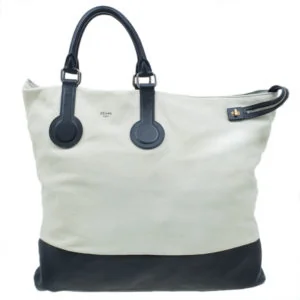
The Celine White and Black Leather Oversized Folded Tote is the clearest example of the trend done well at a mid-luxury price point, listed at $860 through pre-loved retailers like The Luxury Closet.
What makes it work: the tote’s “folded” construction means the asymmetry isn’t cosmetic — it’s structural. The bag’s silhouette shifts depending on how it’s carried, and the black-and-white colorblocking does the rest of the work, drawing a hard line down the bag that makes the off-center handle placement look intentional rather than accidental. It’s oversized enough to function as a genuine daily carry-all, not a decorative accessory that can’t hold a laptop.
At $860 pre-owned versus Celine’s current retail pricing on newer asymmetrical styles (often well north of $2,000 new), this is one of the more accessible entry points into the trend from a house that’s actively driving it. That price gap is also exactly why authentication matters more here than it would on a straightforward, symmetrical classic — asymmetrical construction is harder to fake convincingly, but it’s also harder for an inexperienced buyer to evaluate.
Buying Pre-Loved Designer Totes: What to Check for Authenticity #
Asymmetrical bags introduce a wrinkle that classic silhouettes don’t: there’s no “expected” shape to compare against. A counterfeiter copying a Birkin has decades of reference photos to work from. A counterfeiter copying an asymmetrical Celine tote is working from a much smaller pool of images, which means construction flaws show up faster if you know where to look.
Stitching. On an asymmetrical bag, stitch lines often follow curved or angled seams rather than straight ones. Authentic pieces keep stitch length and tension consistent even around curves. Counterfeits frequently pucker or bunch at the exact points where the seam changes direction — which, on an asymmetrical design, is often the most visible part of the bag.
Hardware. Off-center handles put uneven stress on hardware attachment points. Check that rivets, D-rings, and handle clasps sit flush and show even wear patterns consistent with the bag’s actual carrying angle — not symmetrical wear on a bag designed to hang crooked.
Leather grain. Folded or draped asymmetrical construction relies on leather that holds a shape without cracking at the fold line. Run a hand along any structural fold; authentic full-grain or treated leather will have a slight give and consistent texture, while bonded or heavily coated fakes tend to feel stiff or plasticky exactly where the fold stresses the material most.
Dust bags and packaging. Not proof on their own, but a mismatched dust bag, wrong font on a care card, or missing authenticity card for a house that includes one are red flags worth pausing on.
The honest downside: buying pre-loved asymmetrical designs is genuinely riskier than buying a well-documented classic shape, simply because there’s less comparison material available online. If you’re not confident authenticating it yourself, buy from resellers who offer in-house authentication and a return policy — not from marketplaces where you’re relying entirely on seller photos.
How to Style an Asymmetrical Tote #
The trap with asymmetrical bags is over-styling around them — pairing an off-center tote with an asymmetrical hemline and a single statement earring, and ending up looking like a mood board instead of a person.
Everyday: Let the bag be the one asymmetrical element. Structured trousers, a simple tee, clean sneakers or loafers — the bag does the visual work, everything else stays quiet.
Office or elevated daytime: Pair with tailoring in a single solid color. The asymmetry reads as intentional against a clean, monochrome base rather than competing with patterns or additional statement pieces.
Evening: Oversized asymmetrical totes aren’t evening bags by design, but the smaller asymmetrical shoulder styles and clutches from the same trend absolutely are — carried against a simple slip dress or tailored suit, where the bag’s shape becomes the only “story” in the outfit.
Occasion note: These bags photograph best when the asymmetry is visible in profile or three-quarter shots — worth keeping in mind for anyone shopping resale who’s evaluating a bag primarily through seller photos rather than in person.
What Makes a Bag “Asymmetrical” #
Not every unevenly shaped bag qualifies. In practical design terms, an asymmetrical bag is one where the handle placement, silhouette, closure, or panel construction deliberately breaks from a mirrored, centered layout — the two halves of the bag, if you drew a line down the middle, would not match.
This shows up a few different ways: a single handle mounted off-center (like the Celine tote above), a body that’s wider or higher on one side than the other, an asymmetrical flap or closure, or panels of contrasting material or color split unevenly across the bag rather than symmetrically. The common thread is intent — asymmetry as a design decision, not a manufacturing defect.
Where the Trend Came From #
The asymmetrical bag trend didn’t start with bags at all. It traces back to asymmetrical hemlines and one-shoulder gowns on the runway and red carpet, where a single exposed shoulder or a high-low skirt became shorthand for modern, unfussy sensuality — a deliberate move away from the rigid symmetry of previous decades.
Accessories followed the same logic a few seasons later. Loewe’s mono-earring — a single statement earring worn alone rather than as a pair — was an early, highly visible signal that asymmetry had moved beyond clothing. Bags were the natural next step: brands like Celine began experimenting with off-center handle placement and folded, uneven silhouettes, treating the bag itself as a sculptural object rather than a symmetrical container.
The through-line across all of it is the same idea: perfect balance isn’t a requirement for a piece to feel finished. It’s a trend built on confidence in imperfection, which is part of why it’s had staying power beyond a single season rather than fading as a one-off runway moment.
FAQ #
Is the asymmetrical bag trend still relevant, or has it peaked? It’s held steady rather than spiking and fading, largely because houses like Celine and Loewe keep reintroducing asymmetrical elements into new collections rather than treating it as a one-season gimmick. It’s less “trend” at this point and more an established design category.
Are asymmetrical totes harder to carry day-to-day than symmetrical ones? Slightly — an off-center handle shifts weight distribution, so heavier loads can pull the bag at an angle. It’s worth trying one on with actual weight inside before buying, especially secondhand, rather than judging fit from photos alone.
Do asymmetrical bags hold their [[[resale value](/prices-and-value/luxury-price-hikes-2026-resale-impact/)](/brands/celine-luggage-tote-guide-sizes-history-resale-value-1/)](/brands/celine-luggage-tote-guide-sizes-history-resale-value/)? Design-forward, statement pieces from established houses (Celine, Loewe) tend to hold value reasonably well if condition is strong, though they can be a narrower resale market than classic symmetrical staples — fewer buyers are specifically looking for an asymmetrical silhouette.
What’s the safest way to buy a pre-loved asymmetrical designer bag? Buy from a reseller offering in-house authentication and photo documentation of stitching, hardware, and interior tags — not blind marketplace listings. Given how few reference images exist for less common asymmetrical styles, third-party verification matters more here than on classic shapes.
How should I care for the leather on a folded or draped asymmetrical bag? Pay extra attention to fold lines and structural creases — these are the first places leather cracks or dries out with wear. Condition leather at fold points more frequently than flat panels, and store the bag stuffed enough to hold its shape without stressing the fold when not in use.
Related Articles #
- Handbag Trends 2024: The Bags You’ll Actually Wear
- How to Carry & Style Bally Bags for Everyday Wear
- 4 Reasons Bally Bags Are Worth Buying: A Buying Guide
- Fendi First Bag Guide: History, Design & Resale Value
- Saint Laurent Kate Bag Review: Style, Fit & Resale Value
Related guides
- Online Bag Authentication: What Photos Can and Cannot Prove
- Blue Crocodile Lady Dior Tote: Buying Guide
- Chanel Vintage Flap Bag Buying Guide: Navy Lambskin
- Louis Vuitton Palm Spring Backpack: Complete Buyer's Guide
- How to Buy an Authentic Luxury Bag from China Safely
- New vs Pre-Owned Luxury Bags: Which Route Is Right for You?
- Chanel Bag Guide: What to Know Before You Buy
- Luxury Bag Houses


Keyword index