Introduction#
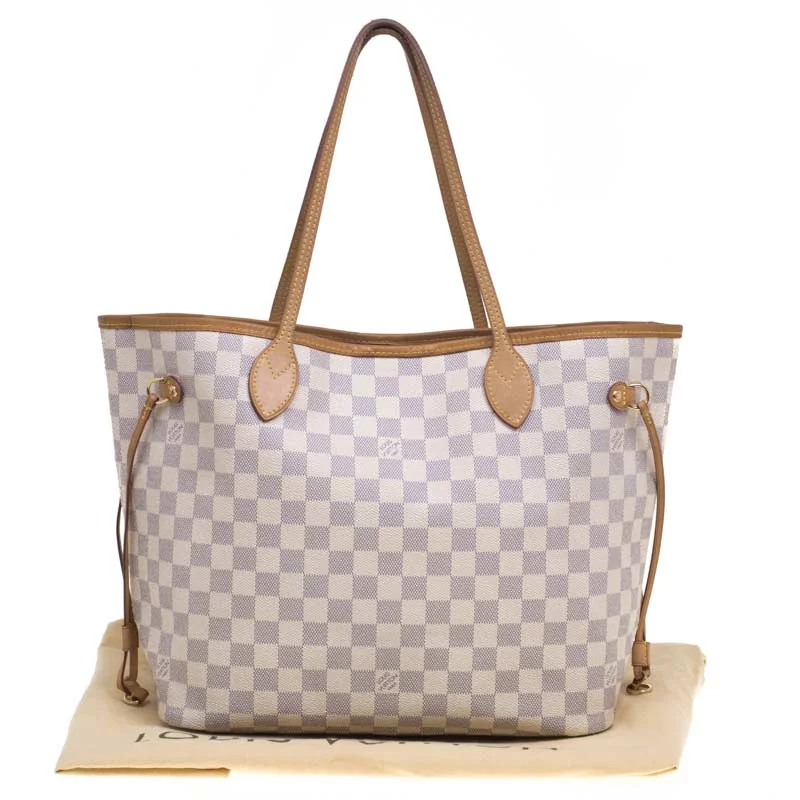
The Neverfull is, by a wide margin, the most counterfeited Louis Vuitton handbag on the market. Louis Vuitton launched it in 2007 as an unstructured tote that could genuinely hold “everything and still not be full,” and that combination of a recognisable [[monogram canvas](/authentication/how-to-spot-a-fake-louis-vuitton-bag/)](/buying-guides/most-popular-louis-vuitton-bags-2026/), a low barrier-to-entry price point (relative to the rest of the LV catalogue), and a design simple enough to mass-produce is exactly why it’s been copied more than almost any other bag in luxury.
I’ve inspected more Neverfulls than I can count, both in showroom condition and coming through resale channels, and the pattern is consistent: fakes rarely fail on one obvious point. They fail on a combination of small things — a slightly wrong shade of canvas, a logo that lands on the wrong square, a heat stamp with lettering that’s just a touch too thin. This guide walks through exactly what I check, in the order I check it, so you can go through the same process before you commit to a purchase, whether you’re buying new, pre-owned, or from a private reseller.
Before You Buy: Where Fakes Slip Into the Market#
Before you even get to the bag itself, the context of the sale tells you a lot.
- Louis Vuitton does not discount new merchandise. There are no outlets, no seconds, no sample sales, and no “factory overstock” for current-season bags. Any listing advertising a brand-new Neverfull at a markdown is not selling a genuine, new Louis Vuitton bag.
- Pre-owned doesn’t mean cheap. A well-cared-for Neverfull holds a meaningful percentage of its retail price on the resale market, especially in Damier Azur and Damier Ebene. A “pre-owned” listing priced dramatically below market resale value is a red flag, not a bargain — sellers of genuine bags rarely have a reason to underprice them that aggressively.
- Be wary of vague or stock photography. Legitimate resellers and private sellers photograph the actual item, including the interior, date code, and heat stamp. If a listing only shows glamour shots pulled from elsewhere, ask for real photos before you pay anything.
- Location and platform matter. Marketplaces with minimal seller vetting see a disproportionate volume of counterfeits. That doesn’t mean every listing on an open marketplace is fake, but it does mean you should apply every check in this guide, not just glance at the price.
Packaging and Presentation Clues#
For a bag bought new, packaging tells you almost as much as the bag itself.
- No plastic on the handles. Louis Vuitton does not ship bags with plastic film wrapped around the handles or hardware. This is a retail habit associated with mass-market brands, not the house.
- No tags attached to the bag. If there are care cards or booklets, they sit loose inside the dust bag — they are never zip-tied, string-tied, or pinned to the bag itself.
- No plastic authenticity card. Louis Vuitton has never issued a plastic “certificate of authenticity” card with its bags. If a seller cites this as proof of authenticity, treat it as the opposite — it’s one of the most common counterfeit-market inventions.
None of this applies directly to a pre-owned purchase, obviously, since original packaging is often long gone. But if a seller is presenting a “brand-new” Neverfull with any of the above, stop there.
Material and Canvas Check#
The Damier canvas Neverfull is only produced in two colourways for women’s bags:
- Damier Azur — a soft beige canvas with a blue check pattern
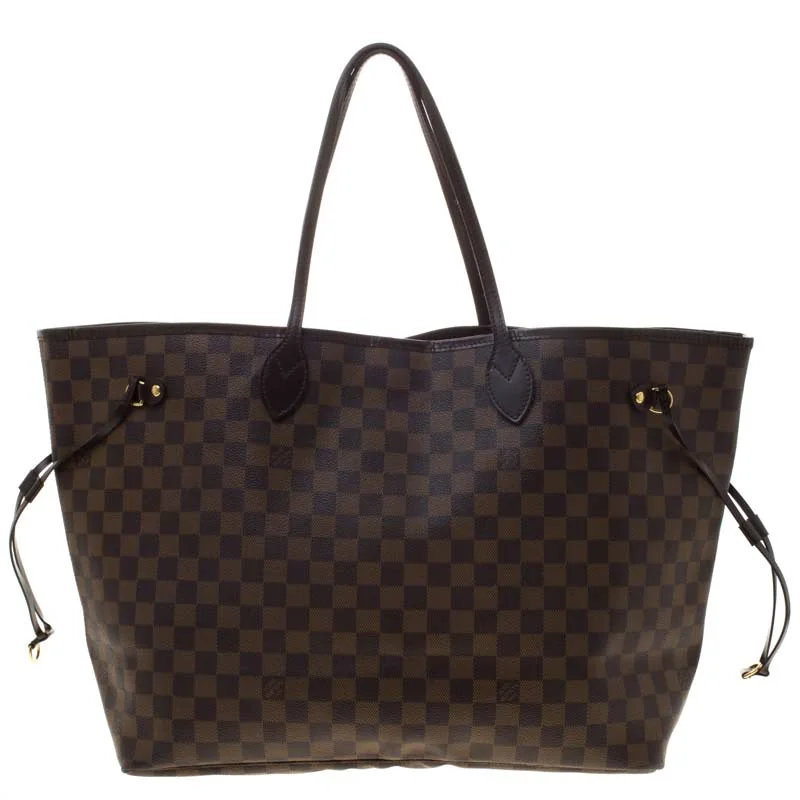
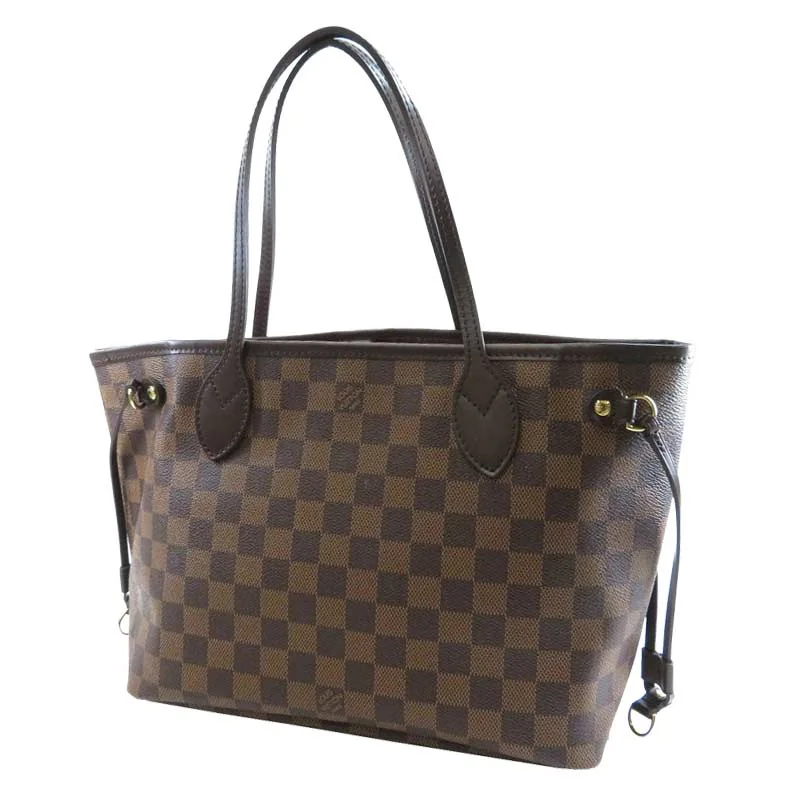
- Damier Ebene — a beige canvas with a light-to-medium brown check pattern
Damier Graphite is a men’s-only canvas. It’s grey with a darker grey check, used across Louis Vuitton’s men’s accessories line, and it has never been produced as a women’s Neverfull. If you see a Neverfull listed in Graphite, you are looking at a fake, full stop — there’s no version, edition, or exception where this exists.
Beyond colourway, look at the canvas itself. Genuine Damier canvas has a tight, even weave with a slightly waxy, coated hand-feel — it should not feel like plain cotton canvas or have a rubbery, glossy sheen. The pattern should be crisp, not blurred or pixelated when you look closely, which is a common tell on lower-grade fakes.
Size and Proportions#
The Neverfull is produced in three sizes, and the proportions are fixed. If a bag advertised as one of these sizes doesn’t match, it isn’t genuine.
| Size | Approximate Dimensions (W x H x D) |
|---|---|
| GM (Large) | 15.7 x 13.4 x 7.5 in (40 x 34 x 19 cm) |
| MM (Medium) | 12.6 x 11.4 x 6.3 in (32 x 29 x 16 cm) |
| PM (Small) | 11.4 x 9.4 x 5.1 in (29 x 24 x 13 cm) |
In practice, size discrepancies are one of the easier tells if you’re buying in person, since fakes are frequently cut slightly smaller to save on material, or the proportions between height and width look “off” even before you measure. If you’re buying online, ask the seller to measure the bag with a tape rather than quoting the size label — sellers reselling authentic bags won’t hesitate to do this.
Monogram, Hardware and Stitching Details#
This is where I spend the most time, because it’s where fakes most consistently fall apart under close inspection.
Monogram symmetry. On a genuine Damier canvas bag, the pattern is perfectly matched across the side seam — square for square, so the check pattern reads as continuous rather than shifted or mismatched. This symmetry is a hallmark of Louis Vuitton’s cutting standards, and it’s genuinely difficult and costly for counterfeiters to replicate consistently across a full production run.
Logo placement follows a fixed grid. This is one of the most reliable checks and one most buyers skip:
- On the GM, the logo sits in the 6th square from the top, with eight logos total on the sides and one on the base.
- On the MM, the logo sits in the 5th square from the top.
- On the PM, the logo sits in the 2nd square from the top.
- The logo repeats every tenth square, and it is never split, cropped, or partially hidden by a handle or seam. If a logo lands awkwardly across a seam, that’s a manufacturing inconsistency Louis Vuitton doesn’t allow through — but counterfeiters, cutting canvas without the same precision, do it constantly.
Grosgrain lining. The trim along the side seams should be neat, tightly finished, and free of loose threads or glue residue.
Hardware. The gold-tone hardware should have a warm, substantial finish — not a thin, bright, or slightly greenish gold that scratches to reveal silver underneath.
Vachetta leather handles and trim. Genuine vachetta starts as a light, natural tan and darkens over time to a rich honey or amber patina, even on a bag that’s never been carried, simply from light exposure. If the handles on a supposedly older bag are still very pale, or conversely look artificially dark and uniform straight out of the box, question it — pale handles on an “aged” bag usually mean replaced trim or a fake; unnaturally even dark handles on a “new” bag are a common ageing shortcut used by counterfeiters.
Stitching. Genuine stitching is even, tight, and consistent in thread tension throughout. Loose threads, visible glue at the seams, or stitch spacing that varies from one panel to the next are not something Louis Vuitton’s ateliers let through quality control.
For deeper verification, three interior details matter:
- Heat stamp — embossed, never printed, on the interior leather tab. The ® sits above LOUIS VUITTON, the L has a short tail, the O is noticeably round and slightly larger than the surrounding letters, the two T’s have strokes that nearly touch, and “made in France” uses a lowercase m. On Damier Ebene bags, this stamp is always in red.
- Date code — stamped on a leather tab in the inner pocket’s corner. Two letters indicate the country of manufacture; of the four digits, the 1st and 3rd represent the production week and the 2nd and 4th represent the year (e.g., SD2009 reads as made in the USA, week 20, 2009). If you’re looking at a Neverfull with a matching Neo pochette, note that the pochette was only introduced in 2014 — a “vintage” Neverfull with a pochette dated earlier than that is inconsistent and worth questioning.
- Interior lining and pocket — Azur bags line in tan, Ebene in red, with yellow and fuchsia appearing in later production years. Whatever the colour, the base should always be a solid, unpatterned lining with a clean seamed binding — striped or monogrammed interior lining doesn’t belong on a genuine Neverfull. The interior slip pocket should also extend fully to the base of the bag; a pocket that stops short is a shortcut fakes take regularly.
Buying Advice: How to Purchase with Confidence#
For a purchase at this price point, I don’t think any single visual check should be your only line of defence — treat this guide as your first filter, not your final word.
- Buy new only through Louis Vuitton boutiques or the official website. There is no legitimate discount channel for current-season bags.
- For pre-owned, use resellers who authenticate before listing. Established luxury resale platforms and consignment houses typically run items through in-house or third-party authentication before sale, and reputable ones will disclose their authentication process on request.
- Ask for full documentation and photos. A trustworthy seller will readily provide close-up photos of the heat stamp, date code, interior lining, and logo placement before you pay — hesitation here is itself a signal.
- Consider a third-party authentication service for high-value or uncertain purchases. Independent authenticators can catch the newer generation of “superfakes,” which have gotten good enough that even experienced buyers can be fooled on visual inspection alone. This is a small cost relative to the purchase price and well worth it if anything about a listing gives you pause.
- Factor in resale value when choosing colourway and size. Damier Azur and Ebene Neverfulls in the MM size tend to hold value well due to sustained demand for the size’s everyday practicality, while very large or very small sizes can see softer resale demand. Original packaging, a clean interior, and healthy vachetta patina (not overly stained or heavily darkened) all support stronger resale pricing down the line.
- Walk away from pressure tactics. “Only one left,” countdown timers, or sellers refusing to answer questions about the date code or heat stamp are consistent with counterfeit operations, not legitimate resale.
FAQ#
What is the fastest way to spot a fake Neverfull? Check the canvas colourway first. If it’s Damier Graphite, it’s fake immediately, since that colourway was never produced for the women’s Neverfull. After that, check logo placement against the size-specific grid (6th square on GM, 5th on MM, 2nd on PM) and the embossed heat stamp lettering.
Does Louis Vuitton sell the Neverfull at a discount anywhere? No. There are no outlets, factory stores, or authorised discounts on new Louis Vuitton bags, including the Neverfull. Any “discounted new” listing is not a genuine new-in-box bag from Louis Vuitton.
Is a printed heat stamp ever authentic? No. Genuine Louis Vuitton heat stamps are embossed into the leather tab, never printed or stamped flat onto the surface. A flat, printed stamp is a reliable counterfeit indicator on its own.
Can date codes alone confirm authenticity? Not entirely. Date codes are a useful cross-check, but counterfeiters have copied real date code formats onto fake bags. Use the date code alongside heat stamp quality, canvas colourway, and logo placement rather than as a standalone proof.
Are pre-owned Neverfulls with heavily darkened handles a problem? Not necessarily. Vachetta leather naturally darkens to a golden-brown patina with age and light exposure, and this is expected on a well-used, genuine bag. What’s suspicious is handles that are unevenly stained, artificially dark straight out of the box on a “new” bag, or noticeably paler than they should be on a bag claimed to be several years old.
Is it worth paying for third-party authentication? Yes, especially for higher-value purchases or listings that raise any doubt. The current generation of counterfeits, sometimes called “superfakes,” can replicate several of the checks in this guide convincingly enough that professional authentication is the more reliable safeguard for a purchase at this price point.
Related Articles#
- How to Spot a Fake Burberry Bag: Full Guide
- How to Sell Luxury Items Online: The Luxury Closet Guide
- How Pre-Owned Luxury Fashion Is Reshaping the Industry
- Best It Bags to Buy This Year: A Definitive Guide
Related guides
- Online Bag Authentication: What Photos Can and Cannot Prove
- Fake Goyard Bag Guide: How to Spot Real vs Fake (2026)
- How to Spot a Fake Chanel Flap Bag: Authentication Guide
- How to Spot a Fake Hermès Birkin: Expert Checklist
- How to Buy an Authentic Luxury Bag from China Safely
- New vs Pre-Owned Luxury Bags: Which Route Is Right for You?
- Chanel Bag Guide: What to Know Before You Buy
- Luxury Bag Houses


Keyword index