Introduction: Celine’s Iconic Trapeze Takes Flight #
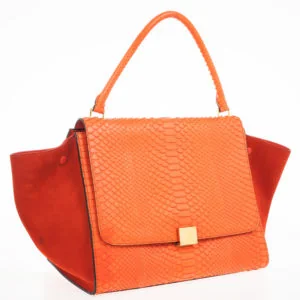
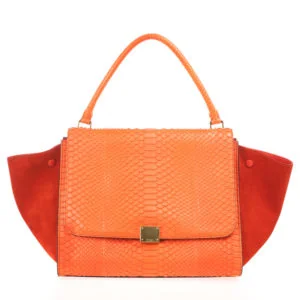
Some bags announce themselves quietly. The Celine Trapeze doesn’t bother with subtlety, and the version worth talking about here proves the point: a large Trapeze rendered in pumpkin-orange python, its structured wings finished in matching suede. It’s the kind of bag that stops a conversation mid-sentence, and it’s also one of the harder Celine pieces to source on the resale market today.
The Trapeze has earned “modern classic” status for a reason. It arrived at a moment when Celine was redefining what a luxury It bag could look like, and more than a decade later, pieces from that era, especially in exotic skins, are commanding renewed attention from collectors and buyers who missed them the first time around. This guide walks through what makes the Trapeze significant, why the python colorway is genuinely scarce, and what you need to check before spending real money on one secondhand.
The Design Story Behind the Trapeze Silhouette #
The Trapeze belongs to Phoebe Philo’s tenure as Creative Director of Celine, a period (2008–2018) widely credited with resetting the brand’s identity around architectural minimalism rather than logo-driven design. Philo introduced the Trapeze in 2011, building on the visual language she’d established with the Luggage tote a year earlier.
The bag’s name describes its shape: a trapezoidal body that tapers slightly from top to bottom, held open by two structured side “wings” that echo the winged silhouette of the Luggage tote. Those wings are the Trapeze’s signature feature. Unlike the Luggage’s leather wings, the Trapeze typically pairs a leather or exotic-skin body with suede wing panels, closed with a fold-over flap and a leather strap-and-buckle or twist-lock closure rather than a full zip. The result is a bag that looks rigid on the shelf but softens and opens generously in use, a structural trick that became something of a Philo signature across the Celine catalog.
Why Exotic Colorways Like Python Are So Hard to Find #
Celine’s exotic-skin releases were never meant to be widely available. Under Philo, exotic colorways, python, crocodile, lizard, were produced in small runs per season, often exclusive to select boutiques, and pulled from the line with little warning once a season closed out. There was no reissue strategy. If you didn’t buy it that season, you generally weren’t buying it at all.
That approach is exactly why a color like pumpkin orange python is difficult to track down now. It wasn’t a permanent catalog item even when it launched, and Celine hasn’t produced anything resembling this specific combination since Philo’s departure in 2018. Every year that passes without a rerelease adds to the scarcity, and demand hasn’t cooled. If anything, it’s picked up since Philo launched her own eponymous label in 2023, which sent a wave of renewed interest back toward her archival Celine work, exotic-skin pieces included.
Craftsmanship and Details Worth Knowing #
The large Trapeze typically measures in the range of 13 x 9.5 x 6 inches (roughly 33 x 24 x 15 cm), with an empty weight noticeably heavier than a standard calfskin bag once you factor in python skin and structured suede paneling, expect it to sit closer to 2.5–3 lbs (1.1–1.4 kg) rather than the lighter feel of a canvas tote. It’s not a bag you forget you’re carrying.
Inside, the layout is intentionally simple: one main compartment, a center divider pocket (usually zippered), and one or two slip pockets for a phone or cards. There’s no elaborate multi-compartment organization here, which is consistent with the Philo-era philosophy of clean interiors over maximalist function.
A few craftsmanship points worth knowing, whether you’re evaluating quality or checking authenticity:
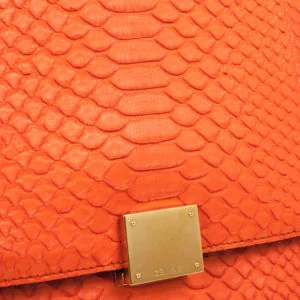
- Python sourcing and scale pattern: genuine python skin shows natural irregularities in scale size and shading across the panel. A printed or embossed fake will show a repeating, too-uniform pattern, especially where panels meet at seams.
- Suede wings: the nap should be dense and consistent, with no shedding or bald patches on an unworn bag. Suede is the first thing to show wear on a well-used Trapeze, so inspect the wing edges and the flap underside closely.
- Hardware: Celine’s hardware from this era is solid, with a matte gold or palladium finish and a clean, deep stamp of the logo, not a shallow or blurry engraving. Weight matters, cheap hardware feels noticeably lighter.
- Stitching and lining: expect tight, even stitching along the wings and base, and a canvas or leather interior lining rather than a flimsy synthetic.
Buying Advice: What to Check Before You Purchase #
Exotic-skin bags carry authentication risks that standard leather doesn’t, because scale texture is harder for counterfeiters to fake convincingly, but easier for buyers to misjudge if they’ve never handled real python in person.
Before buying, I’d check:
- Date stamp: Celine bags don’t carry a serial number system like some houses. Look for a leather tag inside, usually near the interior pocket, stamped with “Céline” and “Made in Italy” along with a date code. Inconsistent font, spacing, or placement is a red flag.
- Scale direction and seam matching: authentic python paneling is cut and matched carefully at seams so the scale pattern flows logically. Mismatched or oddly cropped scales suggest a lower-quality reproduction.
- Condition grading: most reputable resale platforms grade bags on a scale from Pristine/New to Fair. For an exotic-skin Trapeze, pay particular attention to color fading (python dye is more light-sensitive than calfskin dye) and any lifting or cracking at the scale edges, both of which drop a bag from Excellent to Very Good quickly, and affect resale price more than cosmetic leather scuffs would on a standard bag.
- Provenance and platform: buy from resellers who authenticate in-house with named specialists or third-party services, and who disclose condition honestly rather than using vague marketing language. Ask for interior photos, hardware close-ups, and the date stamp specifically if they’re not already included.
If a seller can’t or won’t produce clear photos of the interior tag and hardware stamping, treat that as a reason to walk away, not a minor inconvenience.
Price and Long-Term Value of the Celine Trapeze #
At original retail, the Trapeze in standard calfskin launched in the roughly $2,500–$3,500 range depending on size. Exotic-skin versions, python included, retailed significantly higher, generally in the $6,000–$8,000+ range when new, reflecting both the material cost and Celine’s limited production runs.
On the resale market, expect exotic Trapeze bags in excellent condition to sell for a meaningful discount off that original exotic-skin retail price, but at a premium relative to standard leather Trapeze bags in comparable condition. The gap comes down to scarcity: leather Trapeze bags turn up with some regularity secondhand, while python colorways like this pumpkin orange rarely surface, and when they do, they tend to move quickly.
Celine Trapeze [Resale Value](/brands/celine-luggage-tote-guide-sizes-history-resale-value/): Is It Appreciating or Depreciating? #
Most bag guides gloss over this with a vague “it holds value well.” Here’s the more specific picture.
Standard leather Trapeze bags have generally depreciated over time, in line with most discontinued mid-size designer totes that aren’t in a brand’s permanent core lineup. Supply is decent, and demand, while steady, isn’t scarcity-driven.
Exotic-skin Trapeze bags tell a different story. Because production was genuinely limited and Celine never revisited these colorways, the trend for well-kept python and crocodile pieces has moved sideways to upward over the past few years rather than steadily declining, particularly since 2023. That’s not coincidental timing: Phoebe Philo’s return to the industry with her own label reignited collector interest in her Celine archive specifically, and exotic pieces from that era benefited most, since they were always the rarest subset to begin with. A well-documented, well-conditioned python Trapeze is one of the few Celine pieces from this period where I’d genuinely call the resale trajectory appreciating rather than depreciating, though it’s still a niche market, not a liquid one. Don’t expect to flip it overnight.
Trapeze vs. Modern Celine Bags Under Hedi Slimane #
Hedi Slimane took over as Creative Director in 2018 and moved the brand (rebranded from “Céline” to “CELINE,” dropping the accent) toward a rock-and-roll, logo-forward aesthetic that’s a deliberate departure from Philo’s minimalism. Bags like the 16, the Triomphe Canvas totes, and the Ava all lean into visible branding and quilting rather than the clean-lined structure the Trapeze represents.
Compared to Philo’s other signature styles, the Trapeze sits in an interesting middle ground:
- Luggage tote: more architectural and boxier, with a fully open top and rigid handles. The Luggage was designed as an everyday workhorse; the Trapeze is smaller and more of a statement piece.
- Nano Luggage: the casual, scaled-down version of the Luggage, generally in canvas or lightly structured leather. Far more accessible in price and availability than the Trapeze.
- Box bag: also from the Philo era, more rigid and formal, closed with a distinctive frame clasp. Where the Trapeze feels sculptural but wearable, the Box reads as more precious and evening-appropriate.
The Trapeze’s discontinuation under Slimane’s direction is part of what makes it feel like a closed chapter now. Nothing in the current CELINE lineup replicates its silhouette, which is exactly why demand for original Philo-era pieces, especially exotic ones, hasn’t faded.
Styling It: A Few Notes From Experience #
A colorway this bold works best when it’s doing the talking. Pair it with neutral, texture-minimal pieces, camel coats, dark denim, cream knitwear, so the python and the orange stay the focal point rather than competing with a busy outfit. It also reads surprisingly well against black in colder months, where the warmth of the orange cuts through an otherwise monochrome look. Because the wings expand when the bag is loaded, it carries more comfortably as a daytime piece than its structured silhouette suggests, though I wouldn’t count on it for anything beyond essentials given the compact interior.
Frequently Asked Questions #
Is the Celine Trapeze still in production? No. It was discontinued following Phoebe Philo’s departure in 2018 and hasn’t reappeared under Hedi Slimane’s direction.
Why is python skin more expensive to maintain than leather? Python scales can lift, crack, or fade with UV exposure and dry conditions. It needs conditioning suited specifically to exotic skins, standard leather balm isn’t formulated for it, and should be stored away from direct light in a breathable dust bag.
Is it worth buying a Trapeze in exotic skin as an investment? Only if you’re buying something you’ll also enjoy carrying. Resale trends for exotic Philo-era pieces have been favorable, but this remains a niche collector market, not a liquid investment vehicle.
What’s the biggest authentication red flag on a python Trapeze? A too-perfect, repeating scale pattern across seams. Real python is irregular; a uniform, printed pattern is the clearest sign of a fake.
Related Articles #
- Celine Triomphe Bag Guide: Sizes, Price & Real vs Fake
- Céline Luggage Tote: History & Size Guide
- Fendi First Bag Guide: History, Design & Resale Value
- Lady Dior Python Bag: Dior’s Rarest Exotic Find
- 5 Iconic Bags Named After Famous Women (Buying Guide)
Related guides
- Online Bag Authentication: What Photos Can and Cannot Prove
- Blue Crocodile Lady Dior Tote: Buying Guide
- Chanel Vintage Flap Bag Buying Guide: Navy Lambskin
- Louis Vuitton Palm Spring Backpack: Complete Buyer's Guide
- How to Buy an Authentic Luxury Bag from China Safely
- New vs Pre-Owned Luxury Bags: Which Route Is Right for You?
- Chanel Bag Guide: What to Know Before You Buy
- Luxury Bag Houses


Keyword index