Introduction #
Every fashion house has a handful of design elements that outlive trends, creative directors, and decades of runway turnover. For Gucci, the Horsebit is one. The bamboo handle is another. But no single motif has traveled as far, disappeared for as long, and returned as triumphantly as the Flora print.
If you buy or authenticate vintage and pre-loved Gucci, you’ve probably already run into Flora in some form: a faded silk scarf from an estate sale, a canvas tote with a busy floral repeat, a pair of espadrilles with tiny insects hidden in the print. Knowing where Flora came from, how it changed across eras, and what a genuine print actually looks like up close is the difference between spotting a well-priced find and paying vintage prices for a modern reproduction, or worse, a counterfeit. This piece traces Flora from its 1966 debut to its Alessandro Michele-era comeback, and gives you the practical details worth checking before you buy.
The 1960s: Birth of Gucci’s Most Iconic Designs #
Flora didn’t appear out of nowhere. It arrived at the tail end of a decade in which Gucci had already built the design vocabulary it still leans on today.
The Jackie O bag, originally just Gucci’s shoulder bag, earned its nickname after Jacqueline Kennedy was photographed carrying one repeatedly through the early 1960s. Its soft, hobo-adjacent silhouette and piston-style closure remain in Gucci’s rotation more than sixty years later, periodically reissued to trade on that same association.
Around the same period, the Hobo bag became a favorite of Elizabeth Taylor and Samuel Beckett, an unstructured, gender-neutral shape that predates the “unisex bag” marketing language brands use now. It’s been reinterpreted by Gucci itself and by competitors so many times that the original silhouette can get lost in the noise.
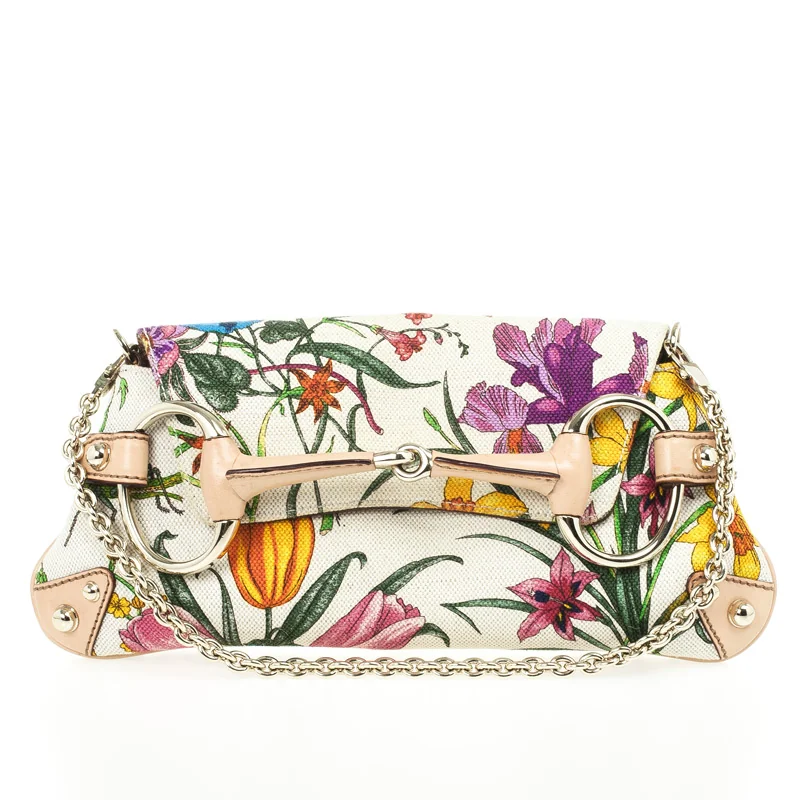
Two more signatures land in this decade: the Horsebit hardware, adapted from equestrian tack and first used on the 1953 loafer before becoming a bag and jewelry motif, and the Moccasin loafer, the shoe that put Gucci hardware on feet instead of just bags. Both the Horsebit loafer and the Jackie O bag are part of the permanent collection at the Costume Institute at the Metropolitan Museum of Art, which tells you how far these pieces moved beyond “product” into design history.
By 1966, Gucci had a house full of hardware and silhouette signatures. What it didn’t have yet was a print.
1966: The Flora Print Is Created as a Tribute to Grace Kelly #
The story, as Gucci has told it for decades, is straightforward: Grace Kelly, by then Princess of Monaco, was a longtime client of the house. In 1966, Gucci commissioned a custom silk scarf as a gift for her, and that scarf became the Flora print.
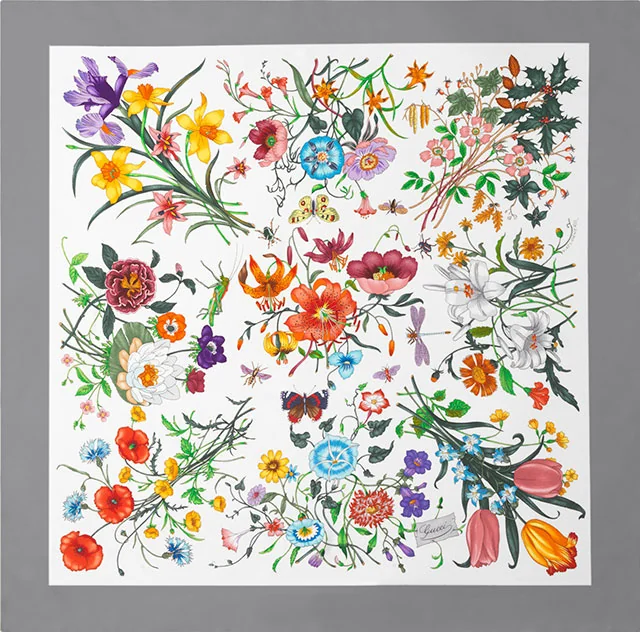
The person who actually drew it was Vittorio Accornero, an illustrator who worked as Gucci’s in-house textile designer from 1960 to 1981. Accornero came from an illustration and editorial background rather than fashion, and it shows in the print’s density and precision. Flora isn’t a repeating floral wallpaper pattern in the way a lot of fashion prints are; it’s closer to a botanical plate, drawn with the same attention you’d expect from a naturalist’s field sketch, then arranged into a fashion-ready repeat.
That distinction matters for authentication. Genuine Flora, in any era, has crisp, individually rendered botanical elements rather than a smeared or simplified floral blob. If a print looks like a low-resolution scan of a scarf rather than an illustration, that’s already a red flag worth pausing on.
Decoding the Design: Colors, Flowers, and Hidden Symbolism #
The original 1966 Flora print used 37 colors on a white ground, which is an unusually high color count for a textile print of that period and part of why the original silk twill production was so labor-intensive. Later reissues have varied the palette and background color considerably, from black and dark green grounds in the Giannini years to the desaturated, almost vintage-photo palettes Michele favored, so color alone won’t date or authenticate a piece. Composition and clarity do.
The pattern is built from five geometrically arranged bouquets rather than a single repeating flower unit. Within them, Accornero placed lily flowers, poppies, cornflowers, wild daffodils, buttercups, anemones, tulips, and iris, interspersed with butterflies, dragonflies, wasps, crickets, and beetles. The insects are the detail most people miss and most counterfeits skip or blur, because they’re small, they require fine linework, and they add nothing to a factory rushing out a knockoff print.
Authenticity checks that live in this detail #
When we’re evaluating a Flora piece, whether it’s a scarf, a bag, or a pair of shoes, the print itself is one of the fastest tells:
- Individual insects should be legible under a loupe or macro photo, with defined wing veins on the dragonflies and butterflies. Blurred or simplified bugs, or their absence entirely, point to a reproduction.
- The bouquets should sit within a deliberate geometric grid. Counterfeits often compress or randomize the layout to save printing costs, so the repeat looks busier and less structured than the original.
- On silk twill scarves, check the hand-rolled hem. Genuine Gucci silk scarves from most eras have a hand-finished rolled edge with visible, slightly irregular hand stitching; a machine-rolled or glued hem is a strong counterfeit indicator.
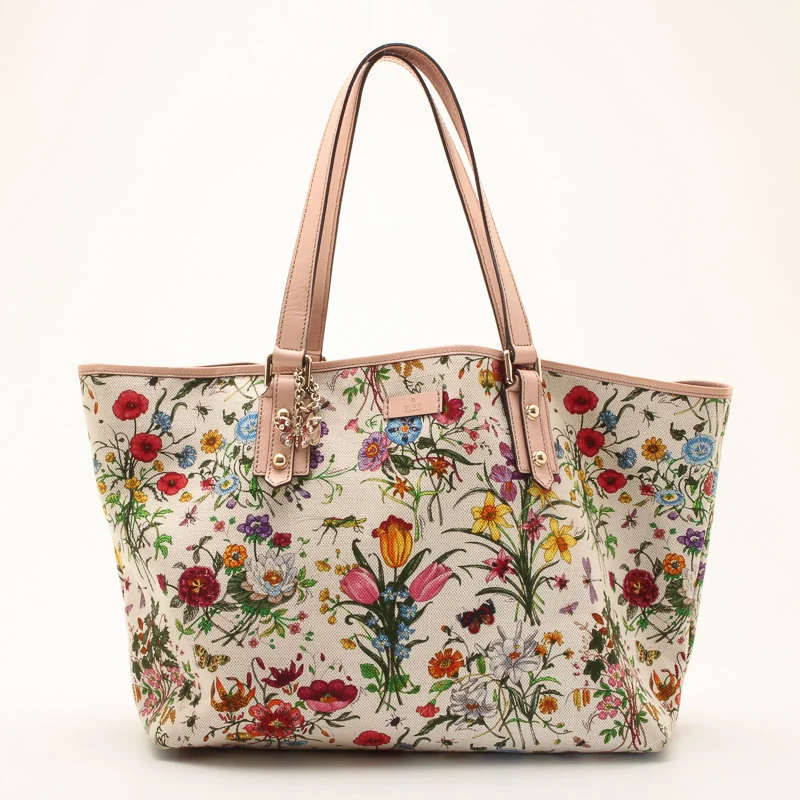
- On canvas goods, the Flora print should sit on the same coated GG or plain canvas base Gucci uses elsewhere in that collection, with consistent print saturation edge to edge. Faded patches near seams or handles, on an otherwise “new” looking bag, suggest the print was applied to non-Gucci canvas.
None of these checks replace a full authentication, but they’re the fastest way to rule a piece in or out before you spend more time on it.
The Decline and Revival: Frida Giannini’s Flora Renaissance #
Flora didn’t stay front and center. Through the 1970s, 80s, and 90s, as Gucci leaned harder into its equestrian identity, the print faded from the collections almost entirely. It never disappeared from the archive, but it stopped being a design priority for the better part of four decades.
Frida Giannini changed that. She took over as creative director in 2004 and, within a year, brought Flora back as the centerpiece of a full bag line launched in 2005. It wasn’t a minor archival nod; it was a deliberate repositioning of the print as a modern Gucci signature rather than a vintage curiosity.
Giannini went further for Resort Spring 2013, expanding Flora into a full menswear collection, which was a genuinely unusual move for a print that had, up to that point, been read almost exclusively as feminine. That collection is a useful reference point if you’re trying to date pieces: Flora shirting, swim trunks, and men’s accessories with clean Gucci branding and this palette generally trace back to that cruise line rather than earlier decades.
The Flora Print’s Enduring Legacy in Gucci Collections #
Giannini’s revival gave Flora a second life, but it was Alessandro Michele, appointed creative director in 2015, who pushed it into a genuinely different register. Michele’s Gucci leaned into maximalism, and Flora fit that sensibility well: he layered it with other prints, ran it across ready-to-wear in unexpected cuts, and paired it with the GG monogram in ways Giannini’s more restrained bag-focused revival never did. If you’re looking at a piece with Flora mixed into a busier, eclectic print combination or unusual colorways like deep burgundy or mustard grounds, that’s more consistent with the 2015–2022 Michele era than with the cleaner 2005–2014 Giannini output.
Flora across categories: scarves, bags, shoes, and ready-to-wear #
The print doesn’t behave the same way, or hold value the same way, across product types.
Silk twill scarves remain the closest thing to the “original format.” They’re the easiest place to check the hand-rolled hem and fine linework, and they’re also the category with the most vintage supply, so pricing varies enormously based on condition and era.
Bags are where most buyers actually encounter Flora today, spanning canvas totes, clutches, and hobo styles across both the Giannini and Michele periods. Canvas printed bags are more durable day to day than silk goods but show soil and edge wear differently, and the print can crack on heavily creased canvas over time.
Footwear, including the espadrilles and loafers produced during the 2013 menswear push and later Michele collections, tends to show the print at a smaller, more compressed scale, which makes insect and flower detail harder to verify visually and easier for counterfeiters to fudge. We’d treat printed Flora shoes as a higher-scrutiny category for exactly that reason.
Ready-to-wear, mainly a Michele-era phenomenon, carries the least standardized print placement, since garments cut the repeat differently piece to piece. That makes “does this look like the reference print” a less reliable check than construction, labeling, and fabric quality.
Resale value and pricing trends #
Flora pricing on the secondary market splits along fairly predictable lines. Original 1966-era silk scarves in strong condition, when they surface, command a premium as design-history pieces rather than everyday accessories, and pricing is driven heavily by print vibrancy and hem condition rather than brand alone. Giannini-era 2005–2013 bags sit in a more accessible mid-tier, generally trading below equivalent GG [[[[monogram canvas](/buying-guides/most-popular-louis-vuitton-bags-2026/)](/buying-guides/louis-vuitton-neverfull-buying-guide/)](/authentication/how-to-spot-a-fake-louis-vuitton-bag/)](/authentication/how-to-spot-a-fake-neverfull-authentication-guide/) pieces from the same years, since Flora has historically been viewed as a seasonal specialty print rather than a core evergreen line. Michele-era Flora pieces, particularly ready-to-wear and the more limited print-mix bags, have held value better, largely because that era’s overall resale demand has stayed strong.
The honest caveat: Flora is a print, not a hardware-driven bag like a Kelly or a Birkin, so its resale value is more sentiment-dependent and less structurally stable. A Flora bag’s value leans heavily on print condition; a faded, cracked, or discolored print tanks resale value far more than equivalent wear would on a plain leather bag.
Caring for silk twill and coated canvas Flora pieces #
Printed silk and coated canvas need different handling, and treating them the same is how a lot of Flora pieces get damaged.
For silk scarves, avoid direct sunlight for storage and display since UV exposure is the fastest way to shift the print’s saturation. Skip home dry cleaning shortcuts; professional silk cleaning or careful hand-spot cleaning with a barely damp cloth is safer than any at-home stain remover. Store flat or loosely folded rather than knotted long-term, since sharp creases weaken the silk fibers along the fold line and can crack the print.
For coated canvas bags, the print sits on a treated surface that can crack if the bag is folded flat for storage rather than stuffed to hold its shape. Avoid saturating the canvas with leather conditioners meant for the trim; they’re formulated for leather, not the printed coating, and can dull or discolor the print. Wipe with a dry or barely damp microfiber cloth rather than baby wipes, which some owners use on monogram canvas but which can strip print saturation over repeated use.
Flora in pop culture, beyond Grace Kelly #
Grace Kelly is the origin story, but Flora’s cultural footprint runs well past 1966. Gucci has repeatedly used the print in its own archive marketing and exhibitions, including retrospective showcases that treat Flora alongside the Jackie O and Horsebit as one of the house’s three or four true design icons. During the Giannini era, Flora also became a recurring red-carpet and street-style print among a younger generation of Gucci-connected style figures, part of how the house repositioned it from “your grandmother’s scarf” to a wearable, modern print again. Under Michele, Flora showed up mixed into campaign imagery and runway sets, styled with tigers, snakes, and bees, another Michele-era motif, reinforcing the idea that Gucci was deliberately building a maximalist, nature-drawn visual world with Flora as one of its oldest anchors.
Anatomy of the Design: Flowers, Insects, and Composition #
Zooming into the print itself, the five bouquets aren’t identical or randomly filled. Each combines large “anchor” flowers, lilies, poppies, and tulips are the most visually dominant, with smaller filler botanicals like cornflowers, buttercups, and wild daffodils arranged around them to balance density. Anemones and iris tend to sit at the transition points between bouquets, doing the visual work of connecting one cluster to the next without making the repeat feel like a hard grid.
The insects are placed with the same logic rather than scattered decoratively. Butterflies and dragonflies, the largest insects in the print, typically anchor open space near the bouquet edges, while the smaller wasps, crickets, and beetles are tucked into denser floral clusters where they read almost like a hidden-object detail. This is the part of the print that rewards close inspection and the part most reproductions simplify away entirely, since rendering a legible beetle at print scale takes far more engraving and printing precision than a generic flower shape does. If you’re comparing two “identical” Flora pieces and one has crisp, countable insects while the other has vague dark specks standing in for bugs, you’re looking at two different production standards, and likely two different sources.
FAQ #
Who designed the original Gucci Flora print? Vittorio Accornero, Gucci’s in-house textile designer from 1960 to 1981, illustrated the Flora print in 1966.
Was the Flora print really made for Grace Kelly? Gucci’s account is that the original silk scarf was commissioned as a personal gift for Grace Kelly in 1966, and the print that resulted became the house’s Flora pattern.
How many colors are in the original Flora print? The 1966 design used 37 colors on a white background. Later reissues under Frida Giannini and Alessandro Michele changed the background colors and palettes considerably, so color count and combination aren’t reliable dating tools on their own.
How can I tell a real Flora print from a fake? Look closely at the insects and smaller flowers first; genuine Flora renders butterflies, dragonflies, wasps, crickets, and beetles with fine, legible detail, while most counterfeits blur or omit them. On silk scarves, check for a hand-rolled hem. On canvas goods, check for consistent print saturation and proper Gucci canvas base rather than a print applied to generic fabric.
Which era of Flora is most valuable on the resale market? Original 1966 silk scarves in strong condition carry the highest design-history premium. Among bags, well-kept Michele-era pieces have generally held resale value better than Giannini-era pieces, though condition of the print itself affects value more than era does.
Is Flora still part of current Gucci collections? Yes. Since its 2005 revival, Flora has remained a recurring print in Gucci’s rotation across bags, ready-to-wear, and accessories, rather than a one-off archival reissue.
Related Articles #
- 5 Iconic Bags Named After Famous Women (Buying Guide)
- Kelly vs Birkin: Hermès Bags Compared
- Hermès Scarves Guide: History, Prints & Buying Tips
- Lady Dior Bag: The Story Behind Princess Diana’s Icon
- Louis Vuitton Twist Bag: Design, Style & Buying Guide
Related guides
- Online Bag Authentication: What Photos Can and Cannot Prove
- How to Spot a Fake Hermès Birkin: Expert Tips
- How to Authenticate a Chanel Bag: 10 Expert Checks
- Fake Goyard Bag Guide: How to Spot Real vs Fake (2026)
- How to Buy an Authentic Luxury Bag from China Safely
- New vs Pre-Owned Luxury Bags: Which Route Is Right for You?
- Chanel Bag Guide: What to Know Before You Buy
- Luxury Bag Houses


Keyword index