Introduction: The Woman Behind the Wardrobe #
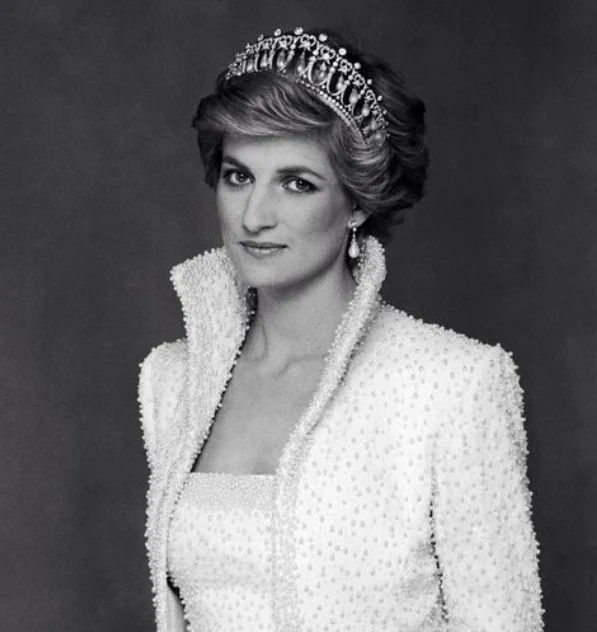
Princess Diana never dressed to be photographed. She dressed to be understood. That’s the thing people forget when they reduce her to “the most photographed woman in the world” — the clothes were never the point. They were the delivery system for a message, and the message was almost always about people who had none of her privilege: AIDS patients she touched without gloves when the world was still afraid to, landmine survivors in Angola, children in hospital wards who got a real hug instead of a photo-op wave.
That’s why her wardrobe still gets studied, copied, and now — quite literally — bid on. When a Diana gown crosses the auction block, buyers aren’t just chasing silk and beadwork. They’re chasing proximity to a woman who made compassion look like the most fashionable thing in the room.
In 2025, Julien’s Auctions is giving collectors that chance again, putting a fresh set of Diana-owned and Diana-worn pieces up for sale. Some are famous. Some are quieter, more personal items that never made a magazine cover. All of them raise the same question this piece is here to answer honestly: what’s actually going under the hammer, what’s it worth, and is it worth your money.
What Made Diana’s Style So Iconic—and So Enduring? #
Diana’s style worked because it was never one thing. She could wear a $500,000 tiara and a $30 sweatshirt in the same week and look equally convincing in both. That range is rare, and it’s the reason her fashion legacy has outlasted three decades of trend cycles.
Three qualities did the heavy lifting:
- Approachability. She repeated outfits — often. In an era when royal women were expected to appear in something new for every engagement, Diana wore the same blazer or the same day dress multiple times without apology. It read as confidence, not economy, and it’s aged into something we’d now call conscious dressing.
- Symbolism. Her clothing choices were rarely accidental. Colors, cuts, and even the timing of an outfit often carried a message — support for a cause, a subtle nod to the country she was visiting, or, in the case of the Revenge Dress, a statement she didn’t need words for.
- Simplicity with impact. Clean lines, sharp tailoring, and a restrained palette. She let the cut of a coat dress or the drape of an evening gown do the talking instead of piling on embellishment.
That combination — accessible but never careless, symbolic but never costume-y — is why her clothes still photograph as modern today. Most royal fashion from the 1980s reads as dated. Hers largely doesn’t.
From Sloane Ranger to Global Icon: Diana’s Style Evolution #
Her wardrobe tracked her life almost like a diary, and you can read the whole arc in five stages.
Early 1980s — the Sloane Ranger. Before the world knew what to make of her, Diana dressed like exactly what she was: a well-bred young Englishwoman with a taste for ruffled blouses, pie-crust collars, and pastel knits. It was safe, slightly girlish, and told you nothing yet about the woman underneath.
1981 — the wedding gown moment. Elizabeth Emanuel’s ivory silk taffeta gown, with its 25-foot train, was the last gasp of that fairy-tale aesthetic. It was gorgeous and it was also, in hindsight, a costume for a role she hadn’t fully agreed to play.
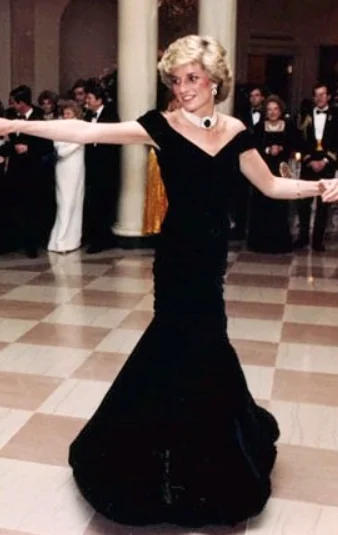
Mid-to-late 1980s — the glamour years. This is where Catherine Walker became her trusted collaborator, and where designers like Victor Edelstein and Bruce Oldfield gave her real star power. The 1985 black velvet Edelstein gown she wore dancing with John Travolta at the White House, and Walker’s beaded “Elvis Dress” from her 1989 Hong Kong tour, both belong to this period. Diana was learning that clothes could command a room without her having to say a word.
Early 1990s — the confident modernist. Sleeker silhouettes, bolder color, fewer flourishes. Bellville Sassoon’s soft floral “Caring Dress,” worn on hospital visits between 1988 and 1992, sits at the intersection of this era and her humanitarian work — proof that even her softest, most casual pieces carried intention.
1994 onward — the post-divorce reinvention. This is Diana at her most fashion-fluent. Christina Stambolian’s black off-the-shoulder “Revenge Dress,” worn the same night Prince Charles publicly admitted to infidelity, and the sleek [[Versace](/brands/versace-medusa-aevitas-platform-pumps-review/)](/brands/versace-eros-pour-femme-fragrance-launch/) pieces that followed, show a woman dressing entirely for herself. No royal dress code, no committee approval — just instinct. It’s not a coincidence that these later pieces are also the ones commanding the biggest prices today. Confidence photographs well, and it apparently auctions well too.
Inside the 2025 Julien’s Auction: What’s Going Under the Hammer #
Julien’s Auctions has built a genuine specialty in royal and celebrity provenance sales, and its 2025 Princess Diana auction continues that track record with a mix of headline gowns and smaller, more personal lots.
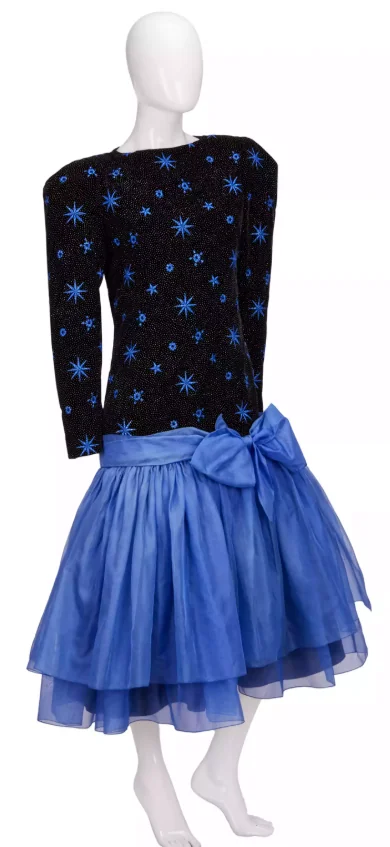
The Versace shift dress. A sleeveless blue shift dress by Gianni Versace, representative of Diana’s sleeker ’90s wardrobe, sold for $230,000 at the 2025 sale. It’s a good example of how much a garment’s value is driven by who wore it rather than its design complexity — this is a relatively simple dress by Versace’s standards, but the Diana provenance multiplies its price many times over.
The Bellville Sassoon “Caring Dress.” This soft floral day dress, worn on hospital visits and charity engagements in the late 1980s and early 1990s, sold for a record $520,000. Of everything in recent Diana sales, this result surprised me the most. It’s not a red-carpet showstopper — it’s a modest day dress. Its price is a direct reflection of the story attached to it: this is the dress of the “People’s Princess,” not the international style icon, and buyers clearly responded to that narrative as much as the garment.
Provenance on both pieces is well documented, which matters more than most first-time bidders realize. Julien’s typically supplies photographic evidence of the item being worn, chain-of-ownership records, and, where available, designer archive confirmation. That paperwork is a large part of what separates a six-figure hammer price from a five-figure one.
Beyond the headline gowns, auctions like this usually round out the catalog with smaller personal items — jewelry, accessories, and occasionally letters or personal effects. These lots rarely generate headlines, but they’re often where more modest collectors can actually enter the market, since estimates on non-gown items tend to be far lower than on a documented, photographed dress.
The Investment Angle: What Diana’s Pieces Are Really Worth #
Here’s where I’ll be blunt: not every Diana item is a good investment, and treating this category as a guaranteed appreciating asset is a mistake I’ve seen collectors make repeatedly.
Look at the actual price history. Catherine Walker’s “Elvis Dress” sold for $81,000 at Christie’s in 1997 — extraordinary for the time. Jacques Azagury’s ballerina-style evening dress sold for $1.14 million in 2023, currently the record for a Diana garment. The Versace shift dress brought $230,000 in 2025. The Caring Dress brought $520,000. That’s an enormous spread for pieces from the same wardrobe, and the spread tells you everything about what actually drives value:
- Narrative weight. The Revenge Dress and the Travolta gown carry stories most people already know. A day dress, no matter how well-provenanced, has to work harder to justify a premium.
- Photographic documentation. Items with clear, widely circulated photos of Diana wearing them consistently outperform items with only written provenance.
- Designer name recognition. Versace and Azagury carry brand equity on top of the Diana premium. A lesser-known name selling the exact same garment would likely fetch less.
- Condition. Silk, beading, and delicate linings from the 1980s and ’90s don’t always survive decades of storage well. Damage or amateur alteration can cut value sharply, regardless of provenance.
The broader trend across royal memorabilia has been upward for two decades, but it’s not a smooth line. Prices spike around anniversaries, documentaries, and renewed public interest (the Netflix effect is real and auction houses know it), then plateau. If you’re buying purely as a financial play, you’re betting on continued cultural relevance, not on the garment itself. That’s a reasonable bet given Diana’s staying power, but it’s still a bet, not a guarantee.
Diana’s Influence on Today’s Royal Style: William, Harry, Kate, and Meghan #
The current generation didn’t inherit Diana’s wardrobe so much as her fashion logic. Kate Middleton has repeated outfits publicly and often, the same quiet statement Diana made decades earlier, and has worn several of Diana’s own jewelry pieces, including her sapphire engagement ring and pieces from her personal collection, on high-visibility occasions. That’s not styling by accident — it’s a deliberate continuity of image.
Meghan Markle’s early approach to royal dressing, favoring accessible, ready-to-wear pieces over exclusively couture looks, echoed Diana’s approachability instinct, even if the execution and public reception differed considerably.
William and Harry’s humanitarian focus — mental health advocacy, conservation work, landmine clearance support — is the more substantive inheritance, and arguably the one Diana would have valued more than any dress getting re-worn. The fashion connection is real, but it’s the values underneath it that give her legacy its actual weight.
Collecting Royal Memorabilia: What to Know Before You Bid #
If you’re considering bidding at a sale like this, a few things I’d want any first-time collector to know going in:
Authentication is not optional. Reputable houses like Julien’s provide provenance documentation, but read it closely. Photographic evidence of the specific garment being worn is stronger than a general “worn by Diana in this period” attribution. Ask for designer archive confirmation when it exists.
Condition red flags matter more with textiles than almost any other collectible category. Check auction condition reports for fabric degradation, sweat staining (common and often disclosed, but affects value), prior repairs, and any alterations. A dress altered for a later wearer, even decades ago, is a different — and lesser — object than one in original form.
Factor in the buyer’s premium. Auction houses typically add 20-25% on top of the hammer price, plus applicable taxes and shipping or insured transport for a garment this fragile. That $230,000 hammer price is not your final cost.
Budget for conservation, not just storage. Historic silk and beading need archival-quality mounting, climate-controlled storage, and occasional professional conservation. This is an ongoing cost, not a one-time purchase.
Buy the story you actually want to own. The clearest advice I can give: decide whether you’re buying for love of Diana’s legacy or purely for resale potential, and be honest with yourself about which one it is. The two strategies lead to different purchases. A collector buying for passion might happily pay a premium for the Caring Dress because of what it represents. A collector buying purely for resale should be more skeptical of paying record prices for lower-profile pieces, since the next buyer may not share the same emotional attachment.
FAQ: Princess Diana’s Style and the Julien’s Auction #
What is the 2025 Julien’s Auction? It’s a Julien’s Auctions sale featuring items owned or worn by Princess Diana, including gowns from designers like Gianni Versace and Bellville Sassoon, alongside smaller personal items. Julien’s has become one of the primary auction houses handling high-profile royal and celebrity provenance sales.
Which pieces from Diana’s wardrobe are included in the 2025 sale? Confirmed highlights include a Versace blue sleeveless shift dress, which sold for $230,000, and the Bellville Sassoon “Caring Dress,” which sold for a record $520,000. Catalogs for these sales typically also include smaller jewelry and accessory lots.
How much are Princess Diana’s clothes worth? It varies enormously by piece. Day dresses and simpler garments have sold in the low hundreds of thousands, while iconic, story-driven pieces like the Jacques Azagury ballerina gown have sold for over $1 million. Provenance quality, photographic documentation, and condition all significantly affect final price.
Is buying Princess Diana memorabilia a good investment? It can be, but it’s not risk-free. Values have trended upward over the past two decades, driven largely by renewed cultural interest, but prices are uneven across item types and can plateau between moments of renewed public attention. Buy for genuine interest in the legacy first, and treat appreciation as a possible bonus rather than a guarantee.
How can I verify authenticity before bidding? Request full provenance documentation, including photographic evidence of Diana wearing the specific item, any designer archive confirmation, and a detailed condition report. Reputable auction houses provide this as standard, but it’s worth reviewing carefully rather than assuming it’s complete.
Why do some simple Diana dresses sell for more than elaborate ones? Narrative matters more than craftsmanship in this category. A modest day dress tied to a well-known moment or cause, like the Caring Dress, can outsell a more elaborate but less storied gown, because collectors are largely paying for the story, not just the garment.
Related Articles #
- Princess Diana Style 2025 Auction: Julien’s Wardrobe Sale
- YSL Tribute Sandals: Why This Iconic Style Still Reigns
- Best Luxury Sneakers 2026: Complete Buying Guide
- White Designer Dresses of 2025: Get the Look for Less


Keyword index