Introduction: Why the [[Céline Luggage Tote](/brands/celine-luggage-tote-guide-sizes-history-resale-value-1/)](/brands/celine-luggage-tote-guide-sizes-history-resale-value/) Became an ‘It’ Bag #
Fifteen years on, the Céline Luggage Tote still gets flagged by authenticators and stylists in the same breath as the Hermès Kelly and the [Chanel Classic Flap](/buying-guides/chanel-flap-bag-buying-guide/) — not because it shares their price tag, but because it changed what a “status bag” was allowed to look like. No monogram. No obvious hardware. Just a slouchy, structured silhouette that did the talking on its own.
The Nano is the smallest member of that family, and it’s the one that shows up most often in resale listings and authentication requests, which tells you something: it’s the size real people actually bought to carry, not just admire. This guide walks through where the bag came from, what to check before you buy one secondhand, what it costs today versus at launch, and whether it still earns a spot in a 2025 wardrobe. If you’re comparing it against a Kelly or a Chanel mini as your next investment piece, the calculus here is different — and worth understanding before you spend.
The Phoebe Philo Era: Design Heritage and Influence #
The Luggage Tote debuted in 2010, early in Phoebe Philo’s tenure as Céline’s creative director. Philo had already reshaped Chloé’s fortunes with the Paddington a few years earlier, and at Céline she applied the same instinct: strip away logos and ornamentation, and let proportion and leather quality carry the design. The Luggage Tote’s winged, boxy shape and near-total absence of visible hardware were a direct reaction against the logo-heavy 2000s. It read as quiet, adult, and expensive without announcing any of those things.
That restraint became the house’s signature and, arguably, its most exported idea. The Trapeze (2011) and the Trio (2013) both carry the Luggage Tote’s DNA — minimal hardware, clean leather panels, structure over embellishment. You can trace a straight line from the Luggage Tote’s success to the broader “quiet luxury” tote category that followed it: The Row’s Margaux, Loewe’s Puzzle in its early years, even Bottega Veneta’s shift toward unbranded leather goods. Industry buyers I’ve spoken with in the resale space still cite the Luggage Tote as the bag that made minimal design commercially viable at scale, which is part of why it holds value better than most non-heritage totes from the same decade.
Design Details That Define the Nano Luggage Tote #
Silhouette and construction #
The Luggage Tote’s identity is its structure: two winged side panels that flare out from a boxy base, a flat bottom that lets it stand upright, and rolled top handles that sit close together rather than spreading wide. There’s no zip closure — the bag stays open at the top, with the wings providing enough rigidity that contents don’t spill. A short leather strap loops through the handles for a bit of extra security, more decorative than functional.
Size and dimensions #
The Luggage Tote line runs Nano, Micro, Mini, Small, and Medium (sometimes still labeled “Classic” in older listings). The Nano is the entry point and the most bag-for-your-money in terms of everyday usability without the bulk of the larger sizes:
| Size | Approx. Width | Approx. Height | Approx. Depth |
|---|---|---|---|
| Nano | 20 cm / 8 in | 15 cm / 6 in | 10 cm / 4 in |
| Micro | 24 cm / 9.5 in | 18 cm / 7 in | 12 cm / 4.7 in |
| Mini | 27 cm / 10.6 in | 20 cm / 8 in | 14 cm / 5.5 in |
| Small/Classic | 30 cm / 12 in | 24 cm / 9.4 in | 18 cm / 7 in |
| Medium | 33 cm / 13 in | 28 cm / 11 in | 20 cm / 8 in |
These figures are averages pulled from measuring several pieces and cross-referencing resale listings — Céline’s own spec sheets varied slightly by production season, so treat any listing’s measurements as a guide rather than gospel, and ask for exact tape measurements before buying secondhand.
Materials and hardware #
Most Nano totes were made in smooth or pebbled calfskin, with the pebbled grain being more forgiving day-to-day since it hides light scuffing better than the smooth version. The tri-color pebbled leather variant — the one most collectors chase now — combines three distinct leather panels (typically the front, back, and side wings) in contrasting tones, so the color-blocking itself becomes the decoration in place of any logo.
Hardware is deliberately minimal: small metal feet on the base for structure and floor protection, tiny snap studs where the side wings fold, and that’s essentially it. There’s no exterior branding at all. The only marking is a small embossed stamp — “CÉLINE PARIS MADE IN [COUNTRY]” — usually found on an interior leather tab or stamped directly into the lining. If a Nano Luggage Tote you’re looking at has visible logo hardware on the outside, that’s already a red flag.
Price and Resale Value: Is It Worth the Investment? #
At launch, the Nano retailed in the range of $1,600–$1,900 depending on leather and colorway, with the tri-color pebbled versions typically priced at the higher end because of the extra leather-cutting and panel work involved. Céline has raised prices across the board since then, and because the Luggage Tote in Nano size has been produced only intermittently in recent collections, current retail availability is limited — most of what’s on the market now is resale.
On the resale side, well-kept Nano totes in popular tri-color combinations tend to sell in the $700–$1,200 range, which is roughly 45–65% of original retail — solid but not exceptional retention compared to something like a Hermès Kelly, which routinely holds or exceeds retail. Condition matters more here than with structured hardware bags, because the pebbled leather shows creasing at the wing folds and the base corners take the brunt of wear. A Nano with sharp corners, unmarked leather, and its original strap will consistently outsell one that’s soft, faded, or missing the strap, sometimes by a few hundred dollars.
The honest takeaway: this isn’t a bag you buy expecting appreciation. It’s a bag that depreciates slowly and predictably if you buy well and take care of it, which is a fair trade for something you’ll actually use.
How to Authenticate a Céline Nano Luggage Tote #
Because the design has so little hardware to fake, most counterfeits give themselves away in leather quality and construction rather than obvious logo mistakes. Check these points before buying:
Stitching — Authentic Luggage Totes have even, tight stitching along the base and wing seams, roughly 8-9 stitches per inch. Loose, uneven, or overly thick thread is a common tell on fakes.
Interior stamp — Look for the “CÉLINE PARIS MADE IN [COUNTRY]” stamp, usually on an interior tab or embossed into the lining leather. The font should be clean and evenly spaced; smudged, bolded, or misaligned lettering is a warning sign. Céline’s stamping conventions shifted over the years, so a bag from an earlier production run may look slightly different from a newer one — this is normal and not itself a red flag, but it means you should compare against a piece from a similar era, not any random reference photo online.
Leather grain — On pebbled leather, the grain should look organic and slightly irregular, not a uniform, stamped pattern that repeats. Run a hand across it; authentic pebbled calfskin has a bit of give and a soft, non-plasticky feel.
Hardware feet and snaps — The small base feet and wing snaps should be weighted metal, not lightweight plastic-feeling alloy, and should sit flush without visible glue residue.
Proportions — Because the Nano is the smallest size, counterfeiters sometimes mislabel a Micro as a Nano or vice versa. Always request exact measurements and compare against the ranges above.
When in doubt, especially on a purchase in this price range, pay for a third-party authentication service before finalizing. It’s a small cost against the risk of an expensive mistake.
Styling the Nano Luggage Tote #
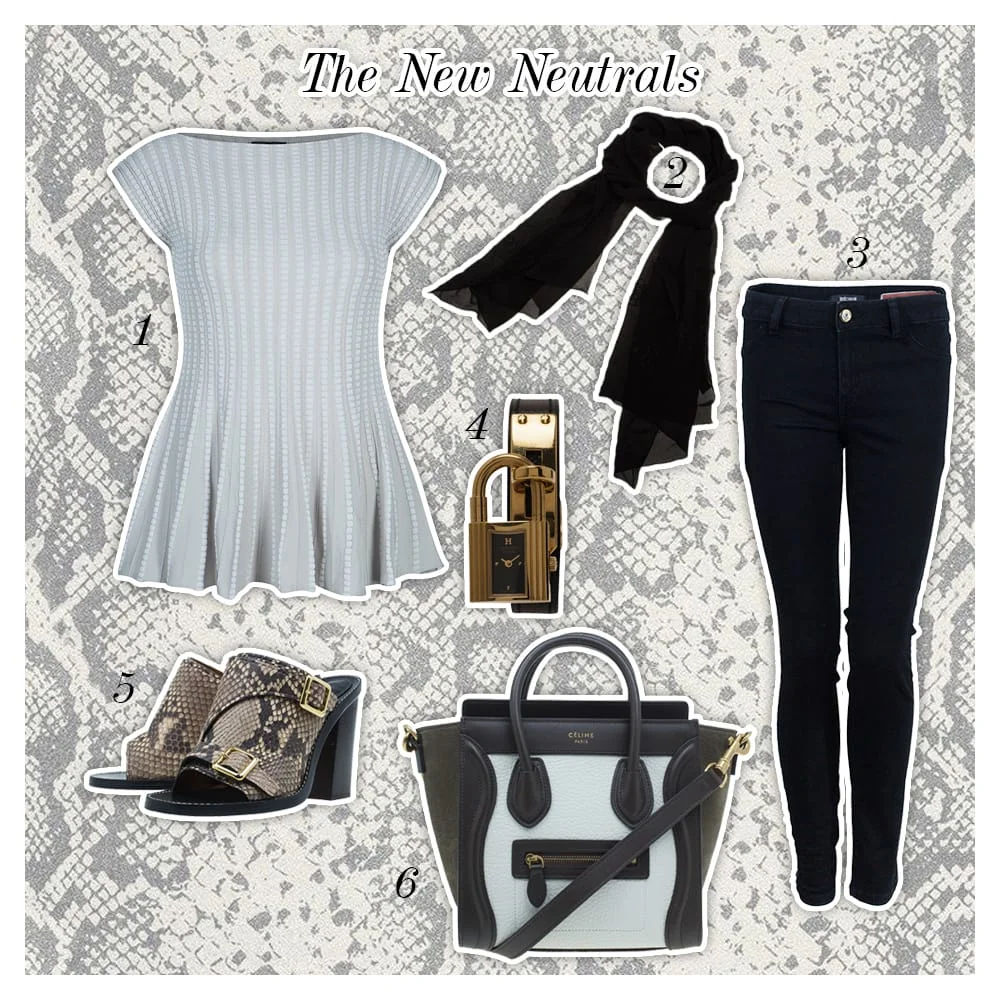
The Luggage Tote earned its “It” bag status by working with almost nothing — it was designed to sit against minimalist, neutral wardrobes rather than compete with them. In practice, that means it does its best work with tailored, uncluttered outfits rather than heavily printed or logo-driven pieces.
 A neutral coat and straight-leg trousers let the tri-color leather do the visual work.
A camel coat, white shirt, and dark denim is close to the bag’s original styling moment — it’s the combination editors were photographed in when the bag first launched, and it still reads as effortless rather than dated. For office or daytime wear, pairing it with a structured blazer and slim trousers plays up the bag’s boxy shape instead of fighting it.
 Cream knitwear and denim keep the focus on the bag’s color-blocked leather panels.
Where it struggles: busy prints, heavily embellished pieces, or anything with its own strong hardware (think a chain-heavy jacket) tend to compete with the tote rather than complement it. This is a bag for outfits with one clear focal point, and the bag itself is usually happiest being that point.
What Fits Inside: A Real-World Packing Test #
The Nano’s compact size is its main practical trade-off, and it’s worth being honest about what it actually holds day to day. In hands-on testing, a Nano comfortably fits: a compact wallet or card case, a phone (including most modern phones without a bulky case), a lipstick or small makeup pouch, keys, and a folded pair of sunglasses. That’s about the ceiling.
What doesn’t fit well: a standard-size tablet, a water bottle, or a bulkier wallet alongside a full makeup bag — the wings give it some flexibility, but the base is narrow enough that anything rigid and larger than a phone starts to strain the shape. If you’re someone who carries a laptop or tablet daily, the Micro or Mini sizes are a more realistic fit; the Nano is best suited to evenings out, weekend errands, or as a second bag layered with a tote for commuting.
Is the Céline Nano Luggage Tote Still Worth Buying in 2025? #
Céline has scaled back production of the original Luggage Tote silhouette under Hedi Slimane and now Michael Rider, favoring newer shapes in current collections. That makes the Nano, especially in tri-color pebbled leather, increasingly a secondhand or vintage-market purchase rather than a current retail item — which changes the buying calculus. You’re not weighing “new bag depreciation,” you’re weighing “is this specific used bag priced fairly for its condition and rarity.”
The case for buying now: prices have settled into a stable, mid-range resale bracket rather than spiking speculatively, the design hasn’t dated the way more logo-forward bags from the same era have, and tri-color colorways in particular are becoming harder to find in excellent condition. The case against: it’s a genuinely small bag with real capacity limits, corner and wing wear are common on pieces that have been used as intended, and if resale appreciation is your primary goal, this isn’t the category for that — heritage houses like Hermès and Chanel outperform it on that metric by a wide margin.
If you want a well-designed, design-history-backed bag to actually carry, and you’re buying from a seller who can verify authenticity and show honest photos of wear, it’s a fair purchase in 2025. If you’re buying purely as a financial asset, look elsewhere.
FAQ #
Is the Céline Nano Luggage Tote discontinued? The original silhouette has seen reduced and inconsistent production in recent years under new creative direction, so availability is limited and most current stock is resale rather than new retail.
What’s the difference between the Nano and Micro Luggage Tote? Roughly 4 cm in width and a noticeably larger interior in the Micro — enough to fit a small tablet, which the Nano generally cannot.
Does the tri-color version hold value better than solid colors? Generally yes, in good condition, because the color-blocked panels are visually distinctive and increasingly scarce, but a well-kept solid-color Nano can still outsell a worn tri-color one.
Should I get it authenticated before buying secondhand? Yes, particularly given the price point — the design’s minimal hardware makes leather grain, stitching, and interior stamping the main authentication checkpoints, and a professional service can catch details a casual buyer might miss.
Related Articles #
- 5 Iconic Phoebe Philo-Era Celine Bags Worth Owning
- Bottega Veneta Chain Pouch Bag: The Ultimate Buying Guide
- Bottega Veneta Quality Check: What to Know Before You Buy
- 5 Most Popular Chanel Bags You Need to Know
- Chanel Denim Bags: History, Value & Fake Spotting Guide
Related guides
- Online Bag Authentication: What Photos Can and Cannot Prove
- Blue Crocodile Lady Dior Tote: Buying Guide
- Chanel Vintage Flap Bag Buying Guide: Navy Lambskin
- Louis Vuitton Palm Spring Backpack: Complete Buyer's Guide
- How to Buy an Authentic Luxury Bag from China Safely
- New vs Pre-Owned Luxury Bags: Which Route Is Right for You?
- Chanel Bag Guide: What to Know Before You Buy
- Luxury Bag Houses


Keyword index