Introduction#
Diamonds have always carried a story, but the story is changing. For over a century, “forever” was tied to a stone pulled from deep underground, at real environmental and human cost. Today, a growing share of buyers are asking a more practical question: can a diamond be beautiful, ethically sourced, and reasonably priced without giving up any of the sparkle? That’s exactly where lab-grown diamonds come in.
This isn’t a trend confined to costume jewelry counters anymore. Lab-grown diamonds have moved into fine jewelry, engagement rings, and statement necklaces, backed by real science and real savings. If you’ve been wondering whether lab-grown diamonds are actually more sustainable than mined diamonds, how they’re made, or whether they hold up as a smart luxury purchase, this guide breaks it down with the nuance the topic deserves — including where lab-grown stones fall short.
Product Overview#
Lab-grown diamonds are, chemically and physically, real diamonds. They’re pure crystallized carbon with the same hardness, refractive [[[[index](/actresses-chanel-vintage-collection/)](/5-things-you-must-know-before-buying-vintage-bags/)](/2023-vintage-market-trend-rank-b-items/)](/online-authentication-limitations/), and fire as a mined stone — the difference is entirely in origin, not composition. Instead of forming over a billion years under the Earth’s mantle, they’re grown in a controlled lab environment in a matter of weeks using one of two established methods:
- CVD (Chemical Vapor Deposition): A carbon-rich gas is broken down inside a vacuum chamber, allowing carbon atoms to deposit layer by layer onto a diamond seed until a full crystal forms.
- HPHT (High Pressure High Temperature): A small diamond seed is exposed to extreme heat and pressure that mimics natural formation conditions, prompting carbon to crystallize around it.
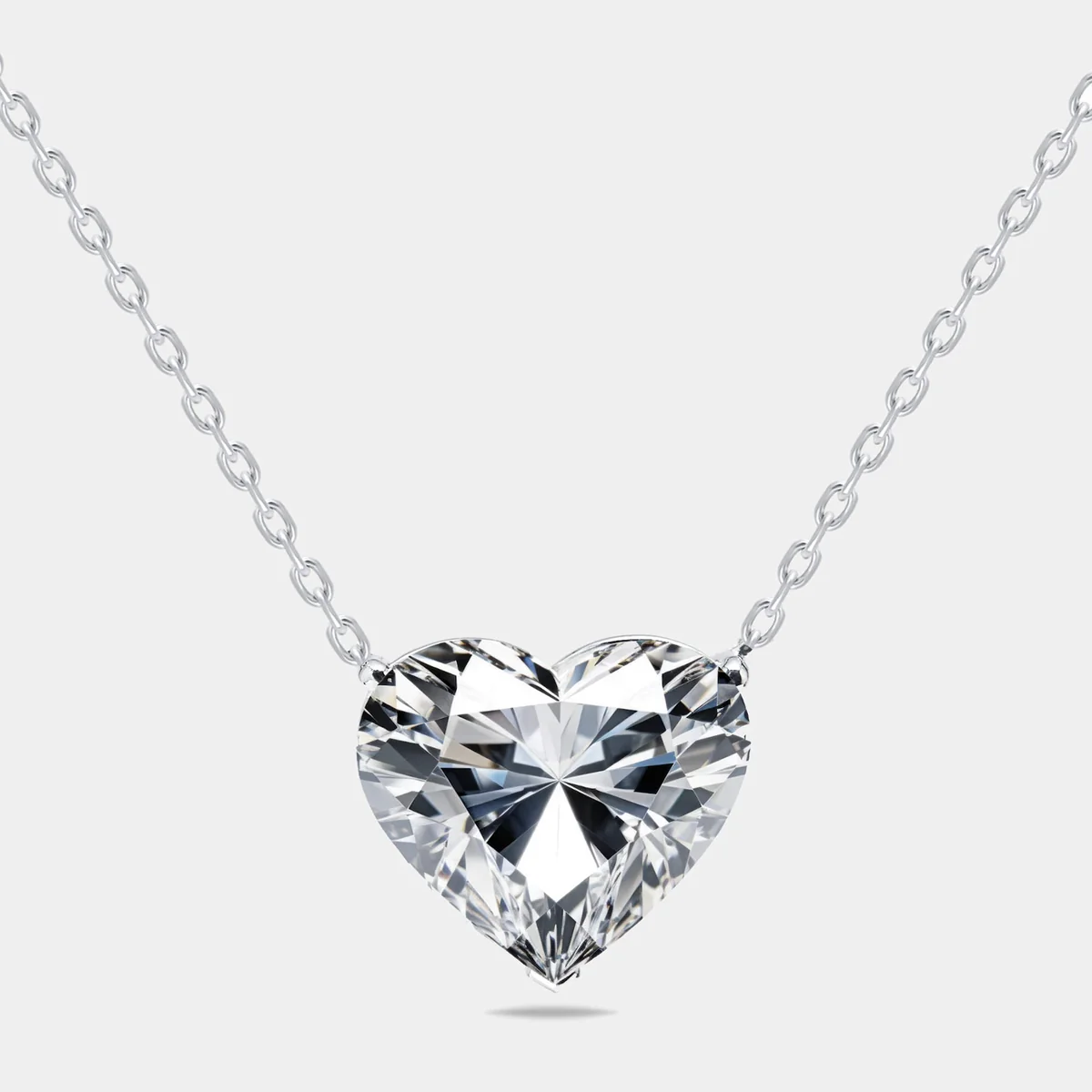
Brands like The Diamond Edit have built entire fine jewelry lines around these stones — necklaces, rings, and earrings set in 18K gold that look, on paper and under a loupe, indistinguishable from mined-diamond equivalents. Even gemological labs like GIA and IGI grade lab-grown diamonds using the same 4Cs (cut, color, clarity, carat) applied to natural stones.
Design#
What’s interesting about lab-grown diamonds isn’t just the ethics — it’s the design freedom they unlock. Because production is more predictable than mining, jewelers have easier access to larger, more consistent stones without the years-long sourcing challenges that come with rare mined carats.
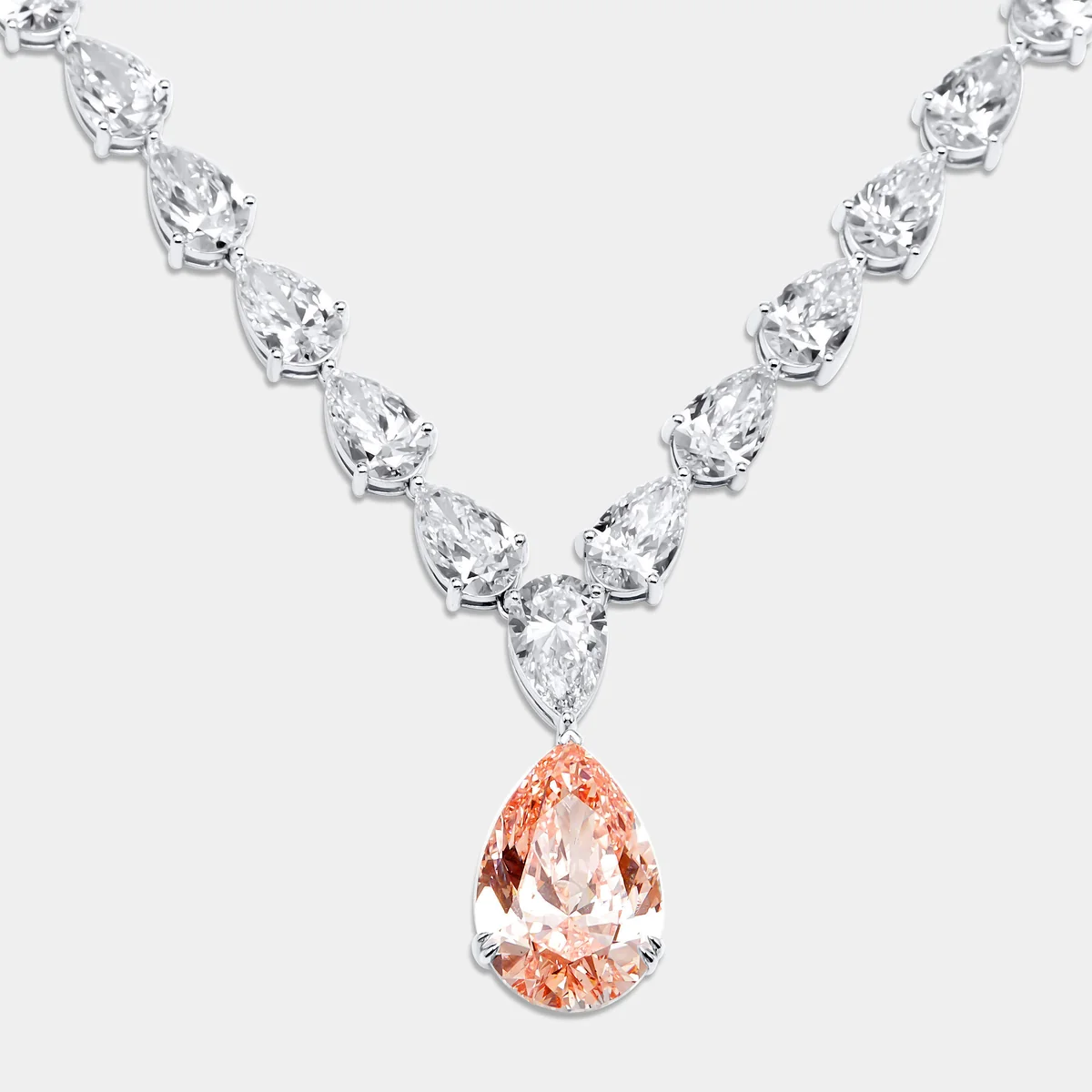
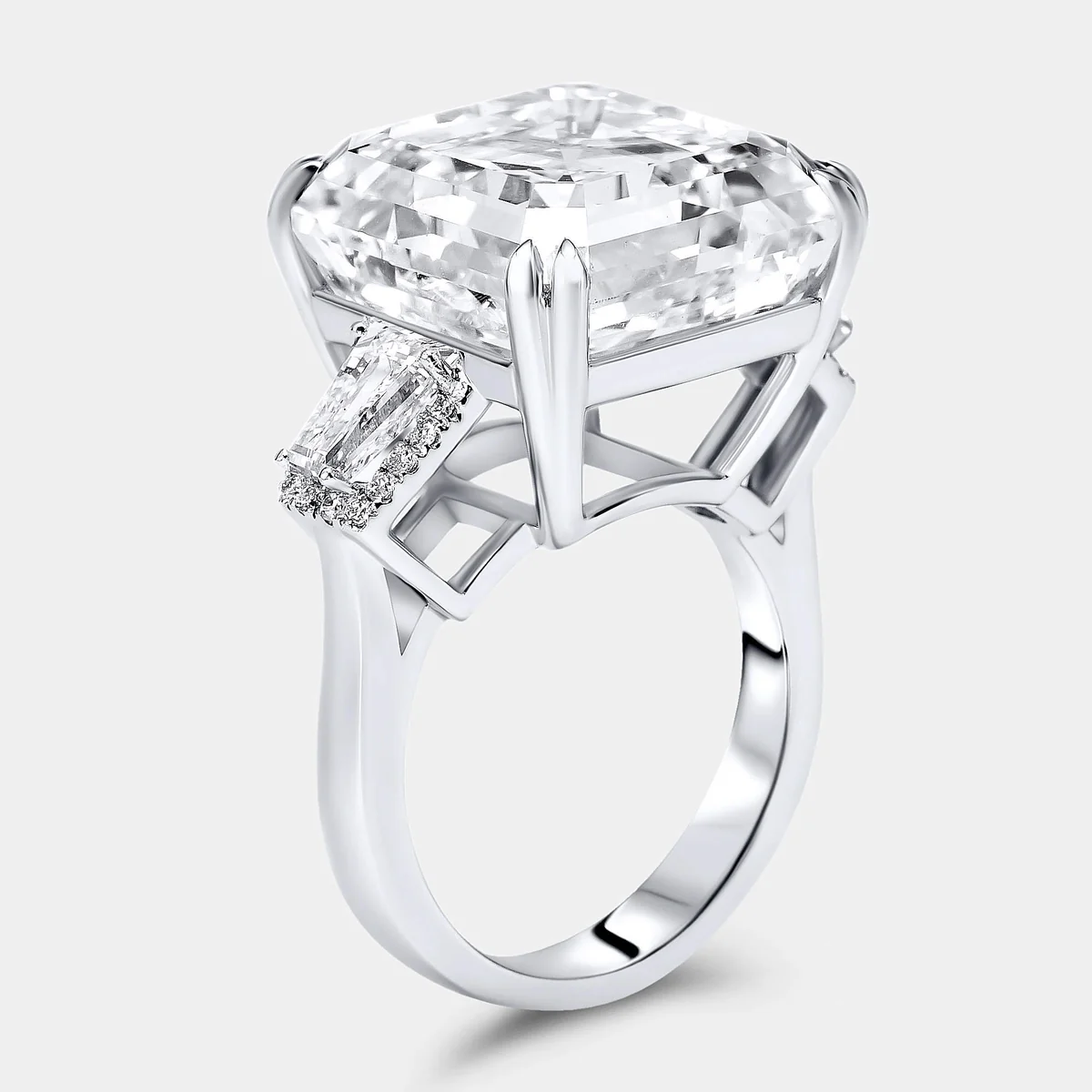
That’s why you’re seeing pieces like a 66.09-carat pink pear-cut lab-grown diamond necklace or a 107.13-carat emerald-cut lab-grown diamond necklace in 18K white gold — carat weights that would be extraordinarily difficult, and extraordinarily expensive, to source naturally at that size and clarity. Designers are also leaning into mixed-cut settings, like a 23.2-carat ring combining asscher, trapezoid, and round cuts, which would be a far riskier (and costlier) undertaking with mined stones of matching quality.
In practice, this means lab-grown diamonds are pushing fine jewelry toward bolder, more architectural silhouettes, since the constraint of “how rare is this exact stone” is largely removed from the equation.
Materials#
The diamond itself is only half the story — setting and metal quality matter just as much for longevity. Most lab-grown diamond jewelry on the market today is set in 18K gold (white, yellow, or rose), which offers a good balance of durability and value retention compared to lower-karat alternatives.
On the stone side, clarity and color consistency in lab-grown diamonds are genuinely a technical advantage. Because growth conditions are controlled, labs can more reliably produce diamonds with fewer inclusions than what nature typically yields. That said, “lab-grown” doesn’t automatically mean “flawless” — quality still ranges widely by producer, and buyers should always ask for grading certification (GIA or IGI) rather than taking carat size or price alone as a quality signal.
Pros and Cons#
Advantages:
- Significantly lower cost — typically 60-90% less than a mined diamond of comparable size and grade
- No mining-related land disruption or ecosystem damage
- Lower carbon footprint when produced with renewable energy (though this varies by facility)
- Traceable, conflict-free supply chain
- Often higher clarity and color consistency than comparable mined stones
- Access to larger carat sizes at a fraction of mined-diamond pricing
Disadvantages:
- Resale value is generally lower and less established than mined diamonds, since the secondary market for lab-grown stones is still maturing
- “Sustainable” claims vary by producer — a lab powered by coal-heavy electricity isn’t meaningfully greener than mining, so energy sourcing matters
- Some buyers still perceive mined diamonds as more prestigious or emotionally significant, rightly or wrongly
- Certification and grading standards can be inconsistent across smaller or less reputable labs
- Not yet as widely accepted at pawn shops or by some traditional jewelers for trade-in value
Who Should Buy#
Lab-grown diamonds make the most sense for buyers who want maximum size and clarity for their budget, and who care more about how a stone looks and performs than its geological age. This includes younger buyers prioritizing ethical sourcing, anyone shopping for a large statement piece (necklace, cocktail ring) without a mined-diamond budget, and engagement ring shoppers who want a bigger, cleaner stone without stretching finances.
They’re a less ideal fit for buyers focused on long-term resale or investment value, or for those who see a mined diamond’s natural rarity as part of its emotional meaning — that’s a legitimate personal preference, not something lab-grown diamonds can fully replicate.
Alternatives#
- Mined diamonds: Still the choice for buyers prioritizing traditional resale value and natural rarity, at a significantly higher price point and with more variable ethical sourcing.
- Moissanite: A different mineral entirely, moissanite offers even lower cost than lab-grown diamonds but with more fire (light dispersion) and less hardness, making it a budget-friendly alternative rather than a true diamond substitute.
- Pre-owned fine jewelry: Buying a certified pre-loved piece, mined or lab-grown, is another sustainable route — it extends the life of an existing stone rather than producing a new one, at a further discount to retail.
FAQ#
Are lab-grown diamonds more sustainable than mined diamonds? Generally yes, particularly on land disruption and water use, but the gap on carbon emissions depends heavily on the energy source powering the lab. A facility running on renewable energy is meaningfully cleaner than mining; one running on fossil-fuel electricity is a smaller improvement.
How are lab-grown diamonds made — CVD vs HPHT? CVD builds a diamond layer by layer from carbon-rich gas in a vacuum chamber, while HPHT recreates the heat and pressure of natural diamond formation around a seed crystal. Both produce chemically identical diamonds; the choice mostly affects production cost and certain crystal characteristics.
Are lab-grown diamonds ethically better than mined diamonds? They eliminate the risk of conflict diamonds and offer a more transparent, traceable supply chain, which is a genuine ethical advantage. Mined diamonds have improved under certification schemes like the Kimberley Process, but sourcing transparency still varies by origin.
Do lab-grown diamonds hold value like mined diamonds? Not currently. Resale markets for lab-grown diamonds are still developing, so buyers should treat them as a jewelry purchase for enjoyment rather than an investment vehicle.
Final Thoughts#
Lab-grown diamonds aren’t a gimmick or a lesser stand-in for the “real thing” — they’re chemically real diamonds that happen to come with a cleaner supply chain and a friendlier price tag. The honest picture, though, includes real trade-offs: resale value lags behind mined stones, and sustainability claims deserve scrutiny rather than blanket trust. For buyers who want size, clarity, and conscience without the mined-diamond price premium, they’re one of the smartest shifts fine jewelry has seen in years. For those who value natural rarity or resale liquidity above all else, mined diamonds still have their place.
Related Articles#
- YSL Tribute Sandals: Style Guide & Buying Tips
- Y2K Fashion 2026: 15 Iconic Pre-Owned Luxury Looks
- Best White Designer Dresses 2025: Luxury for Less
- Authentic vs Fake Hermès Kelly Bag: How to Tell
- How to Spot a Fake Louis Vuitton Bag: 11 Expert Tips


Keyword index