Introduction#
There is a particular kind of buyer who arrives at the Cartier counter not because they are dazzled by advertising, but because they have done their homework. They know the reference numbers, they have read the auction results, and they understand that a well-chosen Cartier is less a watch and more a wearable thesis on what enduring design actually looks like.
This guide is written for that buyer.
Over the following sections, you will find an honest assessment of the six most iconic Cartier references — not just what they are, but what they cost at retail versus what they fetch on the secondary market, which movements are worth respecting and which are quietly underwhelming, and exactly what to look for before spending five figures on a pre-owned piece. No brand puffery. No hedging. Just the information you need to make a decision you will not regret in three years.
Why Cartier Watches Are a Category of Their Own#
Most Swiss watchmakers sell you engineering. Cartier sells you something harder to manufacture: context.
A Rolex Submariner is the world’s most recognisable dive watch because it performs a specific function better than almost anything else in its price bracket. A Cartier Tank performs a rather different function — it tells you, and everyone who recognises it, that you understand the difference between fashion and style. That is not a trivial distinction, and the market prices it accordingly.
What makes iconic Cartier watches genuinely singular is that they occupy a space no competitor has successfully colonised. Audemars Piguet and Patek Philippe compete on technical mastery. Rolex competes on robustness and brand ubiquity. Cartier competes on artistic lineage — and on the fact that its most important silhouettes were designed not by engineers solving problems, but by creative directors solving aesthetic ones. The Tank was not made because anyone needed a rectangular watch. It was made because Louis Cartier thought the proportions were right.
That creative heritage translates directly into resale durability. Cartier watches that hold value best tend to be the ones most deeply embedded in cultural memory — pieces worn by Princess Diana, Andy Warhol, Jacqueline Kennedy, and a supporting cast of tastemakers spanning three continents and a century. You cannot buy that kind of provenance. You inherit it the moment you put the watch on.
If you are researching a Cartier watch as a potential investment or a long-term acquisition, you are already thinking correctly. This is a category that rewards patience, knowledge, and a willingness to look past the obvious options. The following guide will help you do exactly that.
A Brief History of Cartier Watchmaking#
Louis-François Cartier opened his Paris workshop in 1847, initially as a jewellery atelier. For the first half-century of its existence, the house built its reputation on stones and settings rather than movements. Watches, when they appeared at all, were pendant pieces and decorative objects.
The inflection point arrived in 1904. Louis Cartier — grandson of the founder — was dining with his friend Alberto Santos-Dumont, the Brazilian aviation pioneer then circling the Champ de Mars in early heavier-than-air craft. Santos-Dumont complained that pocket watches were useless in a cockpit: you needed both hands on the controls. Louis Cartier’s response was the Santos de Cartier, widely recognised as the first purpose-designed men’s wristwatch. The exposed screws, the square case, the leather strap — all of it was functional problem-solving that happened to look extraordinary.
Thirteen years later, in 1917, Cartier released the Tank, its second major wristwatch design and perhaps the most culturally significant rectangular watch ever made. The case proportions — elongated, with stepped sides called brancards — were said to be inspired by the aerial silhouette of WWI Renault FT tanks. Whether or not that origin story is entirely literal, the result was a watch that required no revision: virtually every Tank produced today is recognisable as a descendant of that original design.
Several more significant designs followed. The Panthère arrived in 1983 with its articulated bracelet and rounded-square case. The Pasha, launched commercially in 1985, introduced a screwed crown protector. The Ballon Bleu debuted in 2007 and became, within a decade, one of the brand’s highest-volume references. The Drive arrived in 2016, Cartier’s most recent attempt to address the market for a contemporary masculine dress watch.
What this timeline demonstrates is that Cartier’s most valuable silhouettes are not recent inventions. The house’s deepest equity sits in pieces that are decades old, which is precisely why provenance matters for value retention. A watch with that kind of cultural sedimentation does not depreciate the way a novelty might. It matures.
The Six Iconic References: Design, DNA, and What Sets Each Apart#
1. Tank Louis Cartier — The Definitive Dress Watch#
The Tank Louis Cartier is not the most practical watch in this list. It is, by most measures, the most important.
The silhouette has not meaningfully changed since its post-war refinements: the rectangular case, the Roman numeral dial with its railway-track minute ring, the sword-shaped hands, the cabochon crown set with a pale blue sapphire. In yellow or white gold, it sits on the wrist with an authority that has nothing to do with size — most references run25–29mm, which by contemporary standards is modest — and everything to do with proportion.
The Tank Louis Cartier is powered by Calibre 430 MC, Cartier’s own ultra-thin manual-wind movement. At 1.94mm thick, it is a genuine horological achievement that allows the case to sit almost flush with the wrist. This matters both aesthetically and practically: the watch disappears under a cuff the way it is supposed to.
Who it suits: Someone who has already figured out their personal style and does not need a watch to announce itself. Strong preference for formal contexts; this is not an adventure watch.
Honest downside: The Tank exists in a confusing number of sub-variants — Tank Solo, Tank Must, Tank Américaine, Tank Française — and not all carry equal weight. The entry-level Tank Solo with a quartz movement and steel case (discontinued in its original form, but common on the secondary market) occupies a very different tier from a gold Tank Louis Cartier with the430 MC. Buyers need to distinguish between variants carefully, or risk paying a premium for something that does not carry the same heritage.
2. Santos de Cartier — The Workhorse That Never Went Out of Style#
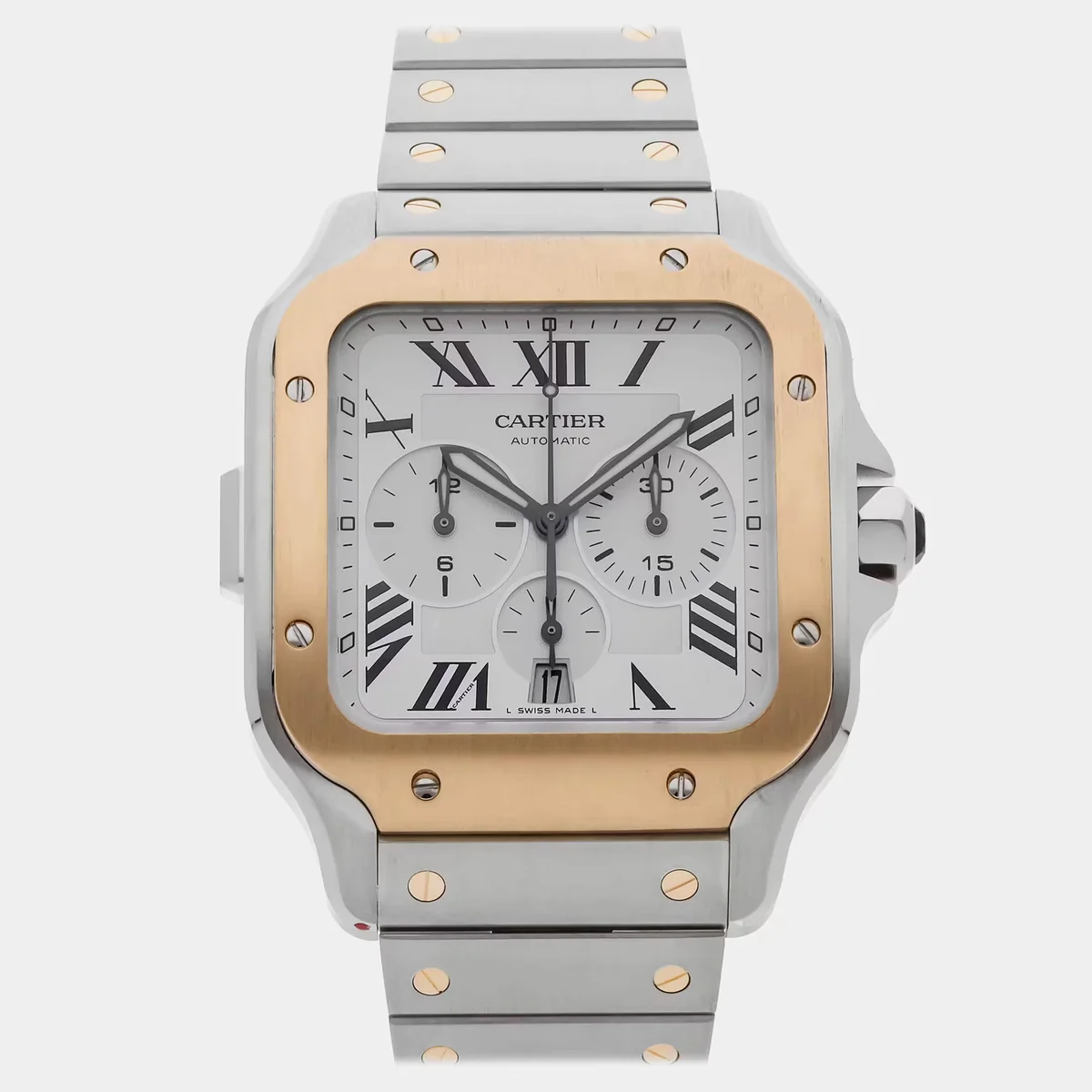
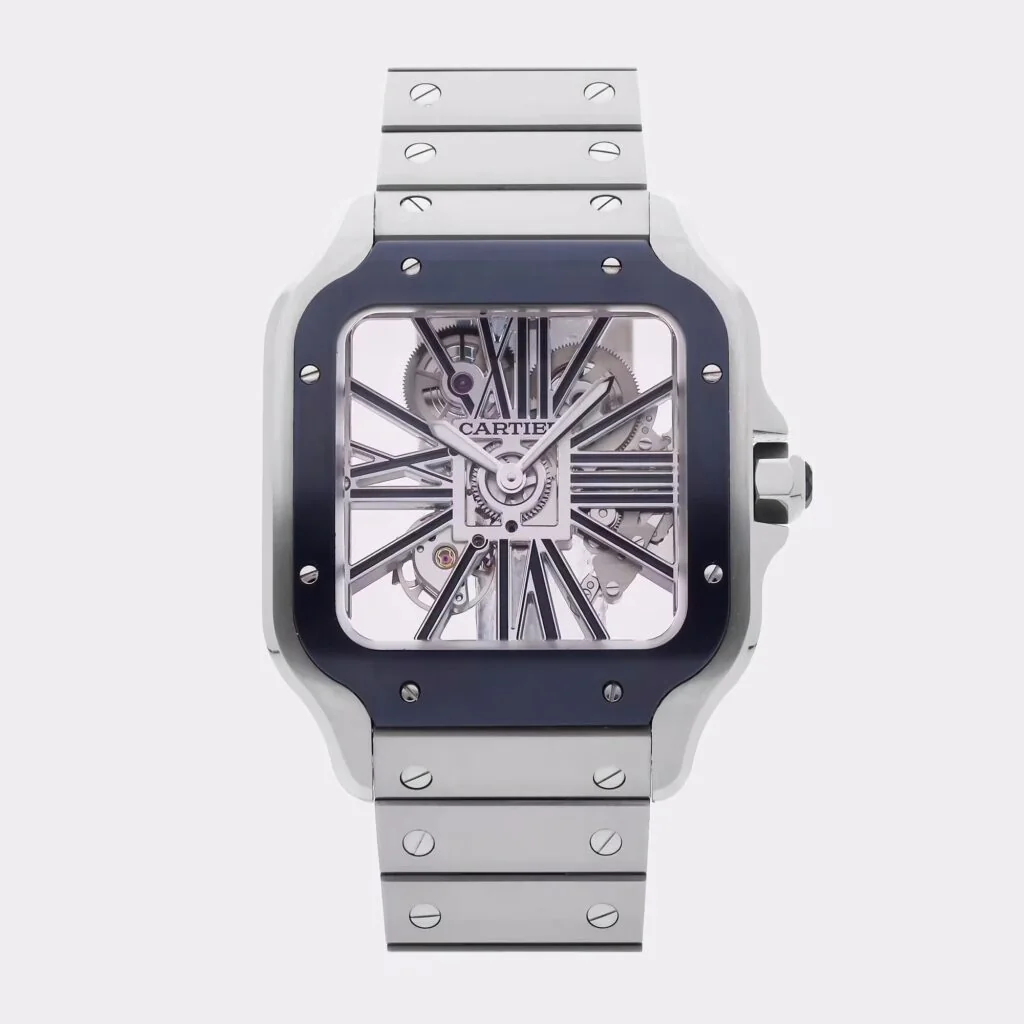
The Santos is the rare watch that can be worn to an airport at6am and a business dinner at 8pm without a moment’s hesitation. Its 2018 redesign — larger cases (35.1mm and 39.8mm), the QuickSwitch strap-exchange system, and a more contemporary bracelet — revitalised a design that had become a little stale in its earlier iterations.
The exposed screws remain the defining visual element: eight of them, visible on the bezel, doing functional work while reading as purely decorative. The case has a slight curve to accommodate the wrist, and the bracelet sits with unusual comfort for a steel sports-dress watch.
Powered by Calibre 1847 MC, a robust automatic with42hours of power reserve, the Santos is not a movement that will impress horologists. It is, however, thoroughly reliable and service-friendly, which matters if you are buying for the long term.
Who it suits: Anyone who wants one watch that covers most situations. The two-tone versions (steel and yellow gold) are particularly versatile. The Santos is Cartier’s most gender-neutral reference in practice, even if it skews masculine on paper.
Honest downside: The exposed screws, while iconic, can catch on cashmere and knits. The 2018 redesign also created a generational divide: purists prefer the older proportions; others find the new case an improvement. This affects resale pricing for pre-2018 models, which can be harder to move.
3. Ballon Bleu de Cartier — Beautiful, Popular, and a Little Overexposed#
Launched in 2007, the Ballon Bleu is Cartier’s most commercially successful modern design. The round case with its distinctive floating sapphire crown guard, the slightly domed dial, and the elegant integration of crown into case make it genuinely beautiful — and, by now, extremely common.
That ubiquity is both the watch’s greatest strength and its most significant weakness. The Ballon Bleu is instantly recognisable, approachable, and available across a wide price range (steel to gold,33mm to 42mm). It is also the watch you will see on every second person at a luxury hotel pool.
The movement varies by configuration: the standard automatic references use Calibre 1847 MC; some larger models and complication versions use in-house calibres. The sapphire crystal is curved, which adds to the visual elegance but increases replacement cost if damaged.
Who it suits: First-time Cartier buyers, or anyone who wants the broadest possible recognition value. The Ballon Bleu communicates Cartier more legibly than any other reference.
Honest downside: Of all the references in this guide, the steel Ballon Bleu has the weakest resale performance relative to retail price. Supply is high, and demand, while steady, does not generate the premiums you see on Steel Santos or Tank pieces. For investment purposes, this is the least compelling option in the line-up unless you are buying in gold or a complication variant.
4. Panthère de Cartier — The Jewellery Watch That Belongs in a Different Conversation#
The Panthère occupies a category that most watch guides ignore: the jewellery watch, designed primarily for aesthetics and wrist presence rather than horological statement. Originally launched in 1983 and relaunched in 2017 with cleaned-up proportions, the Panthère features a rounded-square case on a fully articulated bracelet that moves with the wrist in a way that is genuinely difficult to describe without trying it on.
The movement is quartz in virtually every steel version. For collectors conditioned to evaluate watches by their movements, this is a dealbreaker. For buyers who understand that the Panthère is, at its core, an extraordinarily refined piece of wrist jewellery, it is irrelevant.
Who it suits: Someone who has already made peace with the quartz question and wants the best-wearing bracelet watch in the Cartier range. Skews towards women, though the larger medium and large cases read strongly as unisex. Two-tone versions are among the most elegant combinations the brand has ever produced.
Honest downside: The bracelet links can develop play over time — this is a known issue with heavily worn Panthère pieces. Budget for a bracelet service if buying pre-owned. The quartz movement also places a ceiling on how seriously collectors treat the reference, which somewhat limits upside on steel versions.
5. Ronde Louis Cartier — The Collector’s Choice#
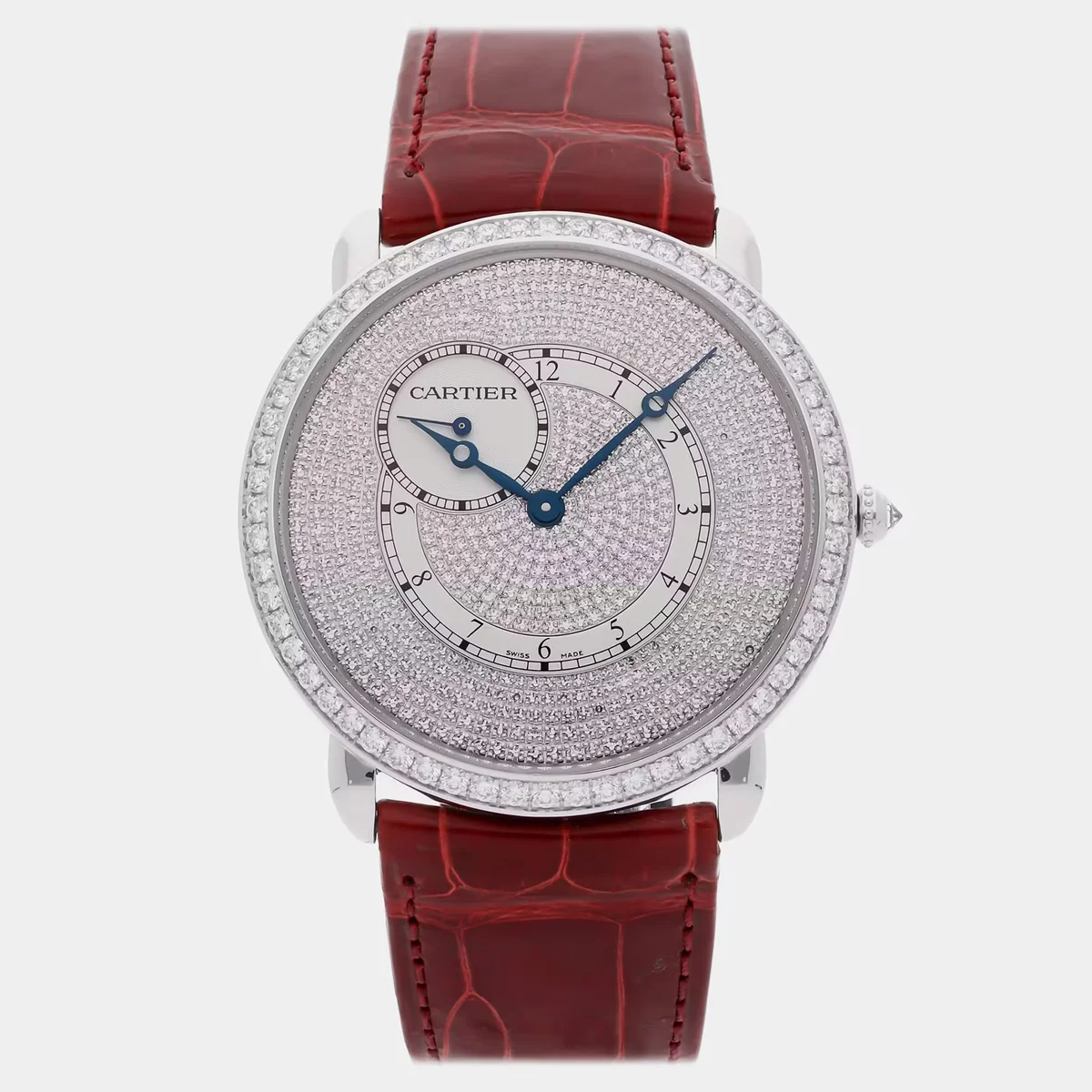
The Ronde is the least-discussed reference in this list and, in many respects, the most sophisticated. A simple round case in yellow, white, or rose gold, housing Cartier’s ultra-thin manual-wind Calibre 430 MC (or, in grand complication versions, something considerably more impressive), the Ronde Louis Cartier is the watch you buy when you know enough to want something that rewards knowledge rather than spectacle.
At 36mm or 42mm, it wears well on a range of wrists. The dial is clean to the point of austerity: Roman numerals, sword hands, small seconds subdial. There is nothing here that does not need to be here.
Who it suits: Experienced collectors, buyers with strong established personal style, anyone who finds the Santos or Ballon Bleu slightly too prominent. The Ronde is a quiet watch that speaks loudly to the right audience.
Honest downside: The Ronde’s relative obscurity works against it in casual resale contexts — general buyers who do not know the reference may underprice or overlook it. Liquidity is lower than the Santos or Ballon Bleu, meaning exit can be slower. Also available only in precious metals at most price points, which raises the entry cost significantly.
6. Drive de Cartier — The Ambitious Newcomer#
Introduced in 2016, the Drive is Cartier’s most recent attempt to create a canonical masculine dress watch. The cushion-shaped case — a shape Cartier calls “pillow” — splits the difference between round and rectangular, and the result is more distinctive than either. The guilloché dial (on select variants) is exceptional; the execution of the overall design is considered and contemporary without being trendy.
Powered by Calibre 1904 MC, an in-house automatic developed in collaboration with Richemont group workshops, the Drive has better movement specifications than the Santos or Ballon Bleu: 48 hours of power reserve, 28,800 vph, certified chronometric precision.
Who it suits: Buyers who find the Tank too formal and the Santos too sporty; someone who wants a contemporary masculine Cartier that will not date in five years.
Honest downside: The Drive lacks the decades of cultural weight that give the Tank and Santos their resale resilience. It is an excellent watch, but you are, in effect, betting on a relatively young design. The secondary market for the Drive is still establishing its floor, which introduces more uncertainty than the other references in this guide.
Model Comparison Table#
| Reference | Case Material | Movement Type | Approx. Retail | Resale Outlook |
|---|---|---|---|---|
| Tank Louis Cartier | 18k yellow / white / rose gold | Manual (Cal. 430 MC) | $7,000 – $28,000 | Strong in gold; weak in quartz steel variants |
| Santos de Cartier | Steel / two-tone / 18k gold | Automatic (Cal. 1847 MC) | $6,800 – $15,000+ | Excellent; most liquid Cartier on the secondary market |
| Ballon Bleu de Cartier | Steel / 18k gold | Automatic (Cal. 1847 MC) | $6,500 – $22,000+ | Moderate (steel); strong (gold); highest resale loss in steel |
| Panthère de Cartier | Steel / two-tone / 18k gold | Quartz | $3,500 – $18,000+ | Strong in gold and two-tone; steady in steel |
| Ronde Louis Cartier | 18k gold | Manual (Cal. 430 MC) | $10,000 – $40,000+ | Excellent; collector-driven, lower liquidity |
| Drive de Cartier | Steel / 18k gold | Automatic (Cal. 1904 MC) | $5,500 – $15,000+ | Developing; moderate and market-dependent |
Retail figures are approximate and subject to regional variation and annual price adjustments. Resale outlook reflects current secondary market patterns, not guaranteed future performance.
Materials Decoded: Gold, Steel, and the Finishing Details That Justify the Price#
Cartier’s material choices are not arbitrary, and understanding them helps explain both the aesthetic logic and the pricing architecture of the collection.
18k Gold — Cartier uses18-karat gold (75% pure gold) across all its precious metal references, available in yellow, white, and rose. The alloy composition affects both colour and hardness: rose gold, which blends gold with copper, is slightly harder and more scratch-resistant than yellow gold. White gold requires rhodium plating to maintain its colour over time — a standard service item. For investment purposes, gold cases provide a material floor that steel does not: the melt value of a gold Tank Louis Cartier in yellow18k is non-trivial, which partly explains why gold Cartiers hold their value more reliably than comparable steel pieces.
Stainless Steel with ADLC Coating — Select Santos and Drive references are offered in steel with ADLC (Amorphous Diamond-Like Carbon) coating applied to specific components. ADLC is a carbon-based coating that is significantly harder than steel, highly resistant to scratches, and gives treated surfaces a matte black appearance. It is a genuinely premium finish — not a paint or PVD coating — and improves durability meaningfully. ADLC-coated references command a premium at retail and tend to hold it reasonably well.
Sapphire Crystals — All current Cartier watches use sapphire crystal, the hardest transparent material used in watchmaking (9on the Mohs scale). Cartier frequently uses curved or specially shaped sapphire — the Ballon Bleu’s domed crystal is a notable example — which increases manufacturing cost and visual elegance, but also increases replacement cost if the crystal cracks. Budget for this in your ownership calculations.
Cabochon Crowns — The pale blue synthetic spinel cabochon set into the crown of most Cartier watches is a signature detail that is also a vulnerability. These can chip or become dislodged on heavily worn watches; replacement is straightforward but adds to service costs. On pre-owned pieces, inspect this detail carefully.
Movements — Cartier occupies an interesting position in the industry: it began producing in-house movements more aggressively after2012, but many of its most commercially significant references (Santos, Ballon Bleu) still run the Calibre 1847 MC, a movement produced in partnership with Richemont group workshops. It is reliable and accurate, but it will not excite movement collectors. By contrast, the Tank Louis Cartier’s Calibre 430 MC — ultra-thin, manual-wind, made in-house at Cartier’s La Chaux-de-Fonds manufacture — is a genuine technical achievement worth appreciating. The Drive’s Calibre 1904 MC is similarly in-house and represents a meaningful step up in movement quality relative to the 1847 MC.
For buyers who care about movement quality beyond brand recognition, the Tank Louis Cartier and Drive de Cartier offer more to appreciate mechanically. The Santos and Ballon Bleu are purchased primarily for design and heritage, not horological innovation — and should be evaluated accordingly.
Value Retention and the Resale Market: Which References Perform Best#
Cartier watches that hold value best share two characteristics: strong cultural recognition and limited availability of their most desirable configurations. Here is an honest breakdown of how the six references have performed in the secondary market, and what factors drive those outcomes.
Santos de Cartier is currently the strongest performer for resale liquidity. The 2018 redesign created a wave of interest that has sustained itself, and the steel large-size model sits at approximately85–95% of retail on the secondary market for pieces in excellent condition with box and papers. This is unusually strong retention for a steel watch. Two-tone and gold references retain even more. The Santos benefits from being genuinely useful, widely recognised, and available across enough configurations to attract a wide buyer pool.
Tank Louis Cartier in18k gold retains value exceptionally well, often commanding premiums over retail for vintage or lightly worn examples in sought-after configurations. The material floor provided by the gold case, combined with the watch’s irreplaceable cultural status, makes it one of the most defensible long-term holds in the Cartier catalogue. Be aware, however, that the quartz Tank Solo and similar entry-level variants depreciate significantly and should not be confused with the Tank Louis Cartier in investment analyses.
Ballon Bleu is the most complicated picture in the group. Steel references in standard configurations have experienced meaningful depreciation — it is not unusual to find a steel 33mm or 36mm Ballon Bleu selling at 60–70% of retail on the secondary market, reflecting the combination of high original supply and steady but unexceptional demand. Gold versions hold considerably better. If you are buying a Ballon Bleu, buy gold, or accept that you are buying primarily for enjoyment rather than value preservation.
Panthère de Cartier in gold or two-tone holds remarkably well, with the yellow gold versions attracting particularly strong demand. The quartz movement, which many watch investors view as a liability, appears to be less of a deterrent to Panthère buyers — who are more oriented toward the jewellery watch category — than it would be for other references.
Ronde Louis Cartier is the sleeper option in this list. Because it is less well-known to general audiences, pre-owned Rondes sometimes trade at mild discounts that do not reflect their actual quality or rarity. For a knowledgeable buyer, this creates genuine value. The gold-cased Ronde with the Cal. 430 MC is arguably underpriced relative to comparable pieces from Patek Philippe or Jaeger-LeCoultre.
Drive de Cartier is the most speculative. As the newest reference in the group, it has not yet established a stable resale floor. Current secondary market prices hover at 70–80% of retail in steel, with better retention in gold. Whether the Drive matures into a genuine Cartier classic or remains a peripheral reference is still an open question.
Condition factors that move the needle:
- Box and papers add a meaningful premium — typically 10–20% over the same reference without documentation
- Service history and original bracelet links are particularly important for bracelet watches (Santos, Panthère)
- Dial condition is critical: refinished, polished, or damaged dials reduce value sharply, often by 30–40%
- Bracelet stretch or missing links is common in pre-owned Panthère pieces and should be factored into pricing
How to Buy a Cartier Watch: New, Pre-Owned, and What to Watch Out For#
New vs Pre-Owned: The Honest Trade-Off#
Buying new from a Cartier boutique or authorised dealer gives you manufacturer warranty, certainty of authenticity, and the full unboxing experience. For some buyers, that is worth the premium. For investment-oriented buyers, it is worth noting that a new Cartier watch typically loses 15–25% of its retail value in the first two years of ownership, regardless of condition — simply because it is now pre-owned. Buying a two-to-three-year-old example in near-mint condition with box and papers captures most of that depreciation for the seller and leaves you with a watch that performs nearly as well at resale.
The pre-owned market has matured significantly. Reputable dealers and certified pre-owned platforms have standardised grading and authentication processes, and Cartier’s own Certified Pre-Owned programme, operating through select boutiques and authorised resellers, offers serviced watches with documentation guarantees. For buyers uncomfortable with the secondary market, this is a defensible middle ground. See our guide to buying pre-owned luxury watches safely for a full breakdown of the authentication process.
Authentication and Condition Checklist#
Before purchasing any pre-owned Cartier, verify the following:
Documentation:
- Original box, outer box, and inner cushion present
- Warranty card with matching serial number
- Any original hang tags or accompanying literature
- Service records if the watch is more than five years old
Case and Bracelet:
- Serial number engraved between the lugs (requires removing the strap/bracelet); number should be crisp and evenly spaced — not re-engraved or polished away
- Reference number also engraved between the lugs; cross-reference against Cartier’s reference catalogue
- Case proportions match published specifications exactly — fakes frequently have slightly off dimensions
- All brushed and polished surfaces retain their original finishing; over-polished pieces have lost material and value
- Bracelet links are even and without excessive play or stretching
- Deployant clasp or buckle bears the Cartier name and operates crisply
Dial and Crystal:
- Dial text is sharp and evenly printed — “CARTIER” and “SWISS MADE” should be crisp at any magnification
- Roman numerals are consistent in weight and spacing
- Cabochon crown is intact, properly set, and undamaged
- Sapphire crystal is free from chips, deep scratches, or cracks
- Hands are properly aligned — minute hand should point precisely to the minute track at the 12 position
Movement:
- Movement should wind smoothly (manual) or rotor should turn freely with no grinding (automatic)
- Timekeeping accuracy should be within approximately±15 seconds per day for automatics,±1 minute per month for quartz
- No unusual rattles or sounds when the watch is moved
Red Flags for Counterfeits:
- Pixelated or slightly blurry dial text under magnification
- Crown that is too large, misaligned, or has a poorly set cabochon
- Bracelet that feels lightweight or has visible joins between links
- Case back that screws on with unusual resistance or displays crude finishing inside
- Serial number that does not match any known Cartier formatting conventions (generally 8 characters, alphanumeric)
- Any reference number that does not appear in Cartier’s published catalogue or on authenticated watch databases
For high-value purchases, independent authentication by a certified watchmaker or a specialist authentication service is worth the cost. Our authentication guide covers what to expect from a professional Cartier inspection.
Where to Buy#
Cartier Boutique (New): Full warranty, boutique experience, current collection. Highest price; no negotiation.
Authorised Dealer (New and Certified Pre-Owned): Slightly more competitive pricing in some markets; Cartier CPO programme offers serviced pre-owned with warranty. Worth comparing against boutique pricing before committing.
Reputable Pre-Owned Specialists: Platforms and dealers who grade, authenticate, and photograph pieces in detail. Prices typically15–30% below retail for clean references. Look for sellers with published return policies and independent authentication credentials.
Auction Houses: Christie’s, Sotheby’s, and Phillips handle Cartier regularly and provide provenance research as part of cataloguing. Best for vintage and rare references; pricing can swing significantly based on competition and provenance narrative.
Private Sales: Highest risk, potentially highest reward. Never complete a private sale without independent authentication, and never transfer payment before physically inspecting the piece or receiving it through an escrow service.
Frequently Asked Questions#
Which Cartier watch holds its value best?
The Tank Louis Cartier in 18k gold is consistently the strongest long-term hold in the Cartier portfolio, combining irreplaceable cultural status with material value from the gold case. For buyers who want liquidity over pure appreciation, the Santos de Cartier in steel is the most tradeable reference — it has the broadest buyer pool and the most active secondary market. If investment is the primary consideration, gold variants across most references will outperform their steel equivalents over a five-year horizon.
Tank vs Santos: which should I buy?
This depends almost entirely on how you live. The Tank is a formal watch — elegant, historically significant, and best understood by those who appreciate its context. The Santos is a versatile sports-dress watch that handles more situations gracefully. If you need
Related Articles#
- Vintage Chanel Bags: Best Finds Up to 60% Off
- Y2K Fashion 2026: 15 Iconic Pre-Owned Luxury Looks
- Lab-Grown vs Real Diamonds: Which Should You Buy?
- Luxury Resale Condition Grades: Fair to Pristine Guide
- 5 Rare Chanel Bags Every Collector Should Know
Related guides
- Online Bag Authentication: What Photos Can and Cannot Prove
- Fake Goyard Bag Guide: How to Spot Real vs Fake (2026)
- How to Spot a Fake Chanel Flap Bag: Authentication Guide
- How to Spot a Fake Hermès Birkin: Expert Checklist
- How to Buy an Authentic Luxury Bag from China Safely
- New vs Pre-Owned Luxury Bags: Which Route Is Right for You?
- Chanel Bag Guide: What to Know Before You Buy
- Luxury Bag Houses


Keyword index