Introduction: Why Tod’s Deserves a Closer Look#
Most luxury brands ask you to choose. You can have the impeccably crafted leather shoe that announces itself from across a room, or you can have the one you’d actually wear to walk ten city blocks without arriving in pain. Tod’s has spent the better part of a century refusing that trade-off — and it’s a distinction that matters more than ever in a market crowded with objects that look expensive but wear poorly.
The brand occupies an unusual position in the luxury landscape: genuinely comfortable, genuinely expensive, and worth discussing in the same breath as the European houses that dominate collector conversations. Its two flagship pieces — the rubber-pebble-soled Gommino moccasin and the Princess Diana-associated D-Bag — have devoted followings among buyers who care less about logo visibility and more about what the object actually feels like to use. That makes Tod’s interesting to a very specific kind of shopper: one who is tired of performing luxury and simply wants to own it.
This guide covers both pieces in depth. What you’re actually paying for, how they hold value on the resale market, how to authenticate them, and which version makes sense for your situation. Because the number of D-Bags and classic loafers now changing hands secondhand has reached a point where those questions deserve proper answers.
A Family Legacy Built on Italian Leather#
The Della Valle family’s connection to shoemaking begins in Casette d’Ete, a small town in the Marche region of central Italy, in the 1920s. Filippo Della Valle — Diego’s grandfather — was a cobbler operating in the artisanal tradition of an area that would later become synonymous with some of Italy’s finest leather goods production. His son Dorino expanded the business through the postwar decades, building local reputation and regional distribution while keeping the handcraft philosophy intact.
Diego Della Valle stepped into the picture in the 1970s with a considerably more ambitious agenda: an internationally recognised luxury brand built on the same artisanal principles, but positioned alongside Hermès, Gucci, and the names that were beginning to define global luxury consumption. The rebranding to Tod’s — from the earlier J.P. Tod’s label, a name Diego reportedly selected partly for its clean cross-market legibility — took hold through the 1980s and 1990s as the brand moved into the United States, Asia, and the Middle East.
What separated Tod’s from the wave of Italian brands internationalising at the same time was Diego’s insistence on a specific, arguable thesis: that luxury and comfort were not mutually exclusive, and that the industry’s assumption otherwise was a failure of craft rather than an inevitable trade-off. “Usually, when people speak of comfort, the product in question is cheap. When they speak of luxury, the product is too stiff, and makes no sense as something to use in modern, everyday life.” The Gommino moccasin was the proof of concept; the D-Bag confirmed that the philosophy translated to accessories.
Today, Tod’s Group also controls Hogan, Fay, and Roger Vivier, but the flagship brand remains the clearest expression of the founding conviction: that leather, worked properly by skilled hands, can be both enduring and genuinely liveable. The Marche production facilities are still operational, still employing artisans trained in the same techniques that Filippo Della Valle practised in the 1920s. That continuity is not just a marketing narrative. It has measurable consequences for what the products feel like and how long they last.
The Tod’s Loafer: Comfort as a Luxury Statement#
The Gommino — from gomma, the Italian word for rubber — is not a complicated shoe to describe, which is part of why it has lasted. It is a moccasin: hand-stitched upper, no rigid last, soft full-grain leather that wraps around the foot rather than holding it in a structured shell. Beneath the sole, 133 rubber pebbles provide grip and cushioning in a pattern that has become as recognisable as any monogram in the [[[[luxury footwear](/buying-guides/military-chic-trend-how-to-wear/)](/brands/ysl-tribute-sandals-guide/)](/buying-guides/why-golden-goose-sneakers-so-expensive/)](/buying-guides/types-of-designer-heels-2025-style-guide/) world.
Those pebbles are not decorative. They were originally engineered for driving: the raised rubber nodes prevent the heel from slipping off a pedal, and the flexibility of the moccasin construction means the shoe articulates with your foot during the movement of pressing and releasing. The driving-shoe origin explains a great deal about how the Gommino wears — and why it divides opinion among people who try it for the first time.
Fit and break-in: the honest version
Tod’s loafers run large by European luxury standards. The consistent advice across the resale and enthusiast community — confirmed by most first-time buyers — is to size down half a size as a starting point. If you fall between sizes, go smaller; the leather will soften and conform over two to three weeks of regular wear, but a loose Gommino never recovers its elegance. The suede versions are immediately more yielding but stretch more significantly over time, which can result in a sloppy fit on narrower feet; size down a full size if you’re in that category.
Break-in is real, not myth. The smooth calf leather versions involve genuine stiffness at the heel during the first week — the moccasin construction means there is no heel counter or structured support, which some wearers find uncomfortable on hard urban surfaces until the leather has shaped itself to the foot. The payoff is substantial: by week three, most owners describe the Gommino as their most comfortable option across any price point. Commit to the break-in rather than abandoning the shoe early.
Colour range and which versions to buy
The Gommino is produced in a seasonally rotating palette that can run to forty colours, anchored by the perennial neutrals: tan, cognac, dark brown, black, and navy. The seasonal brights — cobalt, red, forest green — are appealing in the boutique and carry genuine energy, but they narrow your wearing options and tend to underperform on the resale market. For longevity and value, classic tan or cognac in smooth calf leather is the safe choice. It photographs well for resale listings and has the broadest market of buyers when you eventually want to move it on.
Price-to-wear value, honestly assessed
The Gommino retails between approximately £380 and £600 in the UK, and $420 to $680 in the US, depending on leather type, finish, and seasonal positioning. That is not a casual purchase. But measured against actual usage, the arithmetic is more interesting than the sticker price suggests: owners who wear them regularly report three to five years of meaningful service before significant degradation, and a professional sole replacement resets the clock at a fraction of the original cost. Against designer trainers at comparable price points — many of which show visible wear within six months and cannot be repaired — the Gommino’s cost-per-wear often comes out ahead.
The caveat, because there is always a caveat: the flat, flexible moccasin sole provides limited arch support for extended walking. If your day involves substantial time on hard pavement, a supportive insole from a podiatrist is worth considering. The Gommino is not a hiking shoe or a city-marathon shoe; it is an office-to-dinner-to-car shoe, and within that context it is close to unbeatable.
The D-Bag: Royal Provenance and Enduring Design#
In the mid-1990s, Princess Diana was photographed carrying a structured Tod’s bag — reportedly chosen during a personal visit to a Tod’s boutique. Diego Della Valle subsequently named the style after her, with the blessing of those close to her. It became the D-Bag: a tribute that was also, frankly, an extraordinarily well-timed piece of brand positioning. The combination of Diana’s enduring cultural status and the bag’s genuine construction quality has given it a provenance that holds up under scrutiny in a way that most celebrity associations simply do not.
The bag itself
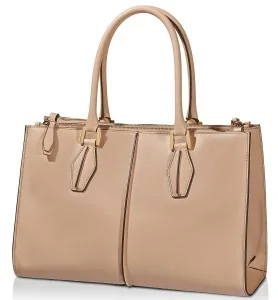
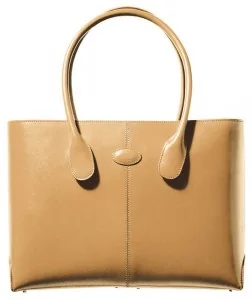
The original D-Bag was characterised by a relatively boxy silhouette: a structured satchel with clean lines, a double-handle configuration, and minimal ornamentation beyond the leather and discreet hardware. The hardware — typically in gold-tone or palladium depending on colourway — is understated by luxury-bag standards, which was always central to its appeal. This is a bag for people who recognise it rather than a bag designed to announce itself.
Over the years, the design has evolved. The D-Cube iteration, which became the primary retail offering more recently, softened the original’s angles into a rounder, more contemporary form with slightly more definedstitching and a gentler overall profile. The evolution is tasteful and coherent, but purists who want the exact Diana-associated silhouette — the squarer, more architectural original — will need to look at the vintage resale market rather than current retail.
The bag is available in Tod’s signature grained calf leather, smooth nappa, and suede, with seasonal colourways adding to the core palette. The medium size is the most versatile and the most frequently photographed; the small is more of a social bag; the large is a genuine working carryall. All sizes share the same hardware and construction quality.
Celebrity visibility and why it translates to collector value
Kate Middleton, Diane Kruger, and Nicole Kidman have all been photographed with versions of the D-Bag. The Middleton association — coming a generation after Diana’s — reinforces the royal-family narrative in a way that matters specifically to the collector market, and not trivially. Pieces with documented or photographed associations with visible public figures do command premiums on the resale market that operate independently of leather quality. Whether that feels meaningful to you will determine whether you find the D-Bag’s provenance story compelling or merely
Related Articles#
- Valentino Alcove Bag: Style, Sizes & Is It Worth It?
- Designer Handbag Trends 2025: What’s Actually Worth Buying


Keyword index