Introduction#

Smeg has spent more than seventy years turning kitchen appliances into objects people actually want to display, not hide behind cabinet doors. Founded in 1948 by Vittorio Bertazzoni Sr., the Italian brand built its reputation on retro-inspired silhouettes, dependable engineering, and a habit of partnering with names that have nothing to do with refrigeration and everything to do with visual storytelling. That instinct is exactly what led to one of the most talked-about crossovers in luxury design: Smeg x Dolce & Gabbana.
This isn’t a logo slapped onto a toaster. It’s a genuine collaboration between an appliance maker known for precision manufacturing and a fashion house known for maximalist, deeply Sicilian imagery. For collectors who already treat handbags and watches as investable objects, this partnership raises a fair question: can a fridge or a blender hold the same kind of desirability, rarity, and resale interest as a Chanel bag or a Cartier watch? Having spent time with several pieces from this range, I think the answer is more nuanced than either the brand’s marketing or the skeptics would have you believe.
The Story Behind the Collaboration#
The partnership between Smeg and Dolce & Gabbana didn’t start as a full product line. It started as a statement piece. In 2016, the two houses released a limited run of 100 hand-painted refrigerators, each one finished by hand rather than printed or wrapped. That distinction matters more than it sounds. Hand-painted decoration on a curved, full-size appliance is a slow, unforgiving process, and it immediately signaled that this wasn’t a licensing deal designed to move volume. It was closer to how a couture house would approach a one-off commission.
Domenico Dolce and Stefano Gabbana have always drawn heavily on Sicily as a creative wellspring, and Smeg’s retro-shaped appliances turned out to be an unusually good canvas for that vision. The curved lines of a classic Smeg fridge or kettle read almost like a blank page compared to the sharp edges of most modern kitchen tech, which gave the illustrators room to work with scale and detail. The 2016 fridge launch was the proof of concept. Everything that followed, from small appliances to full kitchen suites, built on the idea that a household object could carry the same narrative weight as a printed silk gown.
Sicily is My Love: The First Collection#
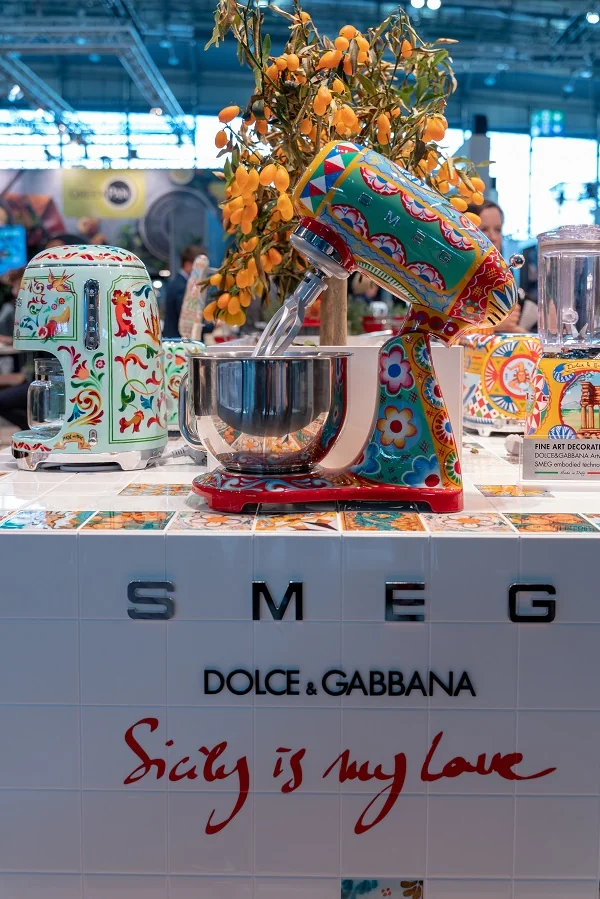
The first proper collection, launched in 2017, was called Sicily is My Love, and it’s still the most recognizable entry point into this partnership. Rather than another one-off fridge, this was a “Made in Italy” range of small appliances: toasters, blenders, juicers, and kettles, all decorated with lemons, pears, cherries, citrus branches, and the kind of ornate folk motifs Dolce & Gabbana has used across its ready-to-wear collections for years.
What separates this line from a novelty print is the production process. Each piece is decorated by Sicilian artisans, not mass-printed, which means there’s a meaningful degree of hand-finishing even on items produced in relatively larger numbers than the original fridge run. You can see this most clearly on the 2-slice toaster and the blender, both of which pair the decoration with genuinely usable specs rather than treating function as an afterthought.
The toaster runs at 950W on a 220-240V system, built in stainless steel with extra-wide slots that comfortably fit bagels and thick-cut bread, six browning levels, a removable crumb tray, and built-in cord storage. The blender matches it with 800W of power, four speed settings, a cast aluminum body, a 1.5L BPA-free Tritan jug, and an included 45ml measuring cup. These aren’t underpowered showpieces. They function like proper Smeg appliances that happen to be wearing couture.
Divina Cucina: Expanding the Vision#
Divina Cucina, translating to “divine kitchen,” is the third and most ambitious chapter of the collaboration, and it’s where the range stopped being a capsule collection and started behaving like a full aesthetic universe. Rather than one visual language, Divina Cucina splits into two distinct lines.
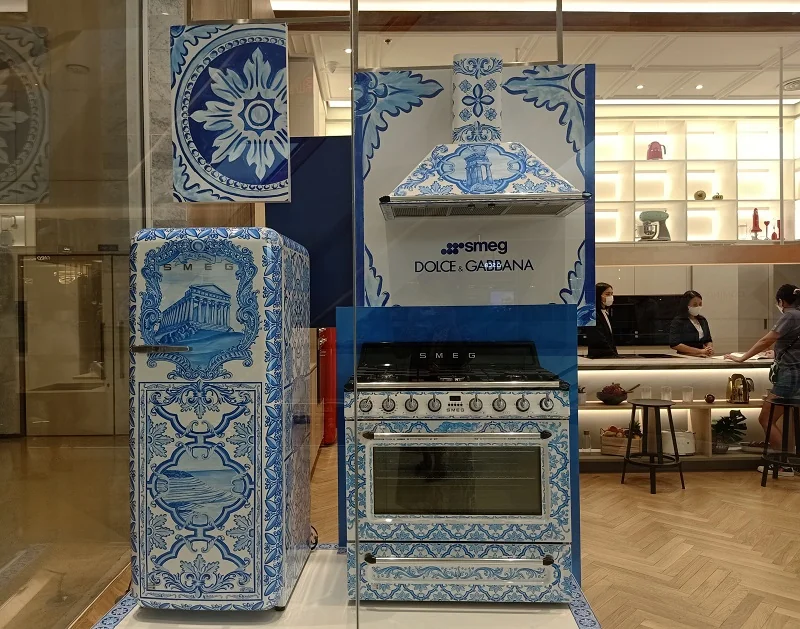
The first leans into Sicilian puppet theatre and the traditional Sicilian cart, built around a palette of red and orange. The second, Mediterranean Maiolica, draws on the blue-and-white ceramic tradition found across coastal Italy. Putting both lines side by side, they read almost like two different design houses interpreting the same region, which is part of what makes Divina Cucina more interesting to collectors than a single-theme drop.
This collection also expanded the category range meaningfully, introducing a cooker hood, a freestanding kitchen set, and the standout piece of the entire partnership: the FAB28 fridge, offered in the SP09PB Salvatore Sapienza “Refrigerator of Art” edition. That specific fridge is decorated with a piece titled “Blind Love,” an illustrated narrative inspired by the paladins of France, rendered in light blue, white, green, and red. At 75.1kg, running on 220-240V with 180 kWh/a energy consumption, measuring 1530 x 601 x 732mm, and offering 256 liters of gross capacity with three adjustable crystal shelves, it’s a fully functional full-size fridge that happens to be wrapped in a museum-worthy illustration. It’s the piece I’d point to if someone asked what separates this collaboration from typical designer-branded homeware.
Craftsmanship and Design Details#
Having handled several pieces from this range directly, the thing that consistently stands out is how much of the decoration is genuinely artisan-led rather than digitally printed and laminated. On the toaster and blender, you can see slight variations in brushwork up close, the kind of inconsistency that only comes from a human hand repeating a motif rather than a machine reproducing a file. That’s a meaningful difference from most “designer collab” appliances on the market, which are typically vinyl-wrapped or screen-printed.
Where I’d push back on the marketing language a bit is the word “art” getting attached to every single piece. The small appliances are beautifully decorated, but they’re still small appliances, and the decoration sits on standard Smeg hardware rather than a bespoke chassis built specifically for this collaboration. The FAB28 fridge is a different story. The scale of that canvas, combined with the narrative complexity of pieces like “Blind Love,” genuinely earns the art comparison in a way the toaster doesn’t quite reach.
Materially, everything holds up to Smeg’s usual standards: stainless steel bodies, cast aluminum housings, BPA-free Tritan components, and the brand’s typical attention to functional details like crumb trays and cord storage. Nothing about the collaboration compromises the underlying engineering, which is worth noting because that’s not always true when fashion houses collaborate with appliance or electronics brands.
Investment Value and Where to Buy#
This is where I want to be honest rather than promotional. Appliances don’t behave like handbags or watches in the resale market, and treating a Smeg x Dolce & Gabbana toaster like a Birkin is a stretch. There’s no established secondary market with consistent price appreciation the way there is for Chanel Classic Flaps or Rolex sports models, and appliances carry real depreciation risk from wear, use, and the simple fact that most people buy them to actually use in a kitchen.
That said, rarity does matter here, and it’s not evenly distributed across the range. The 2016 hand-painted fridges, limited to 100 pieces, sit in a completely different category from the wider Sicily is My Love small appliances, which were produced in larger quantities and are easier to find. Within Divina Cucina, the Salvatore Sapienza FAB28 editions are the pieces most likely to hold or grow value over time, simply because they combine limited runs with named-artist illustration work, closer in spirit to a numbered art print than a kitchen gadget.
My honest buying advice: if you want a genuine investment-grade piece, focus on the FAB28 fridge editions rather than the smaller appliances. If you want something beautiful and conversation-starting for daily use without worrying about resale, the toaster and blender from Sicily is My Love are the more practical entry points, and they’re priced accordingly lower than the full-size fridges. Either way, buy from a source that can verify authenticity and condition, since these pieces show wear and originality issues just like any collectible object. The Luxury Closet currently carries several pieces from across the collaboration, including the 2-slice toaster, the blender, and the Salvatore Sapienza SP09PB refrigerator, which is a reasonable starting point if you’re shopping for verified pieces rather than relying on unclear secondhand listings.
FAQ#
Is the Smeg Dolce Gabbana collection still in production? No. The collaboration was released across limited windows, starting with the 2016 hand-painted fridges, followed by Sicily is My Love in 2017 and Divina Cucina afterward. Availability now largely depends on retailer stock and the secondary market rather than ongoing manufacturing.
Are Smeg x Dolce Gabbana appliances hand-painted or printed? It varies by piece. The original 2016 fridges and the Salvatore Sapienza FAB28 editions feature genuine hand-painted artwork by Sicilian artisans. Smaller appliances in Sicily is My Love and Divina Cucina use high-quality decorative techniques that replicate the artisan aesthetic, though the level of hand-finishing is generally most pronounced on the larger, artist-led fridge pieces.
Do these appliances hold resale value like [designer handbags](/brands/top-tory-burch-handbags/)? Not in the same way. There’s no mature resale ecosystem for designer kitchen appliances comparable to handbags or watches. The FAB28 fridge editions, especially named-artist versions like the Salvatore Sapienza SP09PB, have the strongest case for holding value due to limited production and artistic significance. Everyday small appliances should be bought primarily for enjoyment, not as a financial asset.
Are the small appliances, like the toaster and blender, actually practical for daily use? Yes. Both run on standard specs comparable to non-collaboration Smeg products, with genuine power output, multiple settings, and functional details like crumb trays and BPA-free jugs. They’re decorative, but they’re not decorative-only.
How can I verify authenticity when buying secondhand? Check for consistent hand-painted brushwork versus flat printing, confirm model numbers against official Smeg documentation, and buy from established luxury retailers, such as The Luxury Closet, that authenticate pieces before listing them.
Related Articles#
- Louis Vuitton Alma Bag: The Ultimate Buying Guide
- Designer Handbag Trends 2025: What’s Actually Worth Buying
- Best Tory Burch Handbags Every Closet Needs (2024)
Related guides
- Online Bag Authentication: What Photos Can and Cannot Prove
- Fake Goyard Bag Guide: How to Spot Real vs Fake (2026)
- How to Spot a Fake Chanel Flap Bag: Authentication Guide
- How to Spot a Fake Hermès Birkin: Expert Checklist
- How to Buy an Authentic Luxury Bag from China Safely
- New vs Pre-Owned Luxury Bags: Which Route Is Right for You?
- Chanel Bag Guide: What to Know Before You Buy
- Luxury Bag Houses


Keyword index